On this day – 28th January – in 1813, Jane Austen brightened all subsequent Januarys by publishing the most enjoyable novel in English: Pride and Prejudice. I think Rowling would concur with this assessment – although Emma is her favourite novel, when asked which fictional character she would like to be she replied ‘Elizabeth Bennet, naturally.’ Austen herself criticised the novel (tongue-in-cheek) as ‘rather too light & bright & sparkling’ – a phrase that, as has been noticed, appears to have been remembered in the opening description of Dumbledore’s eyes as ‘light, bright and sparkling’ (Philosopher’s Stone, Chap 1).

Rowling has named Austen as her favourite writer of all time, and she has certainly been her most constant point of reference across decades of interviews, from the late 1990s – when Rowling noted that ‘I always advise children who ask me for tips on being a writer to read as much as they possibly can. Jane Austen gave a young friend the same advice, so I’m in good company there’ – to her recent quotation of Austen on Twitter. In answer to the challenge to give ‘a line from a book that has stuck with you for years’ Rowling responded with the definitive Austen put down (likewise long a favourite of mine): ‘“Elinor agreed to it all, for she did not think he deserved the compliment of rational opposition.” – Sense and Sensibility’
As Austen is my favourite novelist, as well as Rowling’s, I have relished writing on the connections over the years – most recently two posts on ‘Bathilda’s Notebook’ to celebrate Austen’s birthday last month (here and here). There has also been a Potterversity podcast on the topic and I’ve looked at this connection in greater depth in both a book chapter in Cecilia Konchar Farr’s Open at the Close collection of Harry Potter essays and in my Literary Allusion in Harry Potter.
Indeed, it was an Austen allusion – the name of Mrs Norris (Filch’s cat in Harry Potter and Fanny’s evil aunt in Mansfield Park) – that set me off on the hunt that became that book. But I thought I’d celebrate the anniversary of Pride and Prejudice with a look at the influence of Austen on Strike – for Lethal White is the only place (in her novels) that Rowling has explicitly quoted Austen:
‘I agree with Jane Austen on the ideal tenant,’ he told Matthew, standing in the cobbled street. ‘A married man, and without children; the very state to be wished for.’ A house is never well cared for without a lady! Or do you two share the hoovering?’
 This quotes a passage from Persuasion – arguably Austen’s most romantic novel. It is a novel replete with repressed emotion in which – in a Strike-familiar plot – the protagonists are in love with each other, but do not declare it either to each other or (in Captain Wentworth’s case) to himself. There are other similarities – such as the man being in the armed forces and the couple being kept apart by (real and imagined) engagements – and I am tempted by the parallel between Wentworth’s self-accusation for refusing to seek Anne again after her rejection of him (‘I shut my eyes’) and Strike’s self-accusation due to his withdrawal after rejection from Robin ‘if only, in his own recently uttered words, he’d opened his fucking eyes’ (Ink Black Heart).
There is also some circumstantial evidence that Rowling has read her copy of Persuasion with attention. In the picture of Rowling’s bookshelf released on the publication of Deathly Hallows we can see that she has followed her passion for Austen’s novels into her biography: she has a copy of David Noke’s Jane Austen: A Life (1997) and Deidre Le Faye’s Oxford University Press edition of Austen’s letters (the paperback of the 3rd edition, likewise published in 1997). (Philosopher’s Stone, of course, was also published in 1997 and it is tempting to guess that some of Rowling’s first royalty cheque went on purchasing both these books of Austen biography – just as some of her more recent wealth has gone into collecting Austen first editions).
Rowling is interested in Austen’s biography and has spoken of how she imagined her authorship in an Austenian mould: ‘I imagined being a famous writer would be like being like Jane Austen. Being able to sit at home in the parsonage and your books would be very famous and occasionally you would correspond with the Prince of Wales’s secretary.’ This refers to the correspondence between Austen and James Stanier Clarke (which is, incidentally, a very funny read!). Startlingly Clarke mixes with his praise some suggestions of what Austen might like to include in her next novel – a ‘demurely sad’ Clergyman ‘fond of and entirely engaged in literature’ for example? Or – when she turned that suggestion down – perhaps ‘an historical romance illustrative of the august House of Cobourg’ which would have the twin advantages of being both ‘very interesting’ and a shoo-in for dedicating to Prince Leopold? It is a brave man who thinks he has something to teach Austen about writing novels and while she politely but firmly rebuffs him (‘No, I must keep to my own style and go on in my own way’) she does appear to have enjoyed the praise, and presumably the ridiculous aspects of the suggestions likewise, writing ‘I am too vain to wish to convince you that you have praised [my novels] beyond their merits.’
Rowling is likely to have read Persuasion in the penguin classics edition as it is one of the most readily available paperbacks and there are plenty of penguins on her bookshelves. Both the biographical pieces of information Rowling has given about Austen cited above (her writerly advice to young fans to read more and this correspondence) are readily available in James Edward Austen-Leigh’s Memoir of Jane Austen – and this is reprinted at the back of the penguin Persuasion.
After the quotation in Lethal White, the clearest Persuasion allusion in Strike is the protagonist’s echo of Austen’s morally loaded attitude to viewing the sea: ‘lingering only, as all must linger and gaze on a first return to the sea, who ever deserved to look on it at all’ (Persuasion). I think of this line whenever I see the sea, and I suspect Rowling might too. Certainly, Strike shares Austen’s view that there is something morally right about appreciating a sea view: ‘It’s wrong being by the sea without actually laying eyes on it’ (Troubled Blood). In Troubled Blood Strike’s love of the sea is rooted in both his childhood and love of his aunt. Joan (who has a boat named after her) has been buried at sea, meaning that she feels present to Strike on whatever coast he may be. As Rowling noted in the Q&A on 19 October 2023 ‘Strike’s a Cornishman so he’s very drawn to the sea, he’s always happy being near the sea…[it] has such a strong association of childhood for him.’
 It has a childhood association for Strike – and for Rowling too, and she phrases this link with interestingly equivocal grammar: ‘I can remember a very happy childhood holiday in Cromer which also features in the book.’ Rowling means that Cromer features in the book, and that she also had a happy childhood holiday there, but it sounds like her childhood holiday is going to feature in Running Grave. It is always interesting when her characters’ and her own childhoods intersect – as I have written, I think it is significant that Hermione took a family holiday to Rowling’s childhood place, the Forest of Dean. And Cromer, pleasingly, also has an Austen connection. I suspect that Rowling’s mother was also an Austen fan (in my experience it is an enthusiasm that often passes down the maternal line) and perhaps the accolades in Emma influenced that Rowling family holiday: ‘Perry was a week at Cromer once, and he holds it to be the best of all the sea-bathing places. A fine open sea, he says, and very pure air.’ (More on Norfolk Austen connections here!).
In the Q&A Rowling dropped the hint that when ‘he heads for the coast we normally find out something character-wise about Strike, that’s the significance for me’ – and in The Running Grave the sea becomes explicitly linked not only with Joan, but with another woman he loves. As Strike gets settled into his hotel room in Cromer he remembers how he’d been with Robin:
on his last two visits to seaside towns, both taken in the course of other cases: he’d eaten chips with her in Skegness, and stayed overnight in neighbouring rooms in Whitstable.
He remembered particularly the hotel dinner they’d shared that evening, shortly after he’d just broken up with his last girlfriend, and before Robin had gone on her first date with Ryan Murphy. Robin, he remembered, had been wearing a blue shirt. They’d drunk Rioja and laughed together, and waiting upstairs had been those two bedrooms, side by side on the top floor. Everything, he thought, had been propitious: wine, sea view, both of them single, nobody else around to interrupt, and what had he done? Nothing.
Captain Wentworth might well have a similar interior monologue (when he thinks that the smoothly plausible Mr Eliot has won Anne) were he to think back to his own seaside visit to Lyme, where his admiration of Anne is first rekindled, and wonder why he said nothing then. In Running Grave the sharpening of the unspoken attraction our protagonists feel for each other in the sea air, is remembered and regretted by Robin as well as Strike:
Learning that her partner passed within a mile of Chapman Farm on his way to the coast made Robin feel even lonelier. She, too, thought back to the two seaside towns they’d visited together in the course of previous investigations, especially the dinner in Whitstable: the white coral on the mantelpieces set against slate-coloured walls, and the sight of Strike laughing opposite her, framed against a window through which she watched the sea turning indigo in the fading light. (Chap 65)

In both cases the coast is symbolic – Anne, at Lyme, not only meets Wentworth’s closest seafaring friends but is next to Wentworth’s great love as a naval Captain: the sea. It suggests a deeper connection between them that it should be here that his admiration is rekindled. Similarly, Strike’s love of the sea is an essential part of him: ‘the Cornish-born Strike experienced that slight lift of the spirits the smell of the sea and the sound of lapping waves always gave him;’ ‘‘You can have the sea view. I know you’ve got that Cornish thing going on.’ The moment of shared remembering in Running Grave builds on the way that Troubled Blood opens with Strike’s thoughts turning to Robin as he watched a seal disporting itself in the waves and closes with the perfect gift of the balloon donkey (evoking both their trip and Robin’s own childhood coastal pleasures). In Cuckoo’s Calling the evocative closing quotation (drawing a parallel between Strike and Tennyson’s Ulysses setting out once more to sea) had marked out thalassophilia as a rather lonely calling. Now it is something that unites Strike with Robin.
Charlottean Miss Crawford
Something that is highly Austenian about both Rowling’s series is how they combine humour and romance with pulling the wool over the readers’ eyes. Humour is a pretty consistent touchstone throughout Rowling’s writing and Mr Bennet’s dictum – ‘For what do we live, but to make sport for our neighbours?’ – is recalled by some of the funniest lines in Troubled Blood: ‘she could see the neighbors’ heads bobbing behind their kitchen blinds. The Ellacotts were providing rich entertainment this Christmas, all right: first a new baby, then a shouting match about a penis.’ But both the romance and the ‘wool-pulling’ have gone up a gear in Strike now that we have both adult protagonists and a shift from the brilliant multi-genred nature of Harry Potter (at once school-story, bildungsroman, fantasy, and detective-story) to a fully realised murder mystery series. Rowling has explicitly linked her authorial delight in ‘pull[ing] the wool’ over her readers’ eyes with Austen’s, and has noted of the final plot twist in Emma that ‘I have never set up a surprise ending in a Harry Potter book without knowing I can never, and will never, do it anywhere near as well as Austen did in Emma.’

Rowling pulled off a brilliant coup in Running Grave by returning to the kind of plot-twists provided by Philosopher’s Stone and Emma – which work so well precisely because the reader is not reading a detective story and so does not expect there to be a twist. Managing this within a murder mystery series is quite a feat, but for a large part of Running Grave I suspect quite a number of readers were lulled into the belief they were reading a thriller and, fully absorbed by their anxiety for Robin’s welfare, assumed they were just watching the inexorable fall and banging-to-rights of Jonathan and Mazu Wace and failed to guess that there was a murderer outside the UHC to be uncovered. (See more on this here).
As well as being drawn to Austen’s structural balance of humour, romance, social satire and elegant plotting, Rowling’s is soaked in Austen’s phrasing – from the light, bright and sparkling eyes of the Headmaster to the sense that it has been ‘very dull indeed’ (Order of the Phoenix) without him (the famous phrase ‘three things very dull indeed’ from Emma is one that works so well in part because ‘very dull indeed’ is itself a triune phrase). The pain Anne feels in Persuasion at the chill behaviour of the man she loves (‘his cold politeness, his ceremonious grace, were worse than anything’) is echoed in Harry’s similar chill at Dumbledore’s words in Half-Blood Prince: ‘this cold disappointment was worse than anything.’ One of the strongest connections between the Strike series and Austen, however, lies not at a verbal level but in a character-connection. A central character of the series, Charlotte – darkly beautiful, sexy, witty, unprincipled and trying hard to get the hero to choose her over his vocation – is pure Miss Crawford.
The parallel is at its closest at the moment of Strike’s disillusion in Ink Black Heart, which mirrors that of Edmund in Mansfield Park. Each know in their heart of hearts that the woman with whom they are infatuated does not measure up to their strict moral standards, but they have been deluding themselves that she is true at heart, until she says something that shocks them out of this illusion once and for all. In Ink Black Heart this is the moment when Charlotte tells Strike she would happily allow Ross to have access to her children, despite knowing he is a violent father:
the seismic change had happened inside him because he felt something break, and he knew, at last, that there was no putting it back together…. He’d always believed… they shared a similar core, where certain inalienable principles lived… And now he saw he’d been entirely wrong…
In fact, it had just registered upon Strike, as he took in the skin-tight black dress that had been the least of his concerns in Jago’s flat, that Charlotte had gone to her estranged husband’s dressed for seduction…
‘Goodnight, Charlotte,’ said Strike, turning around and walking away, but she ran after him, catching his arm.
‘You can’t go like that. Corm, come on,’ she said, half laughing again, ‘one drink!’
But a vacant taxi was speeding towards them. Strike raised his arm, the taxi slowed, and barely a minute later he was drawing away from the kerb, leaving one of the most beautiful women in London staring blankly after him.
This reads like a modernised version of the final parting between Miss Crawford and Edmund:

…though I had, in the course of our acquaintance, been often sensible of some difference in our opinions, on points, too, of some moment, it had not entered my imagination to conceive the difference could be such as she had now proved it. That the manner in which she treated the dreadful crime committed by her brother and my sister (with whom lay the greater seduction I pretended not to say), but the manner in which she spoke of the crime itself, giving it every reproach but the right; considering its ill consequences only as they were to be braved or overborne by a defiance of decency and impudence in wrong; and last of all, and above all, recommending to us a compliance, a compromise, an acquiescence in the continuance of the sin, on the chance of a marriage which, thinking as I now thought of her brother, should rather be prevented than sought; all this together most grievously convinced me that I had never understood her before, and that, as far as related to mind, it had been the creature of my own imagination, not Miss Crawford, that I had been too apt to dwell on for many months past… She was astonished, exceedingly astonished—more than astonished. I saw her change countenance. She turned extremely red. I imagined I saw a mixture of many feelings: a great, though short struggle; half a wish of yielding to truths, half a sense of shame, but habit, habit carried it. She would have laughed if she could. It was a sort of laugh, as she answered, ‘A pretty good lecture, upon my word. Was it part of your last sermon? At this rate you will soon reform everybody at Mansfield and Thornton Lacey; and when I hear of you next, it may be as a celebrated preacher in some great society of Methodists, or as a missionary into foreign parts.’ She tried to speak carelessly, but she was not so careless as she wanted to appear. I only said in reply, that from my heart I wished her well, and earnestly hoped that she might soon learn to think more justly, and not owe the most valuable knowledge we could any of us acquire, the knowledge of ourselves and of our duty, to the lessons of affliction, and immediately left the room. I had gone a few steps, Fanny, when I heard the door open behind me. ‘Mr. Bertram,’ said she. I looked back. ‘Mr. Bertram,’ said she, with a smile; but it was a smile ill-suited to the conversation that had passed, a saucy playful smile, seeming to invite in order to subdue me; at least it appeared so to me. I resisted; it was the impulse of the moment to resist, and still walked on.
After all Charlotte’s violence, it is something that she says that finally shatters Strike’s illusions about her. Both men walk away and both women pursue them, unaware of the irrevocable change that has just occurred. Each woman attempts a re-seduction – a touch, ‘a saucy playful smile,’ – unable to comprehend that they have lost their hold, never to regain it.
Although the scenes and the characters are so similar, there is little verbal overlap here – but when Strike recalls how he fell for Charlotte in Running Grave his emphasis on his imagination in creating the woman he thought he loved – ‘You fill in the blanks with your own imagination. Paint them exactly the way you want them to be’ – has more than a touch of Edmund’s realisation that ‘it had been the creature of my own imagination, not Miss Crawford, that I had been too apt to dwell on for many months past.’ And there are Austenian connections, likewise, in the novels’ central love-story. Strike, for example, doesn’t seem like the kind of man who is overly attentive to women’s hairstyles. This is true of many of Austen’s heroes likewise, and so it is a clue to his true feelings when Frank Churchill comments on Jane Fairfax’s up-do at a party in Emma. Frank, caught out staring at the woman he is silently in love with, claims that he is merely noticing her hair: ‘Miss Fairfax has done her hair in so odd a way… that I cannot keep my eyes from her.’ When Strike notices Robin’s hair at a party -‘the way she had done her hair reminded Strike of her wedding day’ (Lethal White) – that tiny chime of ‘done her hair’ reminded me that his unusual attentiveness to Robin’s hairstyle is, like Frank’s, evidence of lovesick staring.
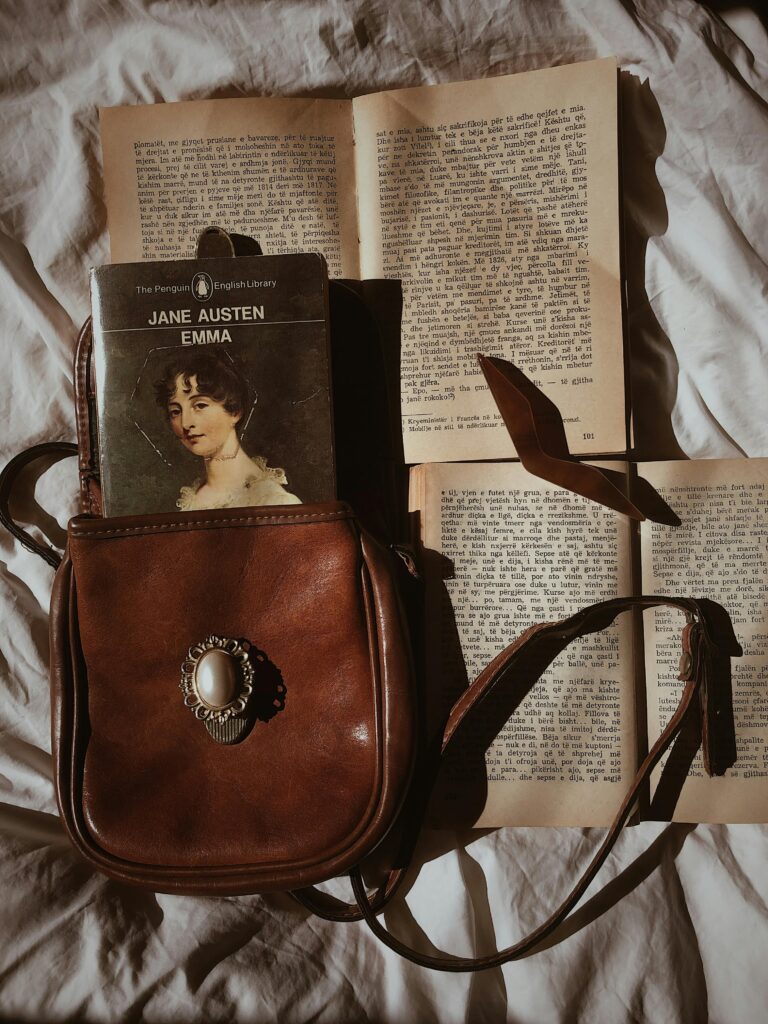 Emma is unique among Austen’s novels in that the two protagonists have been friends for years before realising that they are in love. There is a tiny parallel moment between Emma & Mr Knightley and Robin & Strike when, in a crisis between them, the woman’s emotions are misconstrued by the man, and his strongly gendered response of gallantly assisting her into a carriage/taxi – taking care of her physical wellbeing at a moment of emotional turmoil – precludes his discovering her true feelings. In Emma:
While they talked, they were advancing towards the carriage; it was ready; and, before she could speak again, he had handed her in. He had misinterpreted the feelings which had kept her face averted, and her tongue motionless. They were combined only of anger against herself, mortification, and deep concern. She had not been able to speak; and, on entering the carriage, sunk back for a moment overcome—then reproaching herself for having taken no leave, making no acknowledgment, parting in apparent sullenness, she looked out with voice and hand eager to shew a difference; but it was just too late. He had turned away, and the horses were in motion. She continued to look back, but in vain; and soon, with what appeared unusual speed, they were half way down the hill, and every thing left far behind. She was vexed beyond what could have been expressed—almost beyond what she could conceal. Never had she felt so agitated, mortified, grieved, at any circumstance in her life.
In Ink Black Heart:
And unwittingly, Robin’s expression moved from happiness to fear. He saw it and straightened up again, and before either of them could quite process what had just happened the mundane roar of a motorbike courier heralded the return of the world to its regular course; the tornado had passed and Strike was guiding Robin towards the taxi’s open door, and she was falling back onto its solid seat.
‘’Night,’ he called in after her. The door had slammed and the taxi had pulled away before Robin, dazed, could decide whether she felt more shock, elation or regret.
In both, our heroine for a moment sinks back against the seat, missing the moment at which she could have made her feelings discernible to the other, and is left trying to sort out her turbulent tricolon of emotions (‘agitated, mortified, grieved’/ ‘shock, elation or regret’) alone. Emma and Mr Knightley soon understand each other. Two thousand pages later, Strike and Robin have still failed to iron out the conflicting emotions of this moment. Ah well, soon – we hope!
On a happier note, the first time I felt the pull of an Emma/Mr Knightley pairing between Robin and Strike was the hand-kiss in Silkworm. In Emma:
He looked at her with a glow of regard. She was warmly gratified—and in another moment still more so, by a little movement of more than common friendliness on his part.—He took her hand;—whether she had not herself made the first motion, she could not say—she might, perhaps, have rather offered it—but he took her hand, pressed it, and certainly was on the point of carrying it to his lips—when, from some fancy or other, he suddenly let it go.—Why he should feel such a scruple, why he should change his mind when it was all but done, she could not perceive.—He would have judged better, she thought, if he had not stopped.—The intention, however, was indubitable; and whether it was that his manners had in general so little gallantry, or however else it happened, but she thought nothing became him more.—It was with him, of so simple, yet so dignified a nature.—She could not but recall the attempt with great satisfaction. It spoke such perfect amity. —He left them immediately afterwards—gone in a moment.
The idea of kissing Emma’s hand which changes to just pressing it, is similar to a moment in Troubled Blood when (in a passage likewise intuiting the man’s intentions from the woman’s perspective) ‘Robin though he saw the idea of hugging her cross Strike’s mind, but instead he held out his hand, and shook hers.’ But even closer is the moment in Silkworm in which the old-fashioned gallantry of a kiss on the hand replaces the friendly handshake – which Robin (as Emma above) offers first:
she held out her hand with mock blokeyness, and he shook it… On the point of relinquishing her hand, he gave it a quick twist. He had kissed the back of it before she knew what had happened. Then, with a grin and a wave, he was gone.
Emma is Rowling’s favourite novel (she has even named her dog after its heroine) and this passage, in recalling the failed hand-kiss in Emma, completes it. Rowling, the lover of Emma, closes Silkworm with a moment that remembers and fulfils the wishes of its heroine.
It’s been years since I read Jane Austen, but you’ve certainly gotten me thinking about all these connections (and others – e.g., P&P’s Mrs. Bennet/Linda Ellacott.) And on a kind of fun note, besides the main Emma/Robin association, I detect a whiff of Emma in Ilsa’s meddling in Robin & Strike’s love life too.
Love it! I would say though that Ilsa is meddling right though Emma is meddling wrong – but yes, perhaps the wise would never meddle…
Robin looked at her friend, eyes narrowed.
‘And I’m sure making Strike jealous is the last thing on your mind.’
‘Well,’ said Ilsa with a wink, ‘I wouldn’t say it’s the last.’
Interestingly, I think IIsa gives helpful advice here (the same wise advice as Hermione – very definitely an Emma! – gives Ginny) – certainly it is what opens Strike’s eyes.
I loved this so much. Placing the scenes from Austen and Strike side-by-side to really compare them was just fascinating and delightful to read.
Thank you Shannon – so glad you enjoyed it!
Brilliant! Thank you for this wonderful read, you’ve made me want to go back and reread all three Austen books mentioned (P&P is my all-time favourite Austen, closely followed by Persuasion). I must also thank you Beatrice for introducing me to so many new and interesting words! I keep a log of all the new words I learn throughout the year, and of the 11 already in my list (complete with definitions), I think I can safely attribute at least 8 of them to you from different posts. The more you know!
Thank you Rachael! That is lovely to hear – both that you’ll be revisiting favourite Austens (always a joy) and about the words! I’ll sneak some good ones into my next blog just for you 🙂
I definitely have to read Jane Austen. I’ve never been able to get into them but maybe this time is the charm. My goal between now and the next Robin and Strike novel.
Excellent! I think Pride and Prejudice is the best one to start with – and you could always see if you find an audio book easier to get along with?
What a wonderful article and analysis! I love both Jane Austen and J.K. Rowling and thoroughly enjoyed the parallels that you have discovered in their works. Although I don’t believe that Rowling has mentioned it, I am also convinced that she loves Georgette Heyer who is another of my favorite authors. Venetia is my favorite Heyer and, of course, the name that Rowling gives Robin when she is undercover in Lethal White. In addition, in Lethal White, Fizzy’s husband is Torquil which is a main character in Heyer’s Gothic sendup, Cousin Kate. There are other connections but those are the two that come to mind today. I look forward to any additional analysis you undertake of The Running Grave, specifically, or the series in general, and plan to go back and look for any earlier articles as I have just discovered your web site and the podcast The Strike and Elliott files that led me to you. Best wishes and, again, heartfelt thanks for sharing your scholarship and analysis with us.
Thanks so much Anne – this is lovely to hear! And I love the Heyer parallels – I bet she has enjoyed those novels too!
Great article. Thanks!
“Time will tell” in TRG reminded me of “time will explain” in Persuasion. Would you agree with this parallel?
Thank you Sophie – and I like that parallel A LOT!
This was wonderfully written! So very exciting to see my favorite novels by Austen compared to my favorite novels of JKR! My grandmother gave me P&P on my 16th birthday and I’ve read it and all the other Austens every year since. I’ve been doing the same with JKR’s works. There is so much to mine in both author’s writing.
Thank you Carrie – so pleased you enjoyed it! And yes, I love that both writers write with the confidence that they will be reread – leaving lots of ‘sweets in the bag’ (as Rowling has put it) for us to find!
Thank you Carrie – so pleased you enjoyed it! And yes, I love that both writers write with the confidence that they will be reread – leaving lots of ‘sweets in the bag’ (as Rowling has put it) for us to find!
Since Lethal White, at some several months after the last novel in the Strike series, and after rereading all of them in order, I get so desirous of the next book, that I start hunting for deeper insights. Some predictions and thoughts leave me cold, but I LOVE these – Austen references? YES PLEASE! I have already read Maid of the Silver Sea, The Golden Road to Samarkand, and Hassan, so I needed more recommendations. I actually have not read Persuasion, and I absolutely am going to remedy that situation ASAP. I also appreciate the mention of Georgette Heyer in the comments – thank you for another reading suggestion.
Thank you Nadine! Another possibility is Wilkie Collins – have you read the Moonstone or Woman in White? We know JKR has read them and I think they influence Strike – if only in the subtlest of ways! I’ve written a blog on the Moonstone – but probably best to read after reading the novel as it gives some aspects of the plot away!
https://thesefilespod.com/blog/the-gillespie-theory-and-wilkie-collinss-the-moonstone/
This is such a masterful piece of analysis.
You’ve blended quotes from JKR with sections from her books and provided such clear links to appropriate works by Jane Austen.
I’ve limited experience of the Potter novels, but can clearly observe the parallels between the Strike and JA universes.
Picking one particular section from your article, I simply love the parallels between Strike and Robin and Emma (my favourite JA by coincidence!).
The long term connection is so obvious, now revealed – I just hope for the ‘positive outcome’ before too long!