J. K. Rowling loves crime fiction: ‘I’ve always loved it… I think that the Harry Potter books are in many ways who-dunnits in disguise… I enjoy the golden-age book… to take that finite number of suspects, the genuine who-dunnit style.’ In the summer of 2004 she took away as her holiday reading the book widely regarded as the first detective novel:
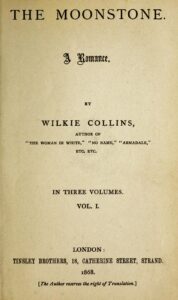
The last novel that I read was Wilkie Collins’s The Moonstone, which I have been meaning to read for years. It is a cracking read. I have just been on holiday and, for the first time in five years, I did not take any Iris Murdoch with me, because it is so depressing. I was just about to put one in my case and I thought, “Why do this? Why put yourself through this?”, so I didn’t bother. I read Wilkie Collins instead and it was a much better experience.
I love the timing of this because it seems possible that The Moonstone may have influenced Half-Blood Prince, which was published a year later on 16 July 2005 – as well as, perhaps, her own future detective novels.
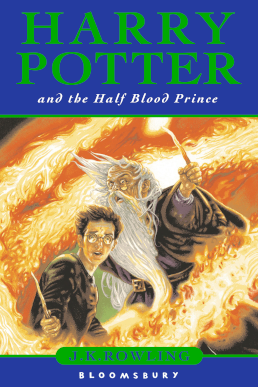
Rowling often describes the Harry Potter novels as ‘who-dunnits’ – saying that Harry Potter ‘is not really a detective novel, but it feels like one sometimes’ – and so it seems highly suitable for these, as well as the Strike novels, to be influenced by the book which, arguably, kick-started the whole genre. Rowling delivered the completed manuscript of Half-Blood Prince to her publishers on 20 Dec 2004 – thanks to Nick Jeffrey for finding this date!) which meant she had five months of writing and tinkering in which the novel she had just read might have influenced the one she was writing.
The place where the influence seems to play out most obviously is at the end, for the denouement of Half-Blood Prince recalls the similarly grim sea-swept hiding place in The Moonstone. On visiting the seashore where Voldemort has hidden the locket Horcrux Harry ‘cannot think any children would have visited such as spot… and boats cannot approach the cliffs; the water around them are too dangerous.’ The seashore hiding place in The Moonstone, meanwhile, is similarly forbidding: ‘no boat ever ventures into this bay. No children from our fishing-village… ever come here to play.’ In both novels in order to reach what has been hidden there, a submerged chain must be pulled up from the water – reachable only by one who knows the secret. In The Moonstone these waters are described as looking as though they are full of the undead, and in Half-Blood Prince it literally is. In both novels a character has committed suicide in this terrible place, and left a note explaining their conduct: ‘I shall be dead and gone, sir, when you find my letter’ writes the character in The Moonstone telling him that she has discovered ‘your secret.’ Regulus likewise leaves a letter in this hiding place which, likewise, runs: ‘I know I will be dead long before you read this but I want you to know that it was I who discovered your secret.’
The Moonstone is a brilliant, seminal novel which sets down many of the tropes we will see again and again in detective fiction. There is a clever detective who suspects the wrong person. There are minor characters who the reader is told we will meet again later, suggesting them to be implicated in the crime (sometimes accurately, sometimes not). There are quite a few people within the novel who suspect that someone they love is the guilty party and thus behave suspiciously in shielding them. One of these exonerates the true culprit in the eyes of the reader. One of these detective-novel style tricks is played out at the end of Half-Blood Prince, as Regulus (a virtuous person) unintentionally muddies the waters. Both Regulus and the suicide in The Moonstone are acting in the service of something they believe morally right. But in both cases their actions, although undertaken for virtuous motives, obfuscate the mystery making it more difficult for the good guys to solve.
When mulling over this connection I also noticed – as supporting evidence that Wilkie Collins’s Moonstone might be influencing Half-Blood Prince – that a new character called Wilkie appears in the novel: Wilkie Twycross, the Ministry Apparition Instructor. (And like a detective novelist with all the answers, he knows how the mystery is done but doesn’t seem particularly intent on communicating this knowledge to his students…).
But even if Rowling read The Moonstone too late to influence Half-Blood Prince, she certainly read it in time for it to influence Strike. I have been thinking about The Moonstone with reference to Strike because of ‘The Gillespie Theory,’ as outlined by Lindsay and Pools:
There is one thing that ties Gillespie and Leda together: Strike’s child support account. To summarize Pools’ theory, she believes that Peter Gillespie could have been embezzling money from that account and Leda somehow found out. In order to keep his secret, especially from Rokeby, he killed her.
One of the reasons I like this theory is that it fits with the plot of The Moonstone – for the impetus for the crime in Collins’s novel is likewise that a seemingly upright and respectable man has been embezzling money. And just like Gillespie (if the theory is correct) embezzling money from a young man for whom the money is kept in trust – so, for many years, the crime goes undetected:
[Our villain] was entrusted with the care of a sum of twenty thousand pounds—as one of two Trustees for a young gentleman, who was still a minor in the year eighteen hundred and forty-eight. That the Trust was to lapse, and that the young gentleman was to receive the twenty thousand pounds on the day when he came of age, in the month of February, eighteen hundred and fifty. That, pending the arrival of this period, an income of six hundred pounds was to be paid to him by his two Trustees, half-yearly—at Christmas and Midsummer Day. That this income was regularly paid by the active Trustee. That the twenty thousand pounds (from which the income was supposed to be derived) had every farthing of it been sold out of the Funds, at different periods, ending with the end of the year eighteen hundred and forty-seven. That the power of attorney, authorising the bankers to sell out the stock, and the various written orders telling them what amounts to sell out, were formally signed by both the Trustees. That the signature of the second Trustee (a retired army officer, living in the country) was a signature forged, in every case, by the active Trustee.
The villain commits the crime of stealing the Moonstone in order to replace the stolen money, which he should have been keeping in trust for the young man. Perhaps the crime of Leda’s murder was also intended to cover up the embezzlement of a young man’s trust fund – and Leda’s profligacy can then be blamed as the reason for the sums not adding up?
Another small clue about the possible importance of debt as a motive in the series as a whole is found in the story of Littlejohn. Littlejohn seemed quite a minor character given everything that was going on in The Running Grave. He provided comic relief, access to a useful piece of evidence, uncovered Pat’s secret and was a playful version of the undercover agent that Robin herself was in the UHC. But he had a sufficiently minor plot pay-off, given the time spent on him, that I did wonder if he pointing towards something more – are his gambling debts a hint to some more important monetary crime underlying the series? Did Gillespie embezzle Strike’s money to cover debts, like Littlejohn and the criminal in The Moonstone, and so find himself being drawn into further crimes to cover his tracks?
One issue with the Gillespie, theory, however, is that he isn’t someone in whom the reader is invested. Indeed, you have to be a pretty committed reader to even know who Gillespie is, so – unless he starts playing a bigger role soon (which is not unlikely if – when! – Rokeby turns up) – he wouldn’t be a satisfying reveal to the majority of readers. As I have suggested before, I think instead that we’re looking for a family member (just as we were with the seeming suicides in the first and fourth books of the series). I think the ‘beast within’ theme in the novels means that we are looking for someone close to Leda. I’m ruling out Strike and Joan (the pathos of her death in Troubled Blood means that Rowling can’t turn round and make her Strike’s mother’s murderer) – but only those two. That leaves us with only seven characters who have been in the story since Leda’s time: Lucy, Ted, Shanker, Whittaker, Rokeby, Gillespie, and Dave Polworth. I think we can discount Dave (like Whittaker’s parents he is just too minor, and he is also too purely a comic character). I am suspicious of Ted, though, because of how much sibling rivalry has been a motive. It is the murderer’s motivation in both Strike 1 and 7, and a big part of Raphael’s backstory in 4 too – and I can’t help but fear this will be relevant in some way. ‘Capricorn’ Ted, ‘I didn’t want her to die’ Lucy and ‘can see no flaw in Leda’ Shanker all have moments that point towards them. I don’t think Lucy would have done it on purpose, but that phrase ‘I didn’t want her to die’ could speak to some unwilling collusion that she did not realise would result in Leda’s death. I don’t think Shanker would have ever have been part of Leda’s death without her collusion – but he could have been part of some kind of Dumbledore/Snape-esque suicide pact of which Leda was the instigator.
 I’ve always been certain that Strike’s arc needs the series to close with the return to, and solution of, the first murder in his life. If you doubt that, though, you’re in good company, I’ve seen a few people in the fandom musing that maybe Leda’s death actually was an accident. I knew, however, that Leda was definitely murdered once I read Lethal White – the second seeming suicide who turned out to be murdered by a family member just seemed too close not to be relevant. One person was involved in the first, two in the second – might three be involved in Leda’s murder? I think that more than one person being involved is likely, because it makes the solution more difficult to guess, but also it would allow a minor character (like Gillespie) to be guilty of the actual murder, while a major character (like Lucy, Shanker, Ted or Leda herself) is wittingly/unconsciously implicated, allowing the reader the emotional payoff of a ‘big twist.’
Rowling herself has since corroborated this belief that Leda was murdered – for those of you still doubting! She said in an interview in 2020 – surrounded with what sounds like the hedging or fudging of someone who has perhaps had second thoughts about giving this away: ‘his mother who was murdered but that murder was never – um, was… never came to trial’ (audio clip of Rowling discussing ‘Strike’s character’ which was uploaded on the Robert Galbraith homepage on 19 August 2020). Rowling’s words here are confusing – Whittaker was put on trial for Leda’s murder, so her murder did come to trial. I think, therefore, that what she means is that Leda’s actual murderer has never been put on trial (if I’m right in that reading, it means that Whittaker is innocent). This clip has now gone from the Robert Galbraith homepage (Nick Jeffery magicked it up for me with his usual brilliance) which could be read as further evidence that Rowling, on second thoughts, either recognised her mistake or decided she did not want to reveal that Leda was murdered. The solution of Leda’s murder will be the climax of the series (which I why I think the scent has gone so cold – the breadcrumb clues were intended to be laid for a shorter, seven book series and now need to be stretched out for a ten-book series).
A possible connection with The Moonstone is also helpful for highlighting the only explicit clue we’ve been given about Leda’s death not being suicide – that she was killed by heroin, a drug which she (a cannabis user) had never touched before. The Moonstone is an interesting novel to place beside Leda’s drug-induced death because is it perhaps the first novel in which knowledge about the operation of class-A drugs plays a major role in the plot. Wilkie Collins was writing from personal knowledge: on one night he ‘consumed, in a single glass, enough laudanum (a potent combination of opium and alcohol) to kill 12 people.’
Collins decided to make use of his intimate knowledge of laudanum to create the crux of the plot in The Moonstone. If the way that drugs are used in The Moonstone did influence Rowling in Leda’s drugged death then it might point to her death as a crime that was committed ‘innocently.’ In The Moonstone someone administers laudanum to another with no aim but of helping them – causing all the ensuing mischief, but morally innocent of the crime that results. A possible parallel with this would be Shanker providing the heroin with no clue as to how it would be used. Or Lucy’s ‘I didn’t want her to die’ could be the words of the character who administered the drugs as in The Moonstone with no intention of doing harm.
Leda was killed by heroin, a drug that she has never taken before – and the reader is told elsewhere in Strike some specific aspects of how this drug acts. This information seemed to me suspicious and interesting – an information dump for those of Rowling’s law-abiding readers who might be unaware of the action of heroin:
If, however, he had taken heroin with Whycliff, Strike knew that the odds of him being in a fit state to infiltrate number 18, Kentigern Gardens, or to work himself into a murderous rage, were negligible. Strike was familiar with the behaviour of heroin addicts; he had met plenty at the last squat his mother had lived in. The drug rendered its slaves passive and docile; the absolute antithesis of shouting, violent alcoholics, or twitchy, paranoid coke-users. Strike had known every kind of substance-abuser, both inside the army and out. The glorification of Duffield’s habit by the media disgusted him. There was no glamour in heroin. Strike’s mother had died on a filthy mattress in the corner of the room, and nobody had realised she was dead for six hours. (Cuckoo’s Calling)
 Leda, as we know, eschews ‘heroin in all its forms’ (Career of Evil) and this gives us our primary clue that she has been murdered. Might this passage suggest a reason? Has Leda been administered heroin by someone – Gillespie, Rokeby, Whittaker or Ted wanting a signature or some acquiescence – in order to render Leda ‘passive and docile’? This would fit with the administration of the drug in The Moonstone which is not done by the criminal, and is done with the aim of proving a point rather than committing a crime.
Finally, the centrality of drugs in The Moonstone draws attention to another important aspect of drugs in Leda’s death, which is that Shanker, while this overdose occurs, is miles away concluding a deal for cocaine. Of all the long-running characters who might have been involved in Leda’s death, it is only Shanker who has been given an alibi:
Nevertheless, he could not always be there. On the day that Leda had died, Shanker had been away on one of his regular, drug-related business trips. Strike would never forget Shanker’s grief, his guilt, his uncontrollable tears when they next met. While Shanker had been negotiating a good price for a kilo of premium Bolivian cocaine in Kentish Town, Leda Strike had been slowly stiffening on a filthy mattress. The finding of the post-mortem was that she had ceased to breathe a full six hours before any of the other squat dwellers tried to rouse her from what they had thought was a profound slumber.
Like Strike, Shanker had been convinced from the first that Whittaker had killed her, and such was the violence of his grief and his desire for instant retribution that Whittaker might well have been glad he was taken into custody before Shanker could get his hands on him. Inadvisably allowed into the witness box to describe a maternal woman who had never touched heroin in her life, Shanker had screamed “That fucker done it!,” attempted to clamber over the barrier towards Whittaker and been bundled unceremoniously out of court. (Career of Evil)
It seems suspicious, on reflection, that Shanker is given such a clear (although obviously rather dubious) alibi – given that it relies on drug dealers who, even if giving what they believe are true statements, might be as likely to have as shaky grasp on precise times as the equally drugged-up Lady Bristow. Shanker would never wittingly have harmed Leda but he, and his drugs, may have been involved in some way.
Finally, I recently spotted what I think might be an additional clue that ‘The Gillespie Theory’ might be running along the right lines.
“You get people like Gillespie round the rich and famous,” said Strike. “His whole ego was invested in being my father’s enforcer. The bastard was half in love with my old man, or with his fame, I dunno. I was pretty blunt on the phone about what I thought about Rokeby, and Gillespie couldn’t forgive it. I’d insisted on a loan agreement between us, and Gillespie was going to hold me to it, to punish me for telling him exactly what I thought of the pair of them.” (Troubled Blood)
Gillespie is being given a little more colour here and something like a motive – ‘half in love with my old man’ – quickly brushed off with ‘or with his fame, I dunno.’ And while Gillespie has only been mentioned in Cuckoo’s Calling and Troubled Blood which makes him, currently, too small a character to be the sole suspect, he could definitely have been involved. And here’s the subtlest of clues that he might be:
“Well, thanks very much for getting back to me,” said Strike. “Social workers work Saturdays as well as detectives, I see.”
“People don’t stop needing help at weekends,” she said drily. “Good luck. I hope you find out what happened to that poor doctor.” (Troubled Blood)
Janice has, in fact, made a slip-up by calling back as ‘Clare’ on a Saturday, because social workers don’t make non-urgent calls at the weekend. This is a clue that ‘Clare’ is working her own business here, not fulfilling the dictates of her job as she claims. So, it would be satisfying if this were retrofitted clue to another weekend call earlier in the series:
‘Ah, Mr Strike,’ said Peter Gillespie’s voice. ‘How nice of you to pick up.’
‘Oh, hello, Peter,’ said Strike. ‘Got you working weekends now, has he?’
Gillespie as Rokeby’s lawyer, like Clare the social worker, shouldn’t (and wouldn’t) be working weekends. So, is this a clue that Gillespie, like ‘Clare,’ is pursuing his own agenda here, not just doing his job as he claims? It is he, not Rokeby, who wants that money back? Is it the subtlest of clues that he, like ‘Clare,’ is a murderer? Because, of course, murderers – like private investigators – do work weekends.
One of the most instructive comments I’ve read in detective fiction is not to ask if a person is capable of murder but to ask, in view of what you know of this character, would they be capable of THIS murder. Based on that criteria, it is very unlikely Lucy or Ted played a role in Leda’s death. Both Ted and Lucy are respectful, honest, ethical people who were living in Cornwall when Leda died. There is no evidence they had experience with or access to illegal narcotics. (Ted does not work in healthcare.) Neither has shown any familiarity with hypodermics. By then, Lucy was doing her best to stay in London and as far from Whittaker as possible. The likelihood of either of these law-abiding people journeying to London, deliberately obtaining a lethal opioid and then injecting it into a close family member grows progressively more unlikely with each fact we know of the matter.
What we do know is that whoever administered the fatal dose did so in close range of the other squatters but escaped detection, either because they were all so impaired that no one noticed the arrival of a stranger or that the perpetrator was someone they knew so well that the appearance was unremarkable.
It is likely that Leda was already unconscious when the injection was administered, since no evidence of resistance was reported. So far, the most likely suspect, to my mind, is Whittaker.
I think Rowling’s comment – ‘his mother who was murdered but that murder was never – um, was… never came to trial’ – means that Leda’s murderer has not been tried for her murder – which rules out Whittaker. From the evidence within the books themselves I agree he is a good suspect.