In the Q&A for The Ink Black Heart, Rowling acknowledged that she does ‘have a bit of a thing about birds.’ She relates this to their folkloric association with inspiration and omen: ‘Birds have an association of messenger, you know, in lots of cultures. And I was playing a lot with the idea of inspiration… many people, me included, find their own source of inspiration quite perplexing… And so, I love the idea of – of bird messengers. They are also creatures of omen, you know, across most cultures you have an idea of something ominous.’ And the most ominous birds of all are corvids. Their collective nouns say it all: an unkindness of ravens can also be known as a conspiracy or a treachery while, even less propitiously, it’s a murder of crows. With their inky black feathers and exceptional intelligence, shown by their ability in mimicry illustrated in The Ink Black Heart, corvids have long been the most ‘ominous’ of all birds, attracting more folklore than perhaps any other. This traditional symbolism is nodded to in Harry Potter in the naming of Hogwarts’s most intelligent house Ravenclaw and it is explored to the hilt in both The Cursed Child and The Crimes of Grindelwald. And now we know that corvids will also be appearing in Sleep Tight, Evangeline.
The only major role played by corvids in Strike so far is Magspie in The Ink Black Heart, while crows have only appeared as similes: the black-clad goths who pick over the merchandise in the shop Trifecta, where Robin works undercover in Lethal White, ‘like drooping crows’ and the mourners who flock ‘like morose crows’ to the funeral at the end of The Hallmarked Man. Rooks, meanwhile, are implicitly present, in Rokeby’s name. Iris has pointed out the rook connection, noting that Rokeby has a toponymic surname derived from a parish in North Yorkshire (and we know Yorkshire will be turning up again in Sleep Tight, Evangeline). Rokeby is named from the Old Norse for a settlement (‘-by’) added to a word meaning rook, crow or raven. Rokeby is not included in A.D. Mills’s Dictionary of British Place-Names (1991) (which is Rowling’s place-name bible) but this dictionary does include similar places named after rooks and ravens such as Rookley (‘Wood or clearing frequented by rooks’), Rookhope (‘Small enclosed valley frequented by rooks’) and Romsley ‘wood or clearing of the raven.’ Rokeby’s surname, however, is in another naming book Rowling uses – P.H. Reaney and R.M. Wilson’s Oxford Dictionary of English surnames (1995) – which notes that it comes from Rokeby in Yorkshire. Bearers of the name Rokeby seem to know about the corvid derivation: there is a house called Rokeby which has a crow room (presumably an intentional pun or rebus on the name).
So while we’ve had crow similes and rooks hidden within names, ravens have been slightly more in evidence in the Strike series so far. There has been a very minor character called Raven, Pat’s ‘raven’s caw’ of a laugh and an actual raven which flew into the window startling Strike in The Running Grave: ‘he and the raven blinked at each other and then, in a blur of black feathers, it had gone’ (Chap 29). Ravens flying into windows are specifically seen as portentous (see, for example, the raven at the window in Edgar Allan Poe’s ‘The Raven:’). After this encounter Strike turns back to view the images on Torment Town’s page, his ‘heart rate slightly elevated’ and, as the raven portent might suggest, he sees a crucial clue. The drawing that he looks at is of a woman in water who is ‘fair haired and wore square-framed glasses.’ In Norse mythology the ravens Huginn (‘thought’) and Muninn (‘memory’) fly over Midgard and return to perch on Odin’s shoulder and whisper their knowledge into his ear. If Strike, and the reader, engage memory and thought here they will get a major clue as to what is really going on. For we have seen a photo of this woman only 66 pages earlier: ‘Fair-haired Deirdre Doherty looked up at him, wearing a pair of square-framed glasses’ (Chap 21).
This is an important raven moment, but watchers of Rowling’s twitter headers have long been expecting corvids to play a more major role. For there have been no fewer than three twitter headers devoted to them: 12th January 2016, 9th April 2017 and 26th September 2018. The header for 9th April 2017 is particularly interesting because Rowling took it from a website detailing how to distinguish crow from ravens – evidence that she is interested in the distinction or evidence that she has some difficulty telling them apart? (Harry Potter has a bit of history with corvids and ornithological identification troubles when the marketeers decided to make Ravenclaw’s heraldic symbol into a raven rather than an eagle).
Up to this point ravens have played a significantly more important role than crows in Rowling’s writing but, as Lindsay has shown, the charm bracelet clue for Sleep Tight, Evangeline is a crow, not a raven. Rowling still could be pointing to a raven, as these two birds are biologically related and often symbolically coterminous; but I think Lindsay is right and Strike 9 will finally be the crow’s chance to shine. In the entry on the crow in T.H. White’s 1954 translation The Book of Beasts: Being A Translation from A Latin Bestiary of the Twelfth Century (one of the bestiaries I’m confident Rowling has studied) the medieval author writes that ‘Soothsayers declare that it [the crow] has to do with the troubles of men by omens, that it discloses the paths of treachery, and that it predicts the future.’ This is food for thought as to what role crows and treachery may play in Sleep Tight, Evangeline. This blog will explore corvids in Rowling’s writing so far to think about what this crow-charm may mean for the future.
Ravens in Crimes of Grindelwald
In The Crimes of Grindelwald, a raven forms the crest of the Lestrange coat of arms. Leta explains this when, seeing thirteen-year-old Newt cradling and caring for an injured raven chick, she says: ‘the raven’s my family’s emblem.’ There is an unspoken and tender suggestion here that Leta sees herself as likewise something abandoned and injured which Newt might be able to heal. But throughout the rest of film ravens fulfil their more usual ominous role. The Lestrange motto ‘Corvus oculum corvi non eruit’ is an old Latin saying meaning ‘a raven will not pull out the eye of another raven,’ equivalent of the English phrase: ‘honour amongst thieves.’ This motto not only incorporates the Lestrange raven into a real Latin phrase but also recalls the unswerving loyalty of the most famous Lestrange (Bellatrix) to the Dark Lord. The Lestrange Mausoleum in Paris is marked by a stone raven on its lintel and hence Grindelwald’s use of the raven symbol in the film is an opaque sign calling his followers to meet him there.

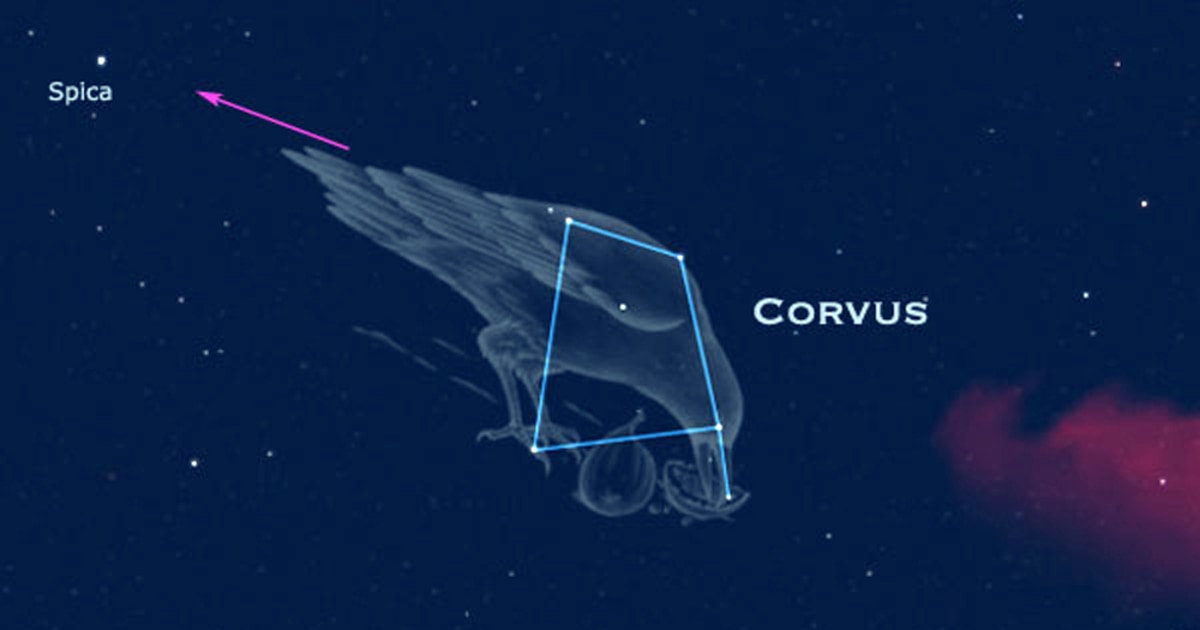
Ravens are the dominant symbol not only of the Lestrange family, however, but of the film as a whole. Corvus, the riddle at the centre of the film’s plot, is Latin for ‘raven’ (the common raven is Corvus corax) and both Leta’s father and her lost brother share the name. Satisfyingly, given all the star and constellation names chosen by pure blood families of Harry Potter, Corvus is also a constellation although (in keeping with the general corvid confusion) this is translated as the Crow constellation. Located in the southern sky, it was first catalogued by Ptolemy in the second century and was probably so-named because it does not contain many bright stars.
The ominous and prophetic aspects of raven symbolism is central to The Crimes of Grindelwald and Yusuf Kama reads the Lestrange family raven as prophesied by The Predictions of Tycho Dodonus:
A son cruelly banished
Despair of the daughter
Return, great avenger
With wings from the water.
Kama reads this as referring to Corvus – ‘You are the winged raven returned from the sea’ – and himself as the avenger who will kill him. But this reading is entirely muddled. In the poetic prophecy it is the avenger who is winged and therefore (from Kama’s perspective) it is he, not Corvus, who should bear the raven imagery: is he at once, somehow, the banished son and the winged avenger? The possibility that Rowling had intended to do something with this misreading (had the full five film scripts been written) is suggested by the black feather in Kama’s fedora.
Delphi the Augurey in Cursed Child
When Leta sees Newt cradling and caring for a raven chick, her own familial connection with ravens means that she suddenly understands the importance of Newt’s generous kindness: ‘As he places the chick gently in her hands, she seems to see him plainly for the first time’ (stage direction). When Newt grows up and writes his magnum opus Fantastic Beasts and Where to Find Them he will include within it another black-winged bird, an Augurey:
The Augurey is a native of Britain and Ireland, though sometimes found elsewhere in northern Europe. A thin and mournful-looking bird, somewhat like a small and underfed vulture in appearance, the Augurey is greenish black. It is intensely shy, nests in bramble and thorn, eats large insects and fairies, flies only in heavy rain and otherwise remains hidden in its tear-shaped nest.
The Augurey has a distinctive low and throbbing cry, which was once believed to foretell death. Wizards avoided Augurey nests for fear of hearing that heart-rending sound, and more than one wizard is believed to have suffered a heart attack on passing a thicket and hearing an unseen Augurey wail. Patient research eventually revealed, however, that the Augurey merely sings at the approach of rain.
The Augurey has since enjoyed a vogue as a home weather forecaster, though many find its almost continual moaning during the winter months difficult to bear. Augurey feathers are useless as quills because they repel ink.
The greenish-black Augurey appears to be a Wizarding version of a corvid, as it shares many characteristics with crows in the Muggle world. In ancient Greece, for example, the crow was sacred to Apollo, symbolising him as the god of prophecy. This symbolic connection between birds and prophecy was the result of the ritual use of bird flight and bird entrails in divination. The ‘augurs’ of Rome were religious officials who practised ‘augury,’ the interpretation of the will of the gods as expressed through the flight of birds. ‘Augury’ gives the Augurey its name, and this prophetic aspect is included in Wizarding lore via the idea that the Quill of Acceptance (which foretells a child’s magical destiny) is made from an Augurey feather. (This is only this deeply magical Quill that can be made from an Augurey feather which, as Newt notes, cannot otherwise be used as a quill.)
Delightfully there is another, rather less well-known, link between crows and Augureys for, according to ancient bestiaries they share in the ability to predict the rain. T.H. White’s Book of Beasts entry on the crow, mentioned at the start of this blog, notes that ‘among the many omens attributed to this bird, they specially mention the foretelling of rain by its voice.’
When the Augurey appears in Cursed Child it becomes more clearly a crow-like bird.

The ominous black wings that overshadow the show, a darkened refraction of a Snitch’s silver wings, are Augurey wings which (spoiler alert!) Delphi has tattooed on her back:
Albus. I hadn’t noticed it before. The wings. Is that what the Muggles call a tattoo?
Delphi. Oh. Yes. Well, it’s an Augurey.
Scorpius. An Augurey?
Delphi. Haven’t you met them in Care of Magical Creatures? They’re sinister-looking black birds that cry when rain’s coming. Wizards used to believe that the Augurey’s cry foretold death… It reminds me that the future is mine to make…
Scorpius. They called you the Augurey. In – the other world – they called you the Augurey. (Cursed Child, Part 2, Act 3.16)
Delphi is the Augurey, just as her name suggests, This transformation is there for us to see if we had remembered that Delphi is the prophetic shrine of Apollo, with his sacred crow used in augury.
The Morrigan
Delphi the Augurey and the self-identification of Leta with the raven chick for whom Newt cares, create a noticeable connection between women and corvids in the Wizarding World. The Auguery is mentioned as a native of Ireland, as well as Britain, which resonates with Irish mythology in which goddesses are particularly linked with ravens and crows: ‘the battle goddesses Badb (Crow) and the Morrigan (sometimes called an badb catha, or Battle Crow) took raven or crow form to bring dark omens.’ This link between the Morrigan and crows is particularly pertinent because Rowling drew attention to it back in 2016. In the origin story for Ilvermorny, Isolt Sayre, a seventeenth-century Irish witch born in County Kerry is a direct descendant of ‘the famous Irish witch Morrigan, an Animagus whose creature form was a crow. William nicknamed his daughter “Morrigan” for her affinity for all natural things when she was young.’
The first written record of the Morrigan is as a gloss on Isaiah 34.14 in a 9th century manuscript of the Vulgate (Jerome’s Latin translation of the Bible). In the King James Version (the translation used in Harry Potter) this verse reads: ‘The wild beasts of the desert shall also meet with the wild beasts of the island, and the satyr shall cry to his fellow; the screech owl also shall rest there, and find for herself a place of rest.’ I love that the King James Version goes for ‘screech owl’ – a bird of omen – to translate the lilit (Lilith) of the Hebrew (a nocturnal creature/night demon). In this 9th century manuscript ‘Lilith’ (rendered ‘Lamia’ by the Vulgate) is glossed ‘a monster in female form, that is, a morrígan.’ The Revised Standard Version of the bible, going in a rather different direction from the King James’s ‘screech owl,’ translates the word ‘night hag’ instead. The Vulgate’s choice of ‘lamia,’ a snake woman, has strongly influenced the Wizarding World, via Keats’s poem Lamia (as discussed in my recent Potterversity Podcast and in my essay on Nagini in Lana A. Whited’s The Ivory Tower, Harry Potter, and Beyond: More Essays on the Works of J. K. Rowling). But in Irish mythology this ‘night hag’ took a different direction and the Morrigan is a crow rather than a snake-goddess. Rowling in her back-story for Isolt Sayre reclaims the link between animal magic and women as an entirely benign image of Morrigan as a nickname for a nature-loving girl, just as the Nagini storyline in Crimes of Grindelwald rewrites the traditionally malign associations of Lamia, the snake-woman.
This appearance of the Morrigan in Rowling’s own lore makes it more likely that the corvid on the charm bracelet points towards this crow goddess. While the Isolt Sayre story domesticates the shape-shifting goddess the Battle Crow, it is possible that her more ominous side will be appearing in Sleep Tight, Evangeline. For she is closely in connection to another piece of Irish mythology which has recently appeared on Rowling’s twitter feed.
As mentioned above, the corvid-like Augurey was believed to foretell death, and the Morrigan takes the form of a crow to bring omens of death. And as Caroline Larrington explains in The Land of the Green Man (2015) folklore relates her to another famous female Irish death-omen – the banshee:
the banshee is an omen of death: a woman with long white hair who is heard keening and clapping her hands together. An Irish tale from County Cork, recorded in 1825, tells of a well-loved minister who fell ill. Kavanagh the herdsman was sent to town to fetch medicine for him. He returned with the bottle all right, but was weeping and trembling uncontrollably. When the minister’s daughter asked what had happened, he declared that ‘the master … is going from us’. The daughter had supposed that her father was on the mend and assured Kavanagh of this, but he related how as I came through the glen of Ballybeg, [the banshee] was along with me keening, and screeching, and clapping her hands, by my side, every step of the way, with her long white hair falling about her shoulders, and I could hear her repeat the master’s name every now and then, as plain as ever I heard it. When I came to the old abbey, she parted from me there, and turned into the pigeon-field …
The minister took a turn for the worse after this. A week later the sounds of moaning and the clapping of hands were heard right outside the sickroom window, for the hour, and the Banshee, were drawing closer. When the family went to look who might be lurking outside, no one was there, but the wails and clapping continued until the dawn – and by then the minister was dead.
In Scotland, the banshee is often conflated with a figure with a different origin, the Washer at the Ford. The Bean Nighe is seen at a ford or a river, washing out bloodstained clothing; she sometimes has webbed feet. She is also said to be a woman who died in childbirth, and, if you question her, she will reveal whose death is at hand. In Irish myth the Washer at the Ford is a recurrent figure; she is an avatar of the Morrígan, the goddess of battle, who determines defeat or victory, and who sometimes takes the form of a crow.
The banshee, a female death omen, is closely aligned with the Washer at the Ford, a female death omen who, like the crow, is an avatar of the Morrigan.
This three-way connection between crows, banshees and the Morrigan is particularly suggestive because banshees with Irish connections appear in Harry Potter. The Banshee is the form of Seamus Finnigan’s Boggart and another banshee that appears comes from the Irish town of Bandon. This is one of the fearsome creatures with which Lockhart claims to have tussled while on holiday: he has not only voyaged with vampires and gadded with ghouls but taken a Break with a Banshee. Later the reader discovers that this banshee is from the Irish town of Bandon – ‘I didn’t get rid of the Bandon Banshee by smiling at her!’ Lockhart quips, failing to mention that he did not get rid of her at all. In January 2025 Rowling too took a break. In the thick of writing Sleep Tight, Evangeline she visited one of her ‘bffs’ in Ireland (perhaps one of those friends after whom she named the Irish Quidditch team players). She posted an image of herself in Bandon with the words: ‘Rare sighting of a Bandon banshee’.
We know that Rowling always goes in person to her locations, and that she has combined fact-finding Strike trips with friendship trips previously. Strike and Robin may or may not make it to Ireland, but I think this banshee link may be a hint that the crow-charm will connect with this Irish mythology and that we may be seeing more of the Morrigan.
And finally, looking ahead to Sleep Tight, Evangeline, I have another spooky little find for Halloween. I have been rereading The Casual Vacancy for the first time since the title of Strike 9 was released, and one of the gravestones jumped out at me. In the Yarvil cemetery are ‘newer graves of highly polished black marble with gold lettering, places where fresh flowers had been laid for the recently dead.
To Lyndsey Kyle, September 15 1960-March 26 2008,
Sleep Tight Mum’
I think we may find the title of Sleep Tight, Evangeline graven on a headstone.
Happy Halloween everyone!
Wow, this was such an interesting read! So informative and so much food for thought. Thank you!
Thank you Jaime! That is really lovely to hear.