Wake: the silver dusk returning
Up the beach of darkness brims,
And the ship of sunrise burning
Strands upon the eastern rims.
(Housman)
Today is J.K. Rowling’s birthday, and it is a birthday which she shares with two beloved characters – not only with Harry Potter, but also Shakespeare’s Juliet. It therefore seems a highly suitable day to look at some of the literary hints she’s dropped for The Hallmarked Man. I have chosen this epigraph to mark the occasion because it brings together a number of things her headers suggest we may be seeing in The Hallmarked Man – silver, ships and golden beaches. But also, because we know Rowling’s been reading Housman. You would, however, have to have been quite quick to spot it.
Last September Rowling tweeted
‘Housman is one of my heroes and always has been. He was a detestable and miserable man. Arrogant, unspeakably lonely, cruel and so on, but an absolutely marvellous minor poet.’ Wow. Imagine what Nick Laird says about people who aren’t his heroes.
She then deleted this tweet later the same day with the explanation – ‘Deleted my Nick Laird quote because it wasn’t him, it was John Berryman. My bad, entirely’ 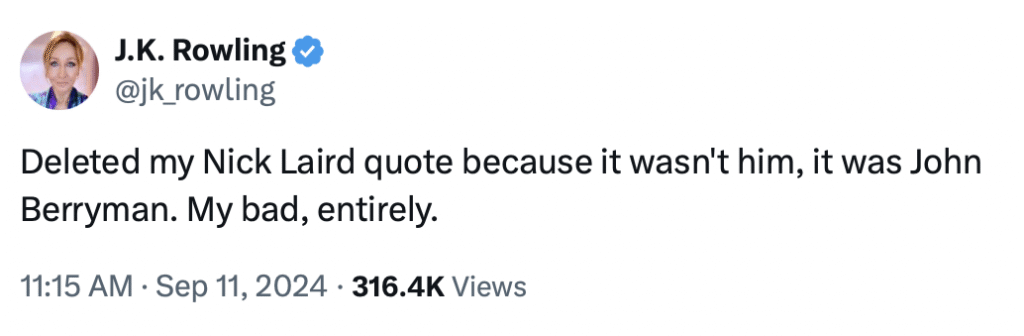
In misattributing the quotation Rowling tells us not only that she was reading the poet John Berryman’s thoughts about Housman – which is quite a famous quotation she might have found in a number of places – but that she was reading Nick Laird quoting it. That, as Nick Jeffrey immediately spotted (hat-tip, as ever, Nick!) means that in September 2024 Rowling was reading A Shropshire Lad and Other Poems: The Collected Poems of A.E. Housman (Penguin, 2010), edited by Nick Laird, in which Laird quotes John Berryman’s famously acerbic assessment in the introduction.
For an overview of this collection of Housman, this is the publisher’s blurb:
In this collection, A. E. Housman’s poems, including ‘To an Athlete Dying Young’, ‘Loveliest of Trees, the Cherry Now’ and ‘When I Was One-and-Twenty’, conjure up a potent and idyllic rural world imbued with a poignant sense of loss and sadness. Their scope is wide – ranging from religious doubt and doomed love to intense nostalgia for the countryside and patriotic celebration of the life of the soldier – and they are made all the more memorable by their distinctive diction and perfectly modulated rhythm and sound. This volume brings together the works Housman published in his lifetime, A Shropshire Lad (1896) and Last Poems (1922), along with the posthumous selections More Poems and Additional Poems, and three translations of extracts from Aeschylus, Sophocles and Euripides that display his mastery of Classical literature.

Obviously, Rowling might just be reading Housman for pleasure, but it seems just as likely, given that this was posted in the last few months before completing the manuscript of The Hallmarked Man (and she has spoken about not reading so much while she is writing) that she might have been cherry-picking some new, or double-checking some old, Housman epigraphs for Strike 8.
If Rowling has, indeed, been mining Housman for epigraphs, it seems safe to assume she was drawn towards passages like the one quoted above:
Wake: the silver dusk returning
Up the beach of darkness brims,
And the ship of sunrise burning
Strands upon the eastern rims.
Another Housman poem that links silver, gold and the stars has a particularly pertinent final line for someone who has just declared their love. We know we’ll be seeing February 2017 quite a bit in The Hallmarked Man and this section of A Shropshire Lad is for the following month, March, and it describes the sun moving into the constellation of Aries (the Ram) on the 21st March:
The sun at noon to higher air,
Unharnessing the silver Pair
That late before his chariot swam,
Rides on the gold wool of the Ram.
….
In farm and field through all the shire
The eye beholds the heart’s desire;
Ah, let not only mine be vain,
For lovers should be loved again.
The final line means that those who love (and declare their love?) should be loved back – a very fitting line for Strike and Robin at this moment!
Last year The Strike and Ellacott Files kindly hosted my blog to celebrate Rowling’s birthday on the silvery book we know will be an epigraph text and silver is the dominant metal Rowling has been hinting about for this novel. But when she posted on Dec 17 2024 that she had completed The Hallmarked Man the image could hardly have been more golden:
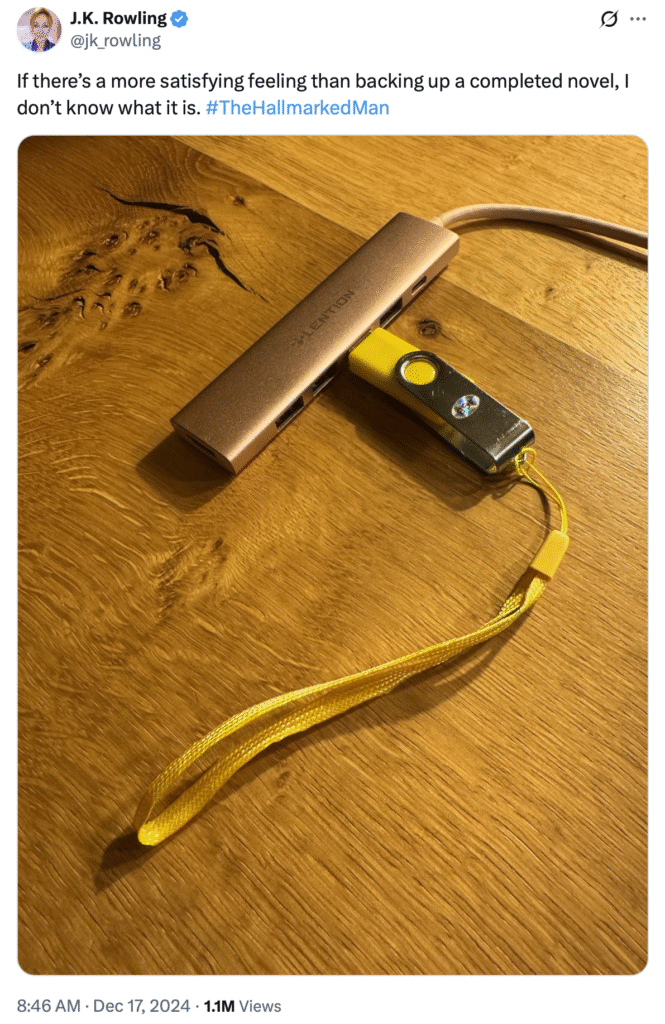
@suekmoorhen quickly responded with ‘Love it, thought you may have had a silver ribbon on the USB stick?’ and Rowling replied that this had indeed been the case: ‘A previous back up WAS on a silver USB stick, but… I lost it. The yellow one’s also got the Running Grave on it.’ So some of the golden lustre of this image may be chance, but it did pick up on the previous golden hint (in Rowling’s August 2024 header) of four lines from James Elroy Flecker’s The Golden Journey to Samarkand (1913) (which I wrote up here).
Robin as the true gold of the series has been signalled in alchemical terms from the beginning of the series through her hair colour, and the ‘golden glow’ of the evening at the Ritz is the most emphatically golden moment of the series so far. Its gold motif was signalled in the concluding epigraph of Troubled Blood that presaged it – an epigraph that promises that the ‘loue of soule’ that Strike and Robin share surpasses that of Strike’s previous attachments to ‘loue of bodie’ as surely as ‘perfect gold surmounts the meanest brasse.’ The links between Robin and gold, and the origins of the term ‘hallmark’ from the Goldsmiths’ Hall (as well as the importance which the Freemasons’ Hall is going to play in this novel) made me wonder if there might be a pun on Robin included in the title (alongside the link with Strike – and the victim – as men known, and marked, by their DNA). For Robin’s name has been ‘Hall’ in three of the novels of the series. This strikingly long alias was invented in Career of Evil, when Robin created the persona of Venetia Hall – representing the legal firm Hardacre and Hall. Robin then revives this alias both to enter the House of Commons in Lethal White and to be a journalist in Ink Black Heart where Venetia Hall extracts information from both Tim Ashcroft and Yasmin Weatherhead. Robin is, punningly and fittingly, given that she is the red-gold headed golden girl of the series, ‘Hall’-marked.
Silver and gold are both highly celebratory, and highly alchemical, colours – and Rowling has hinted at another one for this novel too – the colour red. The red stage – the ‘rubedo’ – is the final stage of the alchemical journey, so that gives a hopeful feel to Rowling’s header on 16 June 2024 of the red lift in the Savoy Hotel (which I’ve written up here.)

The Savoy hotel has only turned up once before in Strike – in a parody version in Skegness:
“‘The Savoy,’” said Strike, smirking as he read the names of the larger hotels, whose upper windows could surely see the distant sea. “‘The Quorn.’ ‘The Chatsworth.’”
“Don’t jeer,” said Robin. “I used to love coming to Skegness when I was a kid.” (Troubled Blood, chap 64)
But I did wonder on this complete series reread (which, like many Strike fans, I do prior to each new novel), if it may have been more subtly foreshadowed.
The Running Grave has more intratextual allusions, or easter eggs, than any previous novel in series. These run from the early references to Silkworm (when it is mentioned that Roper Chard were intending to publish Kevin Pirbright’s book) and Lethal White (when the Graves family inquire about the agency’s probity from the Chiswells) to the multi-novel link of Charlotte’s fashion shoot for Madeleine Courson-Miles Madeline being used as her image in her obituaries (which is a subtle link with Cuckoo’s Calling as well as an explicit one to Ink Black Heart). And the Savoy lift header made me wonder if there might be another hidden among some of the most explicit pointers to previous books.
In The Running Grave Charlotte is dating ‘Landon Dormer, a thrice-married, lantern-jawed billionaire American hotelier.’ Landon’s own unusual Christian name may be a memory of one of the epigraph poets of Ink Black Heart – Letitia Elizabeth Landon – and the Times article about Charlotte’s alleged assault on him is the most intratextual moment of the series:
There were multiple links below the article: Charlotte at the launch of a jewellery collection the previous year, Charlotte admitted to Symonds House the year before that, and Landon Dormer’s acquisition of one of the oldest five-star hotels in London. (Running Grave, Chap 59)
The first two ‘links’ here also link to events within the series: Madeline’s jewellery launch in Ink Black Heart and the suicide attempt from which Strike saved Charlotte in Troubled Blood. The other two ‘links’ in this sentence being such explicit hat-tips to previous novels, made me wonder if the third one might be a hint about something we will see in The Hallmarked Man. The Savoy definitely fits the definition of ‘one of the oldest five-star hotels in London,’ so perhaps when Strike and/or Robin take a ride in the Savoy’s red lift they will be doing so in a hotel owned by Landon Dormer.
This need not mean any continuation of the Charlotte-storyline rather I expect it to function, like the brief nod to Roper Chard at the start of The Running Grave, as one of the ways the Strike books build a fictional London which overlays the real one.
The Savoy has a particularly interesting cultural heritage, and I am hoping that its appearance will lead to a Gilbert & Sullivan reference:
The Savoy’s reputation as a place of glamour can be traced back to its founder, Richard D’Oyly Carte, a man of many guises including theatre manager and talent manager, as well as hotelier. He also brought together famous composer and lyricist pairing Gilbert and Sullivan, later opening the Savoy Theatre in 1881 to host the duo’s operas. The Savoy hotel, built next door to the theatre, opened in 1889, immediately attracting a fashionable crowd from the entertainment world. This included opera singer Nellie Melba, whose name lives on through Melba toast and peach Melba, two created for her at The Savoy by the hotel’s chef, Auguste Escoffier.
I’m hoping that the Masonic references will lead to a reference to Mozart’s Magic Flute (more on that in a bit!) and there seems a possibility, after the Tannhäuser reference in Ink Black Heart that Rowling’s recent swan header may relate to the swan knight (famously the subject of Wagner’s Lohengrin). If this is the case, then surely the operatic history of The Savoy will be mentioned? Perhaps a nod to the opera singer Nellie Melba, but I also suspect that Gilbert & Sullivan’s humour might be something that Rowling would enjoy. And there is already a possible link with their work in Harry Potter – as portraits come to life and chat with the protagonist in Gilbert & Sullivan’s Ruddigore.
So, my fingers are crossed for Housman and Gilbert & Sullivan and a Landon-owned Savoy in The Hallmarked Man!
To end this birthday post – as Rowling has spoken of her love of Christina Rossetti, as well using her poetry as the title-epigraph for Cuckoo’s Calling and as the most frequent epigraph poet of Ink Black Heart – I thought I’d end with ‘A Birthday’ by Rossetti. This beautiful poem mentions gold and the sea and silver twice – and it also just happens to be a celebration of two people coming together in love.
‘A Birthday’
My heart is like a singing bird
Whose nest is in a water’d shoot;
My heart is like an apple-tree
Whose boughs are bent with thickset fruit;
My heart is like a rainbow shell
That paddles in a halcyon sea;
My heart is gladder than all these
Because my love is come to me.
Raise me a dais of silk and down;
Hang it with vair and purple dyes;
Carve it in doves and pomegranates,
And peacocks with a hundred eyes;
Work it in gold and silver grapes,
In leaves and silver fleurs-de-lys;
Because the birthday of my life
Is come, my love is come to me.
Brilliant, as always, Bea!
Thank you Louise!! 🙂
You have quite beautifully captured the anticipation of a rounded up story of two people in love, there is this feeling of harmony, conveyed by the colors and even the cross references in the books. There is also a “free radical” of yet another, not quite happy relationship between Robin and her boyfriend though… Like an annoying question mark.
Thank you Elena! I am so pleased you enjoyed it. I tend to overlook Murphy – he is a negligible threat, I’m sure of that. He’ll be the Bijoux of this book – we don’t quite understand why the protagonist is wasting our time with them, but they will be jettisoned well before the end… 😉
Very interesting! I love the Savoy history you gave us. I recently found out there is a group of poets referred to as the “silver poets” so I see a rabbit hole in my future, mining for potential future epigraphs.
Thank you Heather – and how interesting! Do tell us more when you surface from the rabbit hole… 🙂