
Written by: Leslie L. Golden
Adapting any book to a film can be a two-edged sword. On the one hand, film production companies know the people who loved the book will want to see their work. On the other, devoted readers can and will savage any movie they think doesn’t reproduce beloved scenes and details. That conflict must have crossed the minds of the creative team at Bronte Film & TV Ltd when they began work on the television adaptation of The Ink Black Heart. After all, the story’s about a group of hard-core fans’ attachment to the story they adore! Bronte’s team had a difficult task, reducing a thousand-plus page novel about dozens of characters living simultaneously in two worlds (Real Life and Online) to a watchable four-hour series that exists solely in one. But, the miniseries does more than recapture the essence of the novel. Through lighting, direction, costumes, and camera work, the film highlights some of the original story’s subtext and themes, enriching our understanding of the original work.
For example, a previous novel mentions the heroine, Robin Ellacott’s “Pre-Raphaelite” beauty. This is important because members of The Pre-Raphaelite Brotherhood or PRB (a group of English poets and artists) are referenced in The Ink Black Heart and buried in its Highgate Cemetery. That reference is visually underscored in the series when the camera cuts from a shot of the painting of Hamlet’s Ophelia by John Everett Millais (one of the PRB) to a vision of the actress playing Robin in a similar position to the model in the painting. There’s a second, stronger echo of the painting’s model, Elizabeth Siddal, in the character of Edie Ledwell, played by actress Mirren Mack. In the film, Robin and Edie both possess the coloring of Elizabeth Siddal, which underscores the parallels between the three women. Elizabeth, Edie, and Robin are all gifted women who work in professions traditionally dominated by males. All three are essential contributors to partnerships they’ve developed with men. (Elizabeth, a poet and artist herself, has been called the PRB’s “most significant model”) And, at the beginning of the series, none of these women are getting the recognition they deserve. Elizabeth is chiefly remembered as a model and muse rather than the artist and a poet she was. Fans of the cartoon, The Ink Black Heart, tend to belittle and dismiss Edie’s work in favor of her partner, Josh, and, despite Robin’s four years of sharing the work and responsibility of their partnership, Strike’s name is the only one publicly associated with their detective agency.

The similarities between Edie Ledwell and Elizabeth Siddell are even more profound. Both women showed an aptitude and affinity for the arts but neither received the formal education most people need to develop their talent. Instead, Edie and Elizabeth both gravitated toward a circle of (predominantly male) artists and learned from their friends. Both characters became artists, whose creative work was overlooked and both died at a very young age. In a final, eerie parallel, each woman is buried in Highgate Cemetery, with a tribute written by a man who declared he loved her. In many ways, Edie Ledwell becomes a 21st Century doppelganger of Elizabeth Siddal.
Nevertheless, The Ink Black Heart also injects a note of hope. While Elizabeth and Edie never receive the support and validation they deserve in their respective lifetimes, Robin seems destined for a different fate. Strike’s decision to rename the agency to reflect his partner’s contribution shatters the old pattern and suggests these two can transcend the inequitable past.
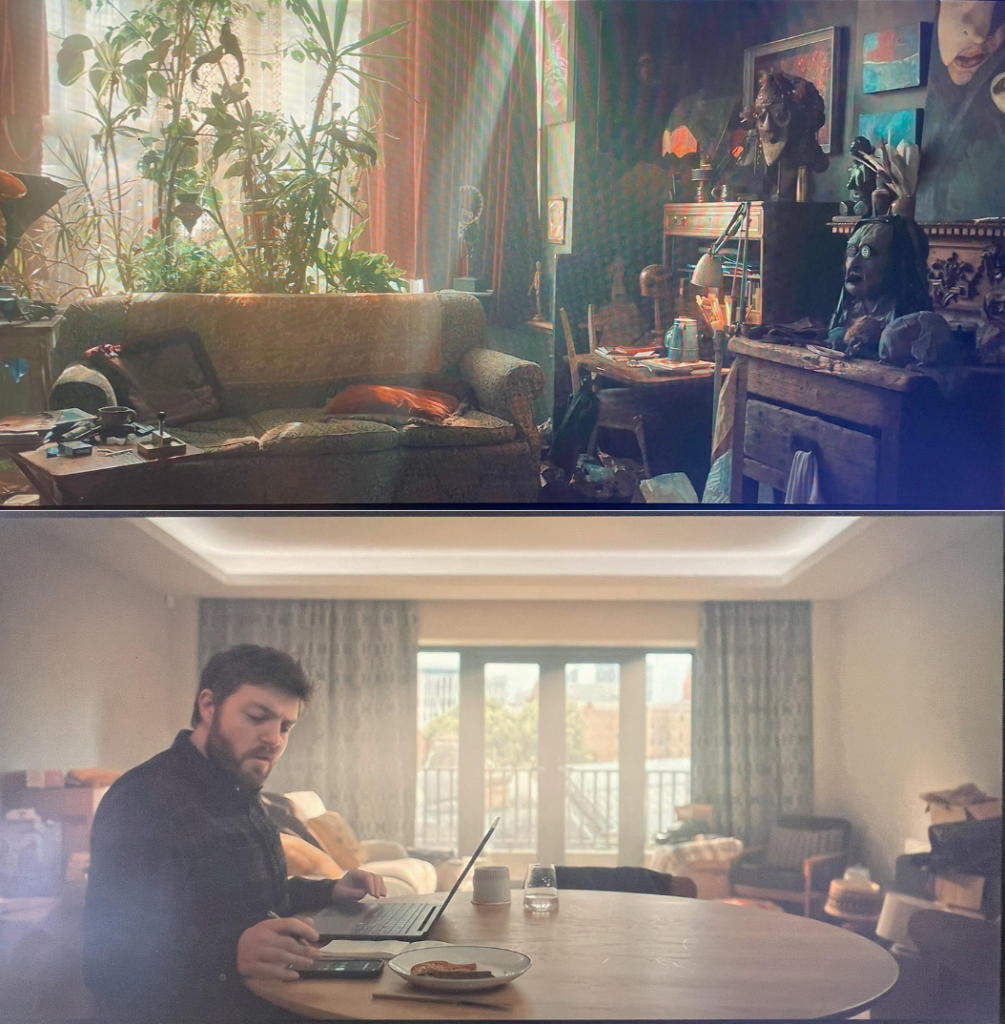
Gender discrimination isn’t the only motif in the novel visually recaptured on film. The theme of unhealthy people and relationships, a structural part of The Ink Black Heart, is reintroduced in this adaptation through ambient lighting. Photographed during the winter, the actors frequently appear pallid; the outdoor settings are cheerless and gray. Although The Ink Black Heart is a crime fiction story, this is not the high-contrast lighting that characterises film noir or the cheery, vibrant tones associated with a cozy mystery tale. This cinematography mimics the dim and anemic light associated with emotional depression and the sick room. The few sets lit to suggest comparatively health and warmth (such as Robin’s flat and the student studio and kitchen in the North Grove Art Collective) memorably reflect the characters’ relationships and interactions in those locales. By contrast, Nils’s studio is as murky as his outlook. The sky above Jago Ross’s home in Kent is as cold and distant as he is.
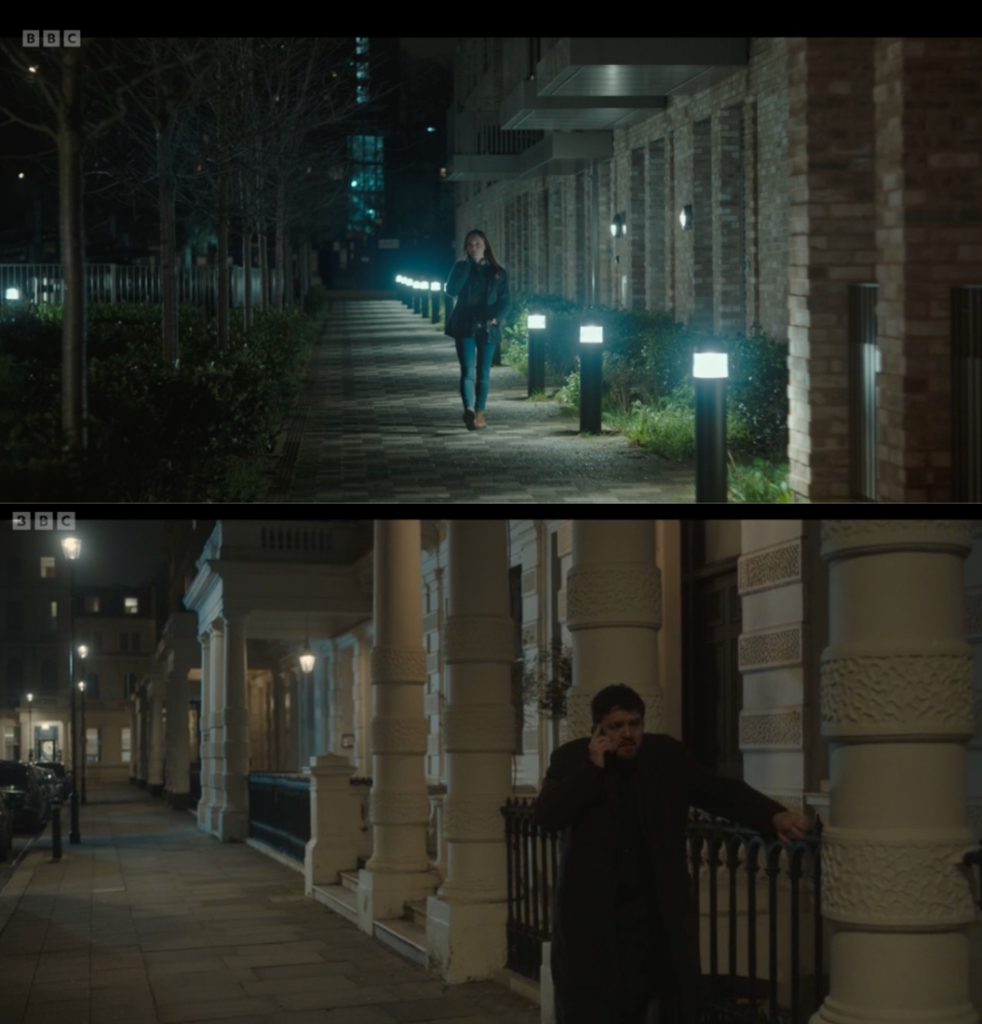
Setting can also visually underscore a point or theme in the narrative. The difference between Robin Ellacott and Charlotte Campbell is underlined dramatically in an exchange between Strike and Robin in Episode 4. The characters are in two separate locations: Strike in Kensington, minutes after leaving Jago and Charlotte Ross, and Robin is in Walthamstow, next to her apartment building. The street where Strike collapses is an endless row of beautiful, white, staid, identical houses, a metaphor for the aristocratic class the Rosses inhabit. The area is lit and clean, almost to the point of sterility, but nothing natural thrives there save a single manicured plant. There is no sign of honest life in this bell jar of a street except Strike, and he’s an unwelcome visitor. The visual subtext in this setting is clear: the only life allowed in Charlotte’s world must be uniform and curated.
Intercut with Strike’s struggle are Robin’s responses, filmed in an outdoor setting as different as Robin is from Charlotte. As Robin talks to her partner, she walks, surrounded by life. Green plants and shrubs flourish between her and her building. The city’s neon lights shine behind her. Even the shadows of leafless trees can be seen in the distance, dormant but living. Robin’s world is vibrant and dynamic. Life thrives wherever she walks.

Costumes and camera angles editorialise about the characters, especially in David Westhead’s portrayal of mercenary Grant Ledwell. Grant’s tailored but slightly too-tight suits (photographed to show strained seams) show that while his niece, Edie, endured poverty and bulimia, he is well fed, carrying extra pounds both in his bank and on his frame. This strengthens what is already inferred in the novel and the script. The true Greedie Fedwell of The Ink Black Heart is Edie’s uncle, Grant.
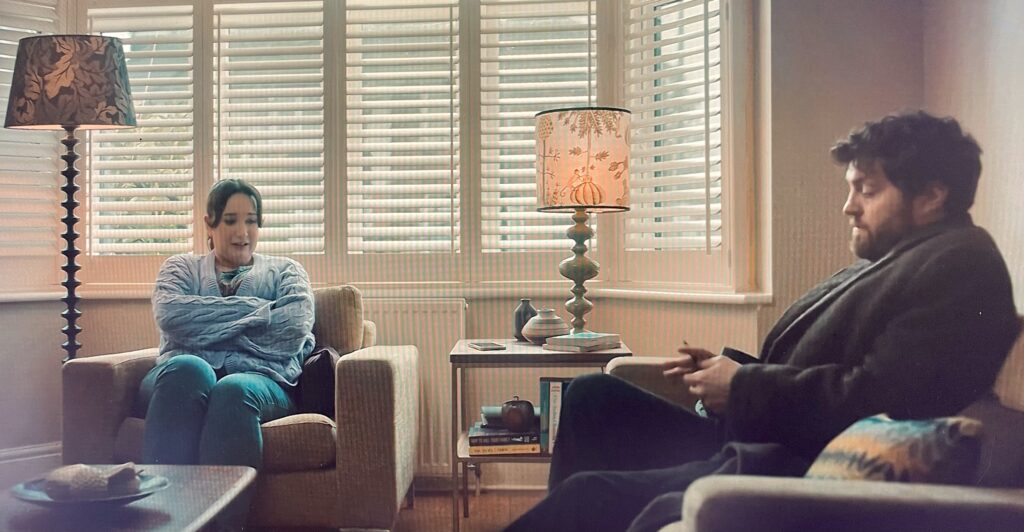
In this production, even the staging reflects what’s happening in the script. When Yasmin Weatherhead is initially questioned in Episode 3, she’s confident in a fashionable ensemble and free to leave when the interview becomes uncomfortable. When Strike questions her in the next episode, Yasmin’s no longer dressed to impress. Instead, she huddles in a chair pushed under an arc-shaped bay window. The horizontal blinds across the windows above her look like bars. The coffee table in front of her blocks any direct exit. Yasmin’s actions and Strike’s questions have trapped her in this corner, and she can’t escape what she’s done.
Sometimes, a film can create a visual reference by recreating a well-known camera shot. Anyone who spends too much time at the movies can recognise the awe-filled “Spielberg face”, or the sense of unease created by the “Hitchcock shot”. In The Ink Black Heart, director Sue Tully’s climactic confrontation recalls the terrifying “Here’s Johnny” sequence in Stanley Kubrick’s 1980 adaptation of The Shining. Either version makes Strike’s suggestion seem prescient: in a world filled with evil, we all need steel-reinforced doors.
Since these cues are separate from the actors’ performances, most viewers overlook them. Things like lighting, sets and costumes provide subtle hints, while audiences focus on dynamic elements like performances and plot. Nevertheless, elements like lighting, costuming and staging help the actors create their performances and ensure the story is told well, without words. At their best, these cues create links and references of their own that add new context to the original work. They’re the well-hidden keys that help solve the mysteries at the center of The Ink Black Heart.
What a well thought out and interesting post. I saw the link between the painting and Robin’s pose but it’s great to see how much more they are referenced to the PRB. Some really good depth to this post
A wonderfully insightful essay!! Thank you so much
Thanks for an insightful essay. There are many “ah, yes” moments and it has made me appreciate the TV production even more as it relates to the book.
Brilliant!! Much appreciated.