The Lead Casket: Sleep Tight, Evangeline?
Previously, I said that Robin must actively choose to be with Strike, and must “give and hazard” all she has. I know that I’m not alone in hoping that this choice happens at some point in the next book, Sleep Tight, Evangeline.
If the next book does give us the culminating kairos moment of the romance between Strike and Robin, I think that there will be traces of lead throughout the book, just as gold appeared in Lethal White and silver in The Hallmarked Man. Whether the lead casket book does turn out to be Sleep Tight, or if it is the unnamed tenth and final book, it will be the time where Robin struggles the most with deciding whether she should take the risk to be with Strike.
There are a lot of possibilities for what might cause Robin to struggle with this choice, refusal to believe that Strike genuinely loves her and wants a committed relationship being the most obvious one. She might also be afraid of what will happen with the agency if she does choose him and it doesn’t work, or she might be hesitant because of her poor mental health or the inevitable messy aftermath of her breakup with Ryan. What we do know about Sleep Tight, Evangeline is that Strike is now (say it with me!) in open pursuit, which means that Robin can’t avoid looking at her feelings and making a decision for much longer.
When we finally do get our hands on Sleep Tight, I’m going to be on high alert for any appearance of lead which could confirm it as the final, correct casket (book). What might this look like? One obvious option would be that the murder victim has been shot (with lead bullets); or perhaps someone could suffer from lead poisoning?
Lead is often used underwater as anchors or diving weights, because of its resistance to corrosion; we know that Portsmouth appears in the novel, and one of the charms in the bracelet header is an angel holding on to an anchor. Could there be a drowning where the victim has been tied to something heavy? Or maybe, since lead is also used as a shield from radiation, such as in medical imaging rooms, there could be some kind of significant medical setting?
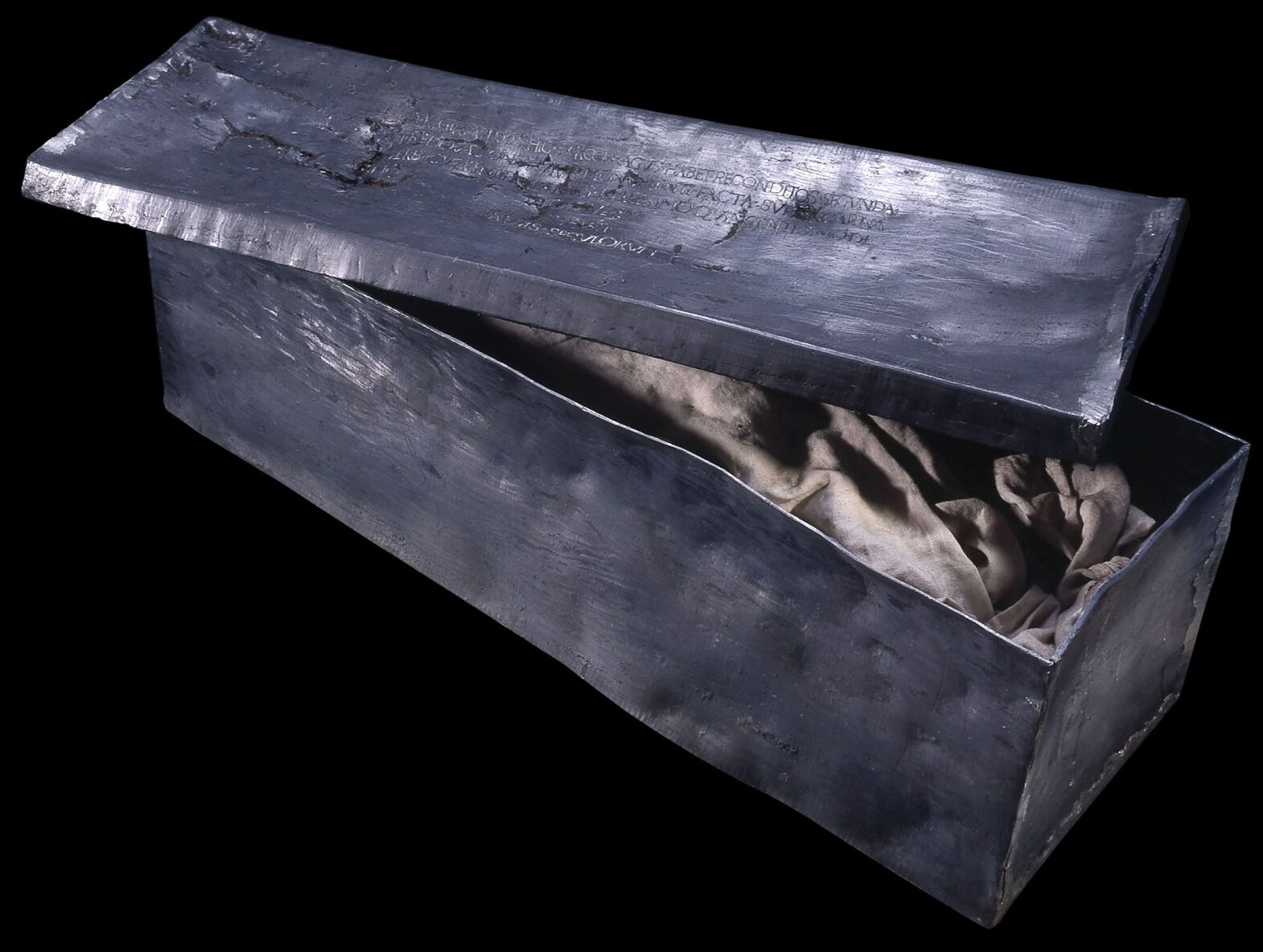
But I think the most intriguing possibility is the one I’m getting from this fun fact: in England, it is law that if a coffin is interred above ground, it must be sealed airtight, which means that coffins are frequently made with a lead lining between the inner container and the outer wood surface. (Incidentally, this is why the royals are all traditionally buried in lead-lined coffins: the effect is to preserve the body for longer.)
Recall that a coffin was one of the three emojis that Jo shared to describe Sleep Tight, Evangeline. Might a body that’s been interred in a lead coffin have to be exhumed? Is it possible that someone could be buried alive in a lead-lined casket to “sleep tight”? (All of my manifesting has lead to this, pun intended!)
Whatever its form, if lead appears somewhere in the plot or settings of the next book, I think we can all be reassured that by the final chapter, Robin will have made her choice – and it will be the right one.
The Shylock Connection
I’ve written quite a bit now about the connections between Portia and Robin, but there is a great deal more to The Merchant of Venice that I haven’t explored – in fact, the plot of Portia’s suitors and caskets is a minor aspect of the play compared to the character of Shylock and his pound of flesh.
When I was first planning this blog, I thought that perhaps we would see elements of Shylock’s story in the murder plots of Sleep Tight, Evangeline or in the tenth book, as a plot component of the final lead casket. However, I have started to realize that the Shylock element may be more integral to the Strike series than I had realized – that, in fact, the seeds were planted as early as Cuckoo’s Calling and might be pointing us towards the identity of Leda Strike’s true killer.

In The Merchant of Venice, Shylock’s insistence on his pound of flesh is motivated by hatred and a desire for revenge, both for the way he has been treated as a Jew by Bassanio and Christians and for the loss of his daughter, Jessica, who has run away (taking with her money she has stolen from Shylock) to convert and marry a Christian.
In Cuckoo’s Calling, we meet Gillespie as the voice on the end of a phone line. He is Jonny Rokeby’s accountant, and spends his days aggressively pursuing Strike for repayment of a “loan” – of course, we later find out that this was Strike’s money all along, that Rokeby had no idea Gillespie was harassing him on Rokeby’s behalf, and that Gillespie was apparently doing this out of a personal dislike for Strike. Could Gillespie be the echo of Shylock, hiding in the background of the text all along?
We’ve speculated previously that Gillespie may have been the true murderer of Leda, or that he conspired to have her murdered, and that a possible motive could have been to cover up his embezzlement from Strike’s child support account. The possibility of a connection to The Merchant of Venice makes me even more convinced that we might be right; but I now think that we will discover a more personal motive on his part, either in addition to the embezzlement or instead of it – a hatred for Leda, or desire for some kind of revenge, that might have made him willing to do a deal with the devil and pay Whittaker for her murder.
–
On their visit to Sark in The Hallmarked Man, Strike drops what could be another signpost when he says to Robin, “this isn’t a Shakespearean comedy, where a man styles his hair differently and instantly becomes indistinguishable from his own sister”. This isn’t quite a reference to The Merchant of Venice (it’s more like Twelfth Night, where a woman disguised as a man is indistinguishable from her twin brother). However, there is an element of a similar disguise in Merchant, as at the end of the play Shylock is defeated in court with clever legal arguments by Portia herself, disguised as a man and a lawyer. (Bassanio does, in fact, fail to recognize his own wife in this disguise).
Could this be a hint that Robin will be the one who finally exposes Gillespie’s crime? Or, bringing us back full circle (so elegant), will Robin go undercover as Venetia Hall one last time to get justice for her Bassanio?
There is a great deal more to say about The Merchant of Venice, but for now I will wait patiently for what is coming for us next in Sleep Tight, Evangeline, and leave the door open (like Robin on her relationship with Murphy!) to come back to the play if further parallels appear.
Pools you are dedicated to the cause and we love it!
I really enjoyed your analyses in these three posts. I love reading these thoughts…my brain just doesn’t seem to work this way. The only thing I would come up with is, Is Robin going to go undercover as a man in STE? I love the alchemy and am looking forward to reading STE with this in mind!
What a great analysis! I’m very sure we’ll hear more from you about this, as I’ve just come across an essay by Sigmund Freud called “The Theme of the Three Caskets”, that makes the connection between the Merchant of Venice, King Lear, Aphrodite, Cinderella, Eros and Psyche, and the Three Fates. In these stories, the choice is that of a man between three women, or if you dig deeper, between birth, life and death. Can’t wait to find out how this will all play out in Sleep, Tight Evangeline!
Pools, I am delighted to finally see this essay and I think it is amazong! I really hope you are right about the lead-lined coffin!