In the previous part of this blog series, I looked at the parallels between Robin’s three romantic interests and the three suitors who sought Portia’s hand in The Merchant of Venice. Each of these suitors chose a casket made of metal – either gold, silver, or lead – and failed or succeeded based on that choice. I’ve talked about the way that both gold and silver showed up in significant moments associated with different stages of Strike and Robin’s romantic development; but when I looked at the broader pattern of the books, I realized that these metals also make significant appearances in the books where Robin is struggling the most with whether or not she should stay in each relationship.
 The Gold Casket: Lethal White
There is actually quite a bit of gold to be found in Lethal White, the book in which Robin miserably tries to make her marriage with Matthew work before finally leaving him for good. The Olympics are a significant part of the background of the novel, with athletes competing for gold medals, and the gold money clip belonging to Chiswell’s late son Freddie is what reveals the murderous affair between Raphael and Kinvara. There is also a sort of metaphorical gold casket to be found in the ultimate motive behind Chiswell’s murder: the treasure hanging unnoticed on a wall, a painting worth a fortune – and, more importantly, the glamorous, enviable lifestyle that such wealth could provide.
Other passing mentions of gold feel significant as well: there is the gold bangle that Robin uses to gain access to Geraint’s office, and the “little gold ring on [Robin’s] finger” – an odd detail, since her engagement band was platinum in Cuckoo’s Calling!
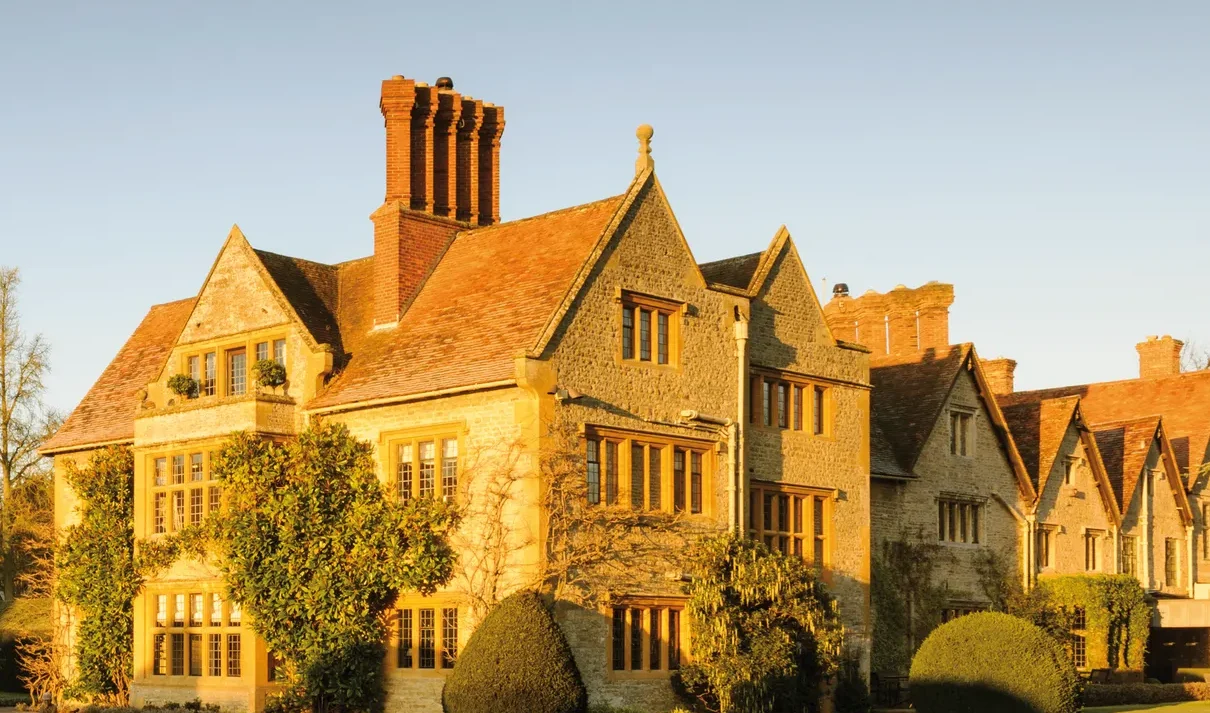
There are also gold buildings and spaces throughout the book: the exterior and interior spaces of Parliament, where Robin does the undercover work that she loves and Matthew hates; the hotel where Robin and Matthew “celebrate” their anniversary which is made of golden brick; and finally, the street down which Robin walks toward Raphael’s trap, which “glowed gold in the evening sun” as she thinks of her first ever date with Matthew Cunliffe.
The Silver Casket: The Hallmarked Man
Throughout The Hallmarked Man, Robin is struggling in her relationship with Murphy, trying to convince herself she wants to be with him. She considers leaving him in the aftermath of his relapse, ultimately deciding to stay because she feels it would be “wanton cruelty” to leave, and because she fears what he might do to himself if she did. It is clear, though, that she is staying reluctantly, and out of obligation:
Walking out on him at this point would be wanton cruelty. She’d decide later, when he was back on an even emotional keel, whether… but this was a thought she kept refusing to finish.
Robin might not want to finish the thought, but we know what it would have been: the exit door on this relationship has been left firmly propped open, and the getaway car is idling outside.
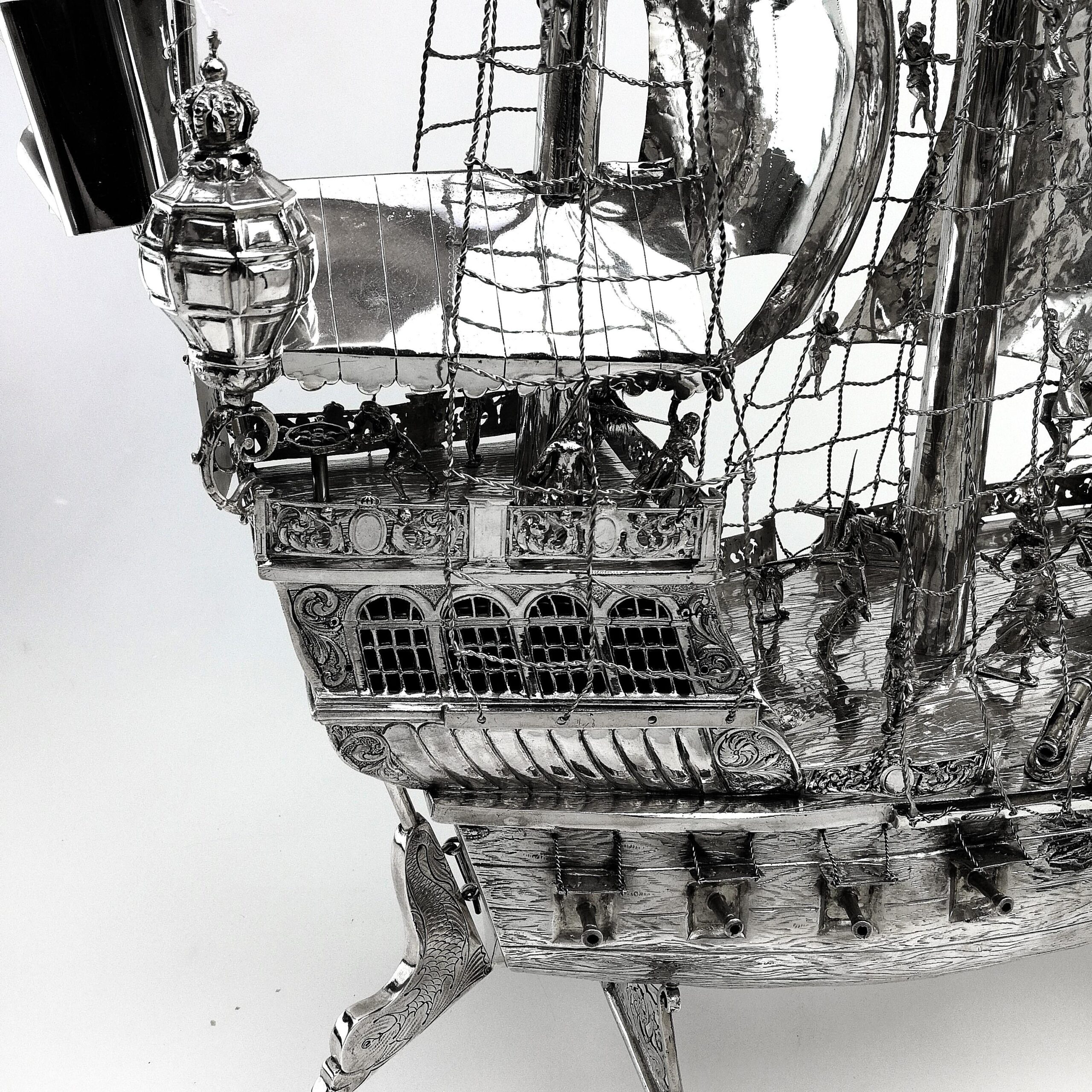
Suitably, and as we’ve discussed before, The Hallmarked Man is absolutely stuffed full of silver. There is of course the masonic silver that was believed to be stolen by the murderers, but which was actually hidden behind a false wall (much like Robin’s true self, hidden behind the mirror she holds up to Murphy). There is also the silver nef that was stolen by Rupert, who was perhaps deserving of it:
It belonged to the Legards. I’m still a Legard, nobody can take that away from me. Dino had no right to it. That’s all I’ll ever take from him, ever, but he owed me something. He fucking owed me.
Robin’s disastrous Christmas Eve at the Bay Horse is set on Silver Street; significantly, this is where Murphy’s sudden rage shocks both Robin and Stephen, and where everything goes “badly wrong”. Her walk home along Silver Street is spent looking at Murphy’s back and thinking about Strike – a clear indication that she is with the wrong man.
While Robin hasn’t yet left Murphy at the end of The Hallmarked Man, it is clear that their relationship will not last much longer – perhaps not even past the opening of Sleep Tight, given the bomb of a proposal that Strike dropped in the stairwell in that final chapter. It is my hunch that the Robin and Murphy break up is imminent (‘first chapter’ imminent? Fingers crossed!), which means that the bulk of Robin’s struggle with whether or not to leave Murphy will be left behind in the silver book. (Much as her relationship with Matthew was left behind in Lethal White, even though he continued to cause her misery in the divorce throughout Troubled Blood).
Mapping the Metals
I was curious as to whether I was reading too much into coincidental metallic adjectives, or if there is indeed a consistent pattern to the appearance of gold and silver in the novels. So, like a professional podcaster does, I went through each Strike & Ellacott book to count up every mention of gold, silver, and lead.
I ultimately did two separate counts: one of the total times that each metal appears as a descriptor in each book, and the other the unique appearances of each metal. That is, in this second count, I considered every description of the same thing as one appearance, even if that thing was actually mentioned multiple times. Robin’s hair, for instance, is described with “gold” 8 times in Silkworm; I counted “Robin’s hair” as one unique instance of gold.
In The Hallmarked Man, I grouped together all mentions of Ramsay Silver and the stolen silver as one instance; the silver vaults and every time silver was mentioned in them as one; every mention of the stolen silver nef as one; and so on. It was necessary to group the broader categories together here, because there is so much silver that including each solitary appearance of the word would make the results too far skewed to be readable.
After I was finished tabulating the metal mentions, I calculated the total counts as a ratio by dividing the number of mentions by the number of pages in each book, then made a graph from the results:
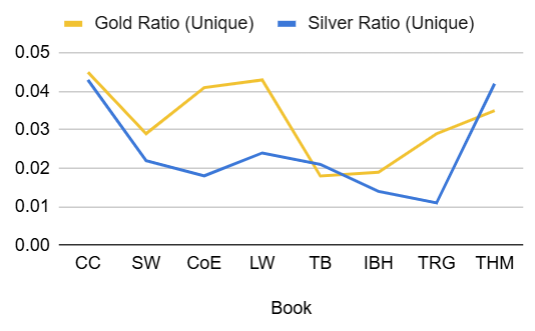
Above are the results for unique instances of gold and silver in each book. I was pleased to see that there are some clear patterns here! The number of unique items of gold does seem to peak around Career of Evil and Lethal White, and silver likewise is highest in The Hallmarked Man. Oddly enough, both metals were also mentioned very frequently in Cuckoo’s Calling; there is also quite a bit of gold in The Running Grave (all of it sinister, as it is associated strongly with the UHC and the Golden Prophet), and in The Hallmarked Man (the Golden Fleece, the goldfish, and Robin’s trip to Harrods account for a significant amount of that).
I decided to seek further clarity by making a more selective version of my count, looking only for mentions of the metals that were associated specifically with Robin’s relationships with Matthew and Ryan, her internal struggles about her romantic life (and her love for Strike), or with the men themselves. The results of this selective count:
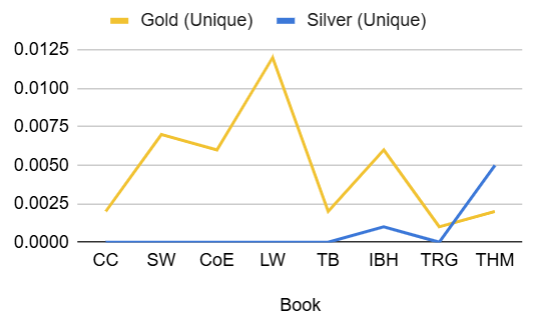
Here, we see that gold peaks in Lethal White, and then spikes again in Ink Black Heart – this spike is almost entirely made up of Strike and Robin’s “golden” night at the Ritz in the beginning of the book. Silver, meanwhile, shows up briefly in Ink Black Heart, the book where Ryan is introduced, and then takes a sharp upwards jump in The Hallmarked Man, as one would expect for the book where Robin struggles with whether she should stay with Ryan. So far so good for my theory!
The Third Metal
It turns out that there aren’t enough mentions of “lead” (in the metallic sense) throughout the series to make a graph worthwhile. The only appearance of the metal in Silkworm, Troubled Blood, and The Running Grave is the occasional set of leaded windows. Leaded windows also appear in Lethal White, and an “old black lead range” pops up in Ink Black Heart. In Cuckoo’s Calling, Strike feels a “leaden fatigue”, and in Ink Black Heart a “leaden weight of obligation”. Meanwhile, there is a “lead weight” inside of Robin in Career of Evil, while in Lethal White “her insides turned to liquid lead” and “a lead weight slid from [her] chest to stomach”.
All told, in the first seven books, lead appears as a significant emotional metaphor only four times (I’m not counting the windows or range here, as those seem like more incidental environmental descriptors to me).
However, once we get to The Hallmarked Man, there is actually a significant upswing in the amount of lead that appears:
● Robin looks out of the hospital window at the “leaden sky” in the beginning of the book; “leaden sky” then appears again in the epigraph of the chapter where she leaves the hospital.
● All that Robin remembers of the pretty house in Deptford where she lived with Matthew was “a leaden feeling of constriction and misery.”
● Strike reads a passage from A. H. Murdoch’s Secrets of the Craft (a book Rowling has invented) that says a Freemason must “never mistake base lead for a nobler metal, else he may find himself forever entombed in the dungeons of lust and licentiousness”.
● Finally, “The knowledge that Robin and Murphy were definitely moving in together was still lying like lead in Strike’s stomach when he entered the Savoy Hotel.”
For those counting, that is: two instances of lead appearing as a metaphor in emotional description, one instance as a symbolically significant environmental descriptor, and the first appearance of lead in an alchemical context. This means that The Hallmarked Man contains as many significant mentions of lead as the first seven books put together. Is this a coincidence or an accident? Does lead appear more frequently in this book simply because Robin and Strike are more miserable than ever before, and it’s a useful metaphor? Or could this be foreshadowing of significance in Sleep Tight, Evangeline?