In celebration of JK Rowling and Harry Potter’s birthdays today, Dr. Beatrice Groves explores the influence of John Oxenham’s A Maid of the Silver Sea on Rowling’s works as well as how its themes could connect to The Hallmarked Man.
Please be aware that this post contains spoilers for A Maid of the Silver Sea– only read if you’ve read A Maid of the Silver Sea or don’t mind knowing how it ends!
Rowling recently revealed that the part epigraph for Part Seven of The Hallmarked Man will be a quotation from John Oxenham’s A Maid of the Silver Sea (1910):
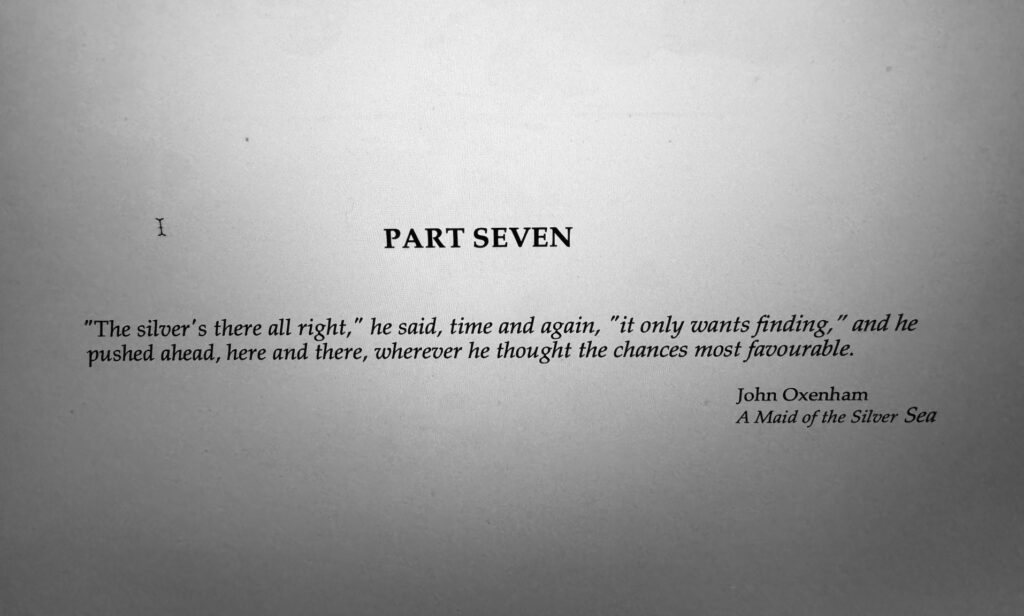
Alongside this she also revealed that Oxenham’s novel is one of five different epigraph texts in Strike 8.

This blog will explore the context of this quotation in a little more detail and, in particular, look at how long A Maid of the Silver Sea may have been influencing Rowling’s writing. But first, I am delighted that Rowling has tied her reveal with some more guesswork for us – and am wondering what the linking thread of those five epigraph texts will be. My first suggestion is that Rowling has chosen five texts with silver in the title: such as Neil Gunn’s Silver Darlings, C.S. Lewis’s Silver Chair, Laura Ingalls Wilder’s By the Shores of Silver Lake, Rosemary Sutcliffe’s Silver Branch or Thomas B. Costain’s Silver Chalice. C.S. Lewis is a writer Rowling definitely, and Sutcliffe a writer she probably, loved as a child, while Gunn’s work is a Scottish classic – so if she does choose silver as a title-theme then I think those are particularly likely options. Another possibility is that the theme will be novels set on Sark (an idea I’ll be following up in future posts). Thirdly, which I think least likely, is that they will all be by John Oxenham. (Dr Louise Freeman is combining these latter two ideas with Oxenham books set on Sark! Check out her thoughts here at The Farting Sofa Faculty Lounge.
If we are seeing more books by John Oxenham then the one that particularly caught my attention is his A Mystery of the Underground (1897, serialised in Today magazine) – which (as has been discussed on The Strike and Ellacott Files podcast) is a murder mystery set on the Underground. This caught my attention as I have been waiting since 2019 for a disused Underground station to make an appearance in Strike – ever since Nick brilliantly spotted J.E. Connor’s London’s Disused Underground Stations (2001) lurking on Rowling’s homepage (I wrote this book up here). If A Mystery of the Underground does turn up in The Hallmarked Man then I think this will finally be the time for that disused underground station to make an appearance!

A Maid of the Silver Sea
‘“The silver’s there all right,” he said, time and again, “it only wants finding,” and he pushed ahead, here and there, wherever he thought the chances most favourable.’’
This seemingly hopeful epigraph comes from Chapter 9 ‘How old Tom found the Silver Heart’ – but its meaning changes upon reading Oxenham novel. The context of the quotation is that Old Tom’s belief in Sark’s silver mines is nothing more than a gambler’s false faith in the big win that will turn his fortunes around. Old Tom (the heroine’s father) sinks the family wealth into mines that never repay him.
Oxenham has presumably chosen this narrative because, historically likewise, the promise of Sark’s silver mines never materialised and those who invested lost more than they gained. There is more information about mining on Sark here and one little detail that caught my eye, is that one person who – trying to woo more investment – placed a silver tea and coffee set made of Sark silver in their office window. I don’t know if these items made of Sark silver still exist, but – like the distinctive Channel Islands’ silver ‘marriage cups,’ – I’d love some to make an appearance in The Hallmarked Man!
In A Maid of the Silver Sea, even when Old Tom’s dreams of silver appear to have come true, it is nothing more than a deadly illusion. He finds the ‘silver heart’ of the island by following a vein of silver that runs under the sea which he believes will ‘lead him to the mother vein, and that to the heart of all the Sark silver.’ The narrative withholds the certainty of this discovery from the reader as well as Old Tom – does he find it or is it only a rock crystal mirage?

Holding his light at arm’s length, above his head, a million little eyes twinkled back at him as the rays shot to and fro on the pointed facets of the rock crystals which hung from the roof and started out of the walls and ground.
The gleaming fingers seemed all pointed straight at him. Was it in mockery or in acknowledgment of his prowess?
For, in among the pointing fingers, it seemed to him that the silver-bearing veins ran thick as the setting of an ancient jewel, twisted and curling and winding in and out so that his eyes were dazzled with the wonder of it all… Here, of a surety, he said to himself, was the silver heart from which the scattered veins had been projected. He had found what he had sought with such labours and persistency. What else mattered?
And then, without a moment’s warning—the end.
Oxenham does something quite unusual in this anti-climactic conclusion. The finding of the ‘silver heart’ of the island’s wealth is subsumed beneath the more important fact of Old Tom’s immediately following death. But also no-one else even knows that he had thought he had found the silver heart. Old Tom never gets to relay the information as he dies upon its discovery, and as he dies that part of the mine is sealed off under the sea, so no other miner will ever enter this cave. But even the reader is withheld from this knowledge – does Old Tom see what he thinks he sees? The finding of the silver in the novel, like the true discovery of silver on Sark, is an anti-climax and Oxenham has again drawn on the history of silver mining on Sark for this seawater flooding disaster:
Good quality ore could fetch up to £600 per ton but all the shafts were drying up and the company was getting further into debt. The final nail in the coffin was the flooding by sea water of Sark’s Hope? This had been the most productive shaft and no further capital remained to purchase pumps to empty the flooded galleries. https://guernseydonkey.com/the-silver-mines-of-sark-a-short-history/
The true silver
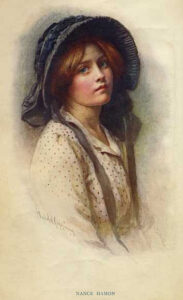
Sark’s silver proves elusive, but in the novel it is replaced by a woman – Nance – who is worth her weight in gold: ‘he would give all the silver in the mines of Sark to win her appreciation and regard’ (Chap 7); ‘Gard, as he watched her, felt like a discoverer of hidden treasure, overwhelmed and intoxicated with the wonder of unexpected riches. He had come to this wild little land of Sark after silver, and he said to himself that he had found a pearl beyond price’ (Chap 11). Nance is the true treasure of Sark – the prize of Gard’s life: ‘and, if he had incurred unreasonable dislike, he had also lighted on the virgin lode of Nance’s love and trust, and that, he said to himself with a glow of gratitude, outweighed all else’ (Chap 20). The phrase ‘virgin lode’ connects Nance (the ‘maid’ of the title) with silver mining via a metaphor of metal as ‘virgin.’ This is a word used for metal ‘of great purity, esp. occurring naturally in an uncombined state’ (The Oxford English Dictionary). But ‘virgin lode’ is not a general mining term – rather it is a specific reference to Gard’s Cornish roots. It recalls the Cornish mines of West Wheal Virgin and Wheal Virgin, and the seam (or ‘virgin lode’) which was the most important and lucrative find of those mines: ‘the most important lode was Virgin Lode which was stopped or over 1.3 miles (2.1 km).’ Gard unconsciously connects Nance with his Cornish roots, just as Strike’s first thoughts on falling for Robin connect her with Trevaylor Woods and his Cornish childhood.
The Maid of the Golden Hair
The metaphor at the centre of A Maid of the Silver Sea is that that Nance is the true silver of Sark. Nobody did this ‘the-true-precious-metal-is-really-the-girl’ trope better than George Eliot in Silas Marner. Rowling is a big Eliot fan – naming her among her favourite authors.1 Rowling’s love of Eliot has also had a profound influence on her novels, for she attempted a modern rewriting of Middlemarch in The Casual Vacancy. And another of Eliot’s works – that follows the same path as A Maid of the Silver Sea in its alchemical imagery of the woman as the true gold/silver – has also, perhaps, influenced Harry Potter.
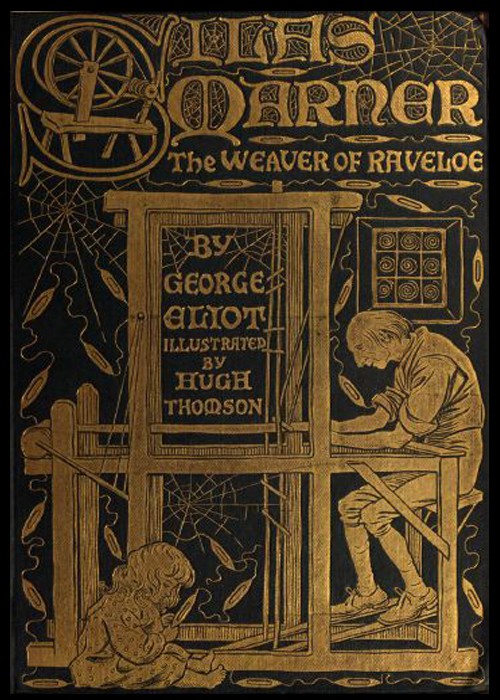 In Silas Marner the gold hair of the glorious baby Eppie is the true gold which softens and revives Silas’s miser’s heart. At first, he mistakes her for the gold – taking ‘her golden curls for his lost guineas brought back to him’ – and then grows to realise that she is worth so much more than this:
Unlike the gold which needed nothing, and must be worshipped in close-locked solitude—which was hidden away from the daylight, was deaf to the song of birds, and started to no human tones—Eppie was a creature of endless claims and ever-growing desires, seeking and loving sunshine, and living sounds, and living movements; making trial of everything, with trust in new joy, and stirring the human kindness in all eyes that looked on her. The gold had kept his thoughts in an ever-repeated circle, leading to nothing beyond itself; but Eppie was an object compacted of changes and hopes that forced his thoughts onward, and carried them far away from their old eager pacing towards the same blank limit—carried them away to the new things that would come with the coming years, when Eppie would have learned to understand how her father Silas cared for her; and made him look for images of that time in the ties and charities that bound together the families of his neighbours. The gold had asked that he should sit weaving longer and longer, deafened and blinded more and more to all things except the monotony of his loom and the repetition of his web; but Eppie called him away from his weaving, and made him think all its pauses a holiday, reawakening his senses with her fresh life, even to the old winter-flies that came crawling forth in the early spring sunshine, and warming him into joy because she had joy.
Eppie is short for Hephzibah, and I don’t think that it is a coincidence that Harry Potter’s Hepzibah is so intimately connected with gold. She owns the golden cup and golden locket that Riddle – the ultimate miser, who treats people like objects and values objects as living things – murders her to gain.
In Silas Marner, Eliot makes the parallels between the girl and the gold unmissable, but the golden guineas (that has seemingly been literally replaced by Eppie, and metaphorically are ousted by her) do return at the end of the novel. This is a satisfying circle and the finding of the gold creates a satisfying conclusion (and plot twist) – while in A Maid of the Silver Sea the literal silver merely peters out like a false seam to be replaced by Nance and the silver sea itself:
“A silver sea! A silver sea!” he cried aloud, and into his mind there flashed an incongruous comparison of the bountifulness of Nature’s silver with the pitiful grains they hacked out of her rocks with such toil and hardship. (Chap 21)
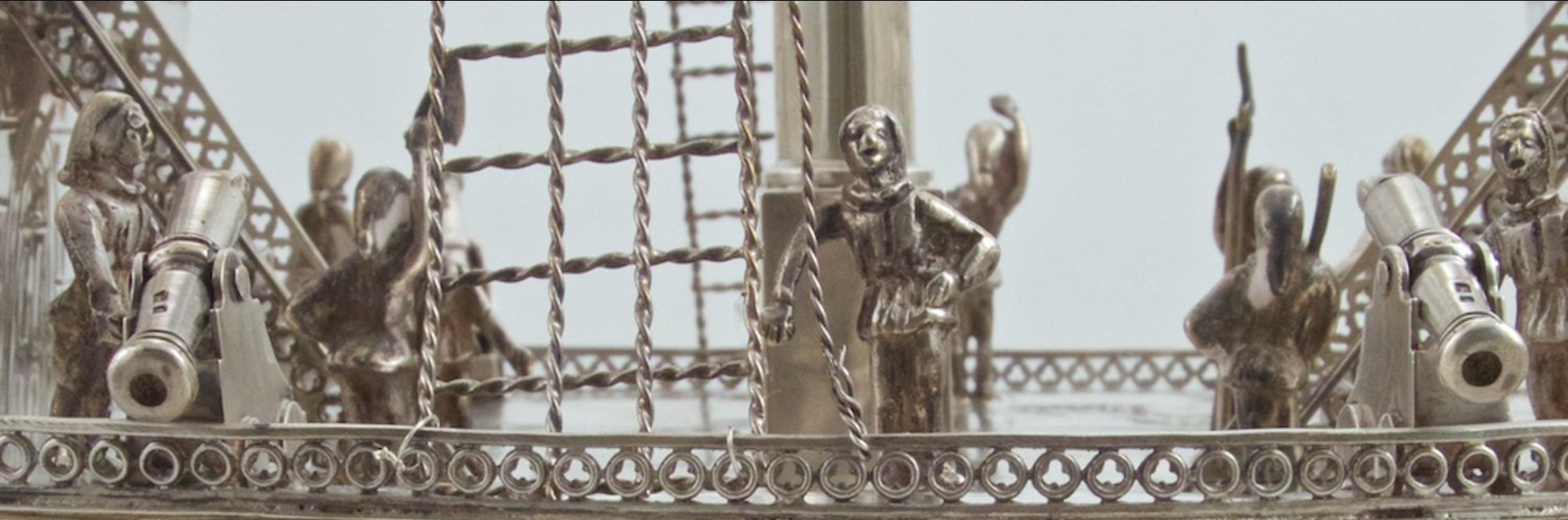
My guess is that The Hallmarked Man will be more Silas Marner than Oxenham and while there will be literal precious metals, and metaphorical connections of these metals with men (the hallmarked man of the title tying to both victim and Strike’s parentage via the ‘hallmarking’ of their DNA), nonetheless the literal silverware of the plot – perhaps the silver nef of Rowling’s header – will (like the lost gold of Silas Marner, and unlike Oxenham’s silver mining) return in a satisfying plot twist at the end of the novel.
A Maid of the Silver Sea: Old favourite or new flame?
Something that always interests me when Rowling reveals a new literary source is how long it has been influencing her. Rowling spoke in her recent ‘On Writing’ interview of how the eclectic nature of her epigraphs reflects the eclecticism of her reading, suggesting that the epigraphs reflect her reading (rather than vice versa) (for my write-up of this interview see: The Rowling Library, Issue 90 ). With each epigraph text, however, we do not know whether it is an old friend that has been influencing her for some time, or a new flame that she’s only just read, unless we have other evidence. With The Faerie Queene epigraphs of Troubled Blood, for example, we now know she had not read the complete poem beforehand. This is unsurprising as very few people who don’t have an English degree have done that and – I speak as a tutor who sets it as required reading each year – not that many of those who do. But we nonetheless have the evidence not only of The Faerie Queene’s influence on Harry Potter but also the quotation engraved into her bookshelf, to show that this was an old friend, not just a poem that she picked up to mine for Strike 5. With the I Ching, conversely, Rowling has spoken in interview of never having read it before looking in it for epigraphs for The Running Grave.
As for A Maid of the Silver Sea – we know that some of The Hallmarked Man will be set on Sark and that silver is going to play a major role in the story. So, although we don’t yet have any evidence for whether Rowling was writing a book about Sark, so read Oxenham’s work, or that she had long loved this book, and that inspired her to set a part of The Hallmarked Man on Sark, surely the probability must be the latter as otherwise she has had a very lucky hit coincidentally finding a book that is, like The Hallmarked Man, about both Sark and silver. (The warmth with which she has spoken about it on Twitter , likewise, suggests that it is an old favourite.)

The only unequivocal evidence that we have so far, however, as to whether this is a new read or has long been influencing her, lies in the book itself – and here there are a number of pointers. None of them are proof in themselves but taken together they suggest that Maid is an old favourite that influenced choosing the Sark setting, rather than vice versa. Firstly, there is a tiny Strike moment when ‘Mrs. Tom very soon let it be known that she considered herself woefully misled, and quite thrown away upon such a place as Sark, and still more so upon this ultima thule of Little Sark…’ (Chap 13). This is concept from classical literature and cartography is a kind of ‘Here be Dragons’ of the north. ‘Thule’ was the most northerly discovered island and ultima Thule (‘farthest Thule’) a metaphor for the purity and danger of the unknown, a frozen waste beyond the ‘borders of the known world.’ Robert Galbraith fans are, of course, well acquainted with ultima Thule from The Ink Black Heart, in which a major role is played by the Brotherhood of Ultima Thule, drawing on the Swedish rock band ‘Ultima Thule’). Rowling may have known about the band first or picked up the idea of ‘Ultima Thule’ in her classical reading at university but if she did read A Maid of the Silver Sea in childhood, it may have been the first place she encountered the uncommon and evocative phrase, and maybe the name stuck in her mind.
Another, rather more thoroughgoing connection, lies in the similarity of the heroes. Strike and Gard have a number of connections beyond their evocative monosyllabic names in their appearance, chivalry and lack of self-pity, but the clearest parallel is that Rowling has chosen for her hero someone who, like Gard ‘was a Cornishman’.
The clearest connection between Strike and Oxenham’s novel, however, lies in the white horse.
White horses
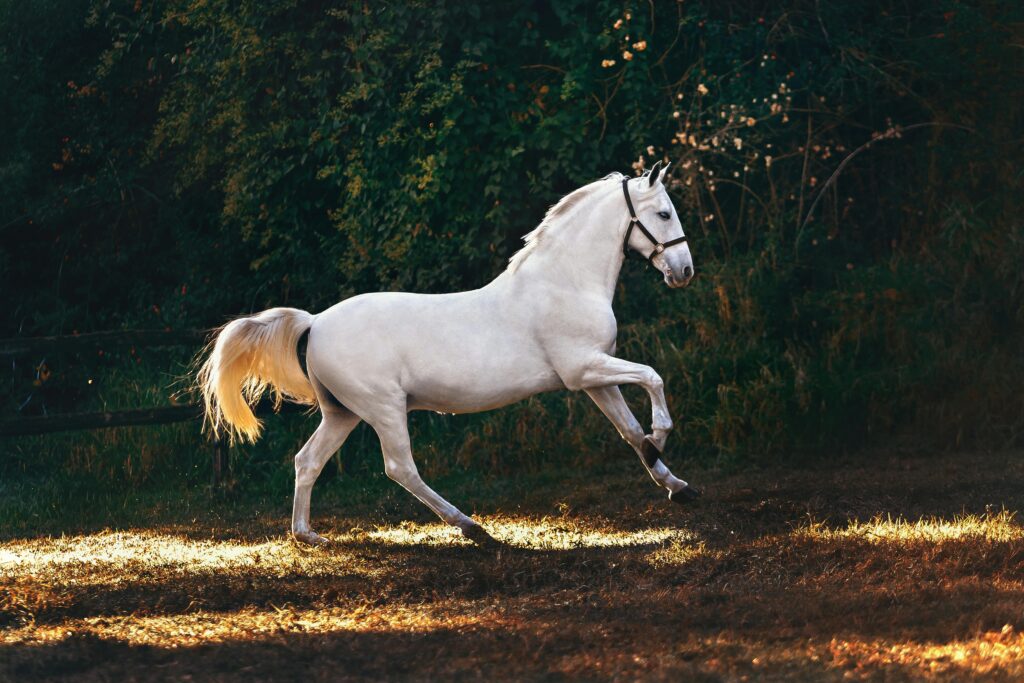
The white horse in A Maid of the Silver Sea is Rowling-esque in that it forms a circle. It feels slightly as if it has appeared from nowhere as the solution of the mystery, but it was alluded to in the opening of the novel when ‘Gard wondered how they would have fared if they had happened to be on the Coupée when the white horse went thundering across’ (Chap 4). Gard also has a dream of this white horse, which – just like Harry’s dream in Prisoner of Azkaban – is a semi-prophetic dream of a white animal:
He dreamed that night that he was cautiously treading an endless white path that swung up and down in the darkness like a piece of ribbon in a breeze. And a great white horse came plunging at him out of the darkness, and just as he gave himself up for lost, a sweet firm face in a black sun-bonnet appeared suddenly in front of him, and the white horse squealed and leaped over them and disappeared, while the stones he had displaced went rattling down into the depths below. (Chap 4)
It is noticeable that Gard’s dream of a white horse here comes true in an unexpected way, just as Harry’s dream of something that seems to be a white horse early in Prisoner of Azkaban will likewise be realised in unanticipated ways (both at the end of the novel and the end of the series itself):
He had a very strange dream. He was walking through a forest, his Firebolt over his shoulder, following something silvery-white. It was winding its way through the trees ahead, and he could only catch glimpses of it between the leaves. Anxious to catch up with it, he sped up, but as he moved faster, so did his quarry. Harry broke into a run, and ahead he heard hooves gathering speed. Now he was running flat out, and ahead he could hear galloping. Then he turned a corner into a clearing and –
(Azkaban, Chap 13)
Harry’s silver-white animal has powerful links with Celtic stories and Arthurian quests, in which white animals are messengers from the Otherworld. This uncanny whiteness of Otherworld animals has survived in two of their most famous modern iterations: the White Whale hunted in Moby Dick and the White Rabbit, whom Alice follows only to fall down the rabbit hole and find Wonderland. It links, likewise, with the white horses of Lethal White. In the Mabingogion, for example, Rhiannon, a Welsh horse goddess, arrives riding on a white horse (something that is remembered in Lethal White which is haunted by the suicide of a character called Rhiannon).
The white horses of Lethal White come, primarily, from its epigraph text: Ibsen’s Rosmersholm, but it is interesting to find them likewise in A Maid of the Silver Sea:
Old Mrs. Carré at Plaisance vowed she had heard the White Horses go past, on the nights before Tom Hamon and Peter were found. And every one knew that when the ghostly horses were heard, some one was going to die.
(A Maid of the Silver Sea, Chap 37)
Mrs. Carré in A Maid of the Silver Sea, like Mrs Helseth in Rosmersholm, believes that White Horses are a harbinger of a death. In both Oxenham and Ibsen it is an older woman – Old Mrs Carré and Mrs Helseth – who transmits the folkloristic symbolism of white horse lore – Mrs Helseth explaining that white horses are seen because ‘They cling to their dead a long time at Rosmersholm’ (a quote Rowling uses as the epigraph for chapter 27 of Lethal White).
While Ibsen is obviously the central source of the white horse imagery in Lethal White, it is interesting to note that they actually function in that novel more like the white horse in A Maid of the Silver Sea. In Oxenham the white horse is mentioned as a death omen, but in reality (as Hermione explains re: the Grim in Azkaban) it is not an omen but the cause of death. In Lethal White, likewise, the white horses feel ominous – but there is nothing supernatural about them. These white horses are not omens but, like the white horse in A Maid of the Silver Sea, the actual cause of death. Chiswell is killed for the sake of a highly valuable white horse and the Uffington White Horse is both witness the near-murder of Raphael (his villain origin story) and carved onto an instrument of execution. The white horse in Lethal White is – like the Grim in Azkaban and the white horse in A Maid of the Silver Sea – ‘not an omen, it’s the cause of death!’
A Maid of the Silver Sea and Harry Potter
The evidence for A Maid of the Silver Sea being an old favourite of Rowling’s – and hence the cause (not the result) of The Hallmarked Man’s Sark setting – is strengthened by some, admittedly slight, links with Harry Potter.
There is, for example, the tiny moment when Gard, in his uprightness, reminded me of Harry. Tom punches Gard and Gard not only does not return the punch (because Tom is too drunk to defend himself) but actually watches over him to make sure he comes to no harm. I was reminded of Ron punching Harry when he (Ron) is similarly incapacitated – in his case by alcohol laced with love potion. Harry, annoyed as he is, takes no retribution but shepherds him to safety. And, in both cases, the care that the hero takes over their attacker is somewhat thrown away as Ron is nearly, and Tom actually, killed immediately afterwards.

Secondly there is the moment of Gard’s religious reflection looking up at the stars which ends with a phrase which resonates with the ending of Harry Potter:
The milky way was as white as though a mighty brush dipped in glittering star-dust had been drawn across the velvet dome. The larger stars, many of which were old acquaintances and known to him by name, seemed to swing so clear and close that they took on quite a new aspect of friendliness and cheer. The smaller—I write as he thought—a mighty host, an innumerable company quite beyond his ken, still spoke to him in a language that he had never forgotten.
Long ago, when he was quite a little boy, he had come upon a great globe of the heavens, a much-prized curiosity of his old schoolmaster. Upon it appeared all the principal stars linked up into their constellations, the shadowy linking lines forming the figures of the Imaginary Ones associated with them in the minds of the ancients. There, on the varnished round of the globe, ranged the Great and Little Bears, and the Dogs, and the Archer, and the Flying Horse, the Lion, and the Crab, and the Whale, and the Twins, and Perseus and Andromeda, and Cassiopeia. And up there, on the dark inner side of the mighty dome, he seemed to see them all again, and time swung back with him for a moment, and he was a boy once more.
And, gazing up at them all, their steady shine and many-coloured twinklings led him to wonder as to the how and the why of them. From the stars to their Maker was but a natural step, and so he came, simply and naturally, to thought of the greatness of Him who swung these innumerable worlds in their courses, and, from that, to His goodness and justice.
Memories of his mother came surging back upon him, and of all her goodness and all she had taught him. She had had a mighty, simple trust in the goodness of God, and had passed it on to her boy, though his rough contact with the world had overworn it all to some extent.
Still, it was all there, and now it all came back to him through the hopeful twinkling eyes of those innumerable stars.
“Have courage and hope!” they sang; and though all his little world, save those two or three who knew him best, was against him, he stood there with his face turned up to the stars, and believed in his heart that all would yet be well. (Chap 22)
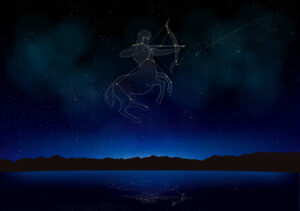
Gard’s faith coming to him through the medium of his mother’s faith recalls the way that it is Joan who is in Strike’s mind in the church-going chapter of The Running Grave. Likewise, the stars here are interesting. The constellations that appear in Harry Potter and the Black family tree (the dogs, Andromeda, and Cassiopeia) are all relatively well-known but ‘the Archer’ is a crucial constellation in Troubled Blood and is, to this reader at least, a much less familiar name: ‘“The constellation Sagittarius is also known as the Archer” (Troubled Blood)
Gard’s meditation ends with the words that he ‘believed in his heart that all would yet be well’ just as Harry Potter ends with the words: ‘all was well.’ Both texts echo Julian of Norwich’s famous affirmation of faithful hope that ‘all shall be well, and all shall be well, and all manner of thing shall be well.’ In Julian’s thirteenth ‘showing’ she receives this answer to the problem of sin:
In my folly, before this time, I often wondered why, by the great foreseeing wisdom of God, sin was not prevented, for then, I thought, all should have been well…. But Jesus in this vision informed me of all that I needed… He answered in these words and said, ‘Sin is necessary… but all shall be well and all manner of thing shall be well.’
Harry Potter ends not, as Rowling had said (prior to the publication of Deathly Hallows), with the word ‘scar,’ a symbol of the wounds that time cannot heal, but with an affirmation, a calm echo of Julian’s transcendent vision: ‘all was well.’ One place Rowling may early have met with these resonant words could have been in a childhood reading of A Maid of the Silver Sea. And like the love story of Gard and Nance – and the way she kisses him ‘with her heart in her lips’ – these words bode well for Strike and Robin’s future.
1In another tweet she also quotes a famous line from Eliot’s Felix Holt (Chap 44) as a (to this reader) painfully witty riposte to a tweet gloating about blocking her: ‘Only in the agony of parting do we look into the depths of love. ― George Eliot’ https://x.com/jk_rowling/status/1014611695615045632