
J.K. Rowling is an exuberantly successful namer and I particularly enjoy it when her names involve literary sources or clues. Of the new names that we meet in The Running Grave the most obviously literary name is that of Colonel Graves’s Labrador ‘Gunga Din.’ Gunga Din is a reference to a Kipling poem (an author Rowling has referred to before, see here and here). This poem was once very popular (a Wodehouse character notes as among his marriageable attractions the fact that he can recite it from memory) although it now reads as painfully unmodern in its attitudes. Graves’s choice to name his dog ‘Gunga Din’ suggests that he, like his son-in-law might be ‘a man who didn’t particularly mind being offensive and might even pride himself on it,’ and it fits with the kind of unthinking attitude that believes that just kidnapping his son and hoping he’ll snap out of it will solve the family’s problems (see the great discussion of this name in the podcast!)
There is also another possible literary reference in this family’s names – in the surname of the Delaunays. Although not a perfect match the name recalls Shelagh Delaney – a well-known UK playwright. Delaney is particularly likely to be referenced by Rowling because she was obsessively referenced by Rowling’s favourite band of teenage days: The Smiths. The Smiths twice used images of Delaney in their cover art and Morrissey’s lyrics often quote her – he has said ‘I’ve never made any secret of the fact that at least 50 percent of my reason for writing can be blamed on Shelagh Delaney.’ This reference, if it is a reference, may not signify much beyond Rowling’s affection for either, or both, Delaney’s writings and Morrissey’s lyrics; but it is perhaps relevant (given the Graves’s history) that Delaney’s most famous play – A Taste of Honey – is an exploration of racial and class tensions within a family.
One of the best literary names of The Running Grave is given by Robin to her plant. In The Running Grave we get the pleasing information that while Murphy’s lack of green fingers has killed off most of Robin’s plants, even he has been unable to cause any harm to her beloved philodendron. And we learn simultaneously that Robin has given Strike’s gift a name: Phyllis. This is a highly suitable name for a plant as it is a female name derived from the Greek for ‘green leaf.’ But it is also an excellent name for Strike’s gift because it intimates the way Robin feels about him. Just as the plant’s heart-shaped leaves intimates Strike’s feelings for Robin, so does the name she gives it reflects back the same feelings: Phyllis being a name familiar from pastoral poetry for a ‘sweetheart.’1
Rowling has placed a well-thumbed copy of Percy H. Reaney and R.M. Wilson’s A Dictionary of English Surnames on her virtual ‘desktop’ as a nudge that we should look for the clues embedded in her names. I was delighted on looking up her own nom-de-plume within it, for example, to find a hint about her own English-to-Scottish identity. There could hardly be a more Scottish name than Robert Galbraith, and yet it is a Scottish name for a foreigner. Galbraith means ‘British foreigner’ or ‘stranger-Briton’ – ‘a name given to Britons settled among Gaels.’

Naming is an important literary skill for ‘when we meet a name that just seems right… a peculiar magic happens that is related to aesthetic pleasure: the instance both modifies and validates the invisible conventions that we didn’t know we knew.’1 Harry Potter is saturated with ‘cratylic’ names – names which declare the nature of the character who bears them. The term ‘cratylic name’ was invented by Anne Barton in her book The Names of Comedy (1990) and the name derives from Plato’s Cratylus: a dialogue in which Socrates explains the nature of language through an explanation of names. His interlocutor Cratylus believes in the divine origin of names and hence thinks that the form of a name – its sound, for example – will ‘fit’ the thing named. Plato’s dialogue suggests that if names have no inherent link to the things they signify then language is arbitrary, but if there is some intrinsic connection between sign and signified – name and thing – then language could be seen as a divinely inspired guide to reality.
The idea of an intrinsic connection between name and thing was often held to exist at the level of sound. As Rowling notes Dumbledore’s name sounds ‘endearing and strangely impressive at the same time.’ The success of this name works primarily at the level of sound with its dependable repeated ‘d’ and a warmth imparted by the soft ‘um’ sound. But this onomatopoeic theory of language has not been generally accepted for – as Socrates notes in Cratylus – so few words sound like the thing that they name. In Plato’s dialogue, therefore, Socrates rejects the philosophical study of language as inferior to the study of things. Socrates’s disappointment, however, is the writer’s opportunity for in fiction writers have the chance to create names that fit their owners to perfection. Cratylic names – named after Cratylus’s hope that names tell us about natures – are one of fiction’s most ubiquitous and enjoyable forms of naming.
I have written about some of the best cratylic names in Strike up to Troubled Blood here and Hogwarts Professor has an exhaustive list of the cratylic names of Lethal White here. One of the most important new names in The Running Grave – that of Will Edensor – follows a long-term habit of Rowling’s naming, in that (like Snape, Runcorn, Flitwick and Dudley Dursley) Will is named after a place. I suspect that Rowling may take her liking for place-naming her characters from one of her favourite authors, P.G. Wodehouse. Wodehouse’s own name is a place name – ‘Wodehuse’ is an early form of the common place-name Woodhouse – which may have encouraged him in naming so many of his characters – from Roderick Glossop and the Hon. Galahad Threepwood to Lord Emsworth – after places. (And it might even be a nod this shared penchant for place-naming, that Rowling has actually named a place after Wodehouse in Strike – Wodehouse Terrace where Anna and Kim live in Troubled Blood.)
The village of Edensor (pronounced Enza) is a fascinatingly equivocal place. For it should be an ancient place – named in the Doomsday book with an Old English name meaning ‘sloping bank or ridge of a man called Eadin’ according the Oxford Dictionary of English Place-Names (another book that appears on Rowling’s homepage!). But it now exists as a custom-built ‘model village,’ commissioned by the 6th Duke of Devonshire and built on his land within Chatsworth Park in the 19th century. Described as ‘a delightful hotch-potch of traditional house designs, from mock Tudor to Swiss cottage,’ this village nonetheless encapsulates an astounding abuse of power for ‘the 6th Duke decided to demolish the old estate village and rebuild it out of sight in the 19th century, because it spoiled his view of the estate from Chatsworth.’ 
The significance of this naming is difficult to read. The history of the effect that aristocratic privilege has had on the village of Edensor fits well with the grand home and wealth of the Edensor family, but this history of a village and all its villagers being uprooted for the sake of Duke’s view suggests all is not well in this family. I wonder if the wilful deracination of this village fits with Will’s own wilful uprooting of himself from his family. The novel opens with the heartbreaking death of Will’s mother longing to reconnect with her estranged son. It is the knowledge of his mother’s death that finally opens Will’s eyes to the fact that the cult’s cant about ‘flesh objects’ has blinded him to the truth of his love for, and connection with, his family. Children, like villages, should not be uprooted from the soil in which they belong.
The name source for Charlotte Campbell?
I enjoyed Louise Freeman’s analysis of the paired meaning of the etymologies of Charlotte and her sister Amelia’s names:
Amelia’s name meaning of “hard-working” sets up her role as the series’ opposite of Charlotte, whose name means “free.” Amelia, like Charlotte, presumably has all the money she needs from the family fortune, but Amelia chooses to work for a living. Charlotte, in contrast, takes on little work other than cushy modeling gigs, and rejects as much responsibility as possible, including that for her own children. As she told Strike in Franco’s, “I don’t want to be needed, I never did. I want to be free.”
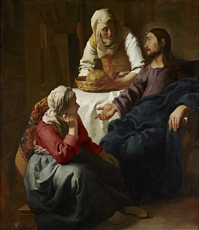
This pairing of a ‘hard-working’ versus a ‘free’ sister feels classic because it goes all the way back to the Gospels in the sisters Martha and Mary ( Luke 10:38–42). There is a famous painting of these sisters which Rowling must (surely!) have seen, as it is a Vermeer which hangs in the main art gallery of the city in which she has lived for the last thirty years. (And Rowling likes seventeenth century religious art: Caravaggio’s Supper at Emmaus is her favourite painting).
I mention this painting because I think that there is another painting, also hanging in Edinburgh’s National Gallery, which I think Rowling will also have seen, after living for so many years close to this fabulous gallery which stands, free to enter, in the centre of the city. This is Johann Wilhelm Tischbein’s popular painting of a writer and famous beauty: Lady Charlotte Campbell.
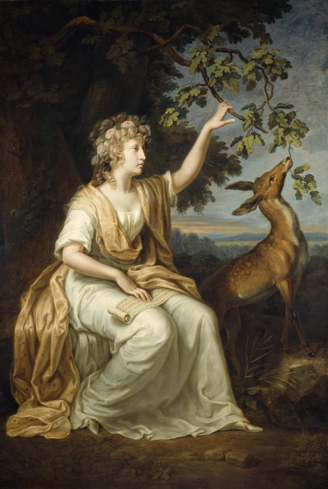
This painting is popular enough to be sold as a postcard in the gallery shop and my friend Ellen Pasternack when she visited Edinburgh sent me a postcard of this ‘famous beauty’ saying that she thought it likely she was the inspiration for Rowling’s character. And I bet she is right! As well as being noted for her stunning looks the historical Charlotte Campbell (1775–1861) has a slight overlap with the fictional one, being famous for her gossip about high-society circles. She wrote novels with titles such as Flirtation (1827) and The History of a Flirt (1840) but she was best known for her Diary Illustrative of the Times of George IV (1838-39) which is gossipy in the knowingly grand way that Charlotte is: ‘What amused me most was to observe how Lady —- courted the foreign ministers, and specially the royal Duke of —–, whom she followed from room to room as if she had been his attendant in waiting.’
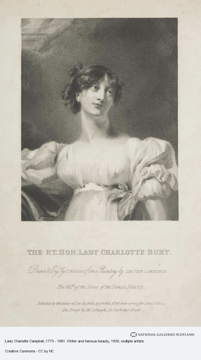
A drawing of Charlotte Campbell also hangs in the National Galleries of Scotland and looks like it could have been used as a guide for her casting….

Rowling may also have been drawn to the name of this famous beauty in naming her own as Campbell is a name with some interesting and equivocal associations not least (as I have written about before) in being part of Rowling’s own blood line:
In August 2005 it was reported that Rowling had recently been informed that her biological great-grandfather was:
Dugald Campbell, an adventurous doctor, born at Lamlash, on the isle of Arran, in 1858, who later travelled to Hawaii, where he helped to establish a free health service for all. The discovery has prompted Rowling to visit the Campbell family burial plot on the island and to e-mail historians in Hawaii seeking information about her great-grandfather.
The Campbells have, shall we say, a chequered history in relation to some other Clans and their motto is a proud reference to this history: ‘Ne Obliviscaris’ (‘Do not forget’). This motto appears to be an intentional riposte to those who might consider that the Campbells would be glad to forget aspects of their history, though it is explained by the current Duke of Argyll with admirable diplomacy as: ‘we have taken great pride in our achievements, yet are conscious of our mistakes, something reflected in our family motto ‘Ne Obliviscaris’.’
Charlotte’s tenacious hold over Strike and her unwillingness to forget him, or let him forget her, fits well with the Campbell motto of Ne Obliviscaris.
My favourite cratylic name in Strike, however, is that of the hero himself.
Cormoran Strike has an avowedly cratylic Christian name – his mother named her big, Cornish baby after a Cornish giant – but his surname is more subtly cratylic and tells us rather more about his true nature. Rowling has said that she found it in a book about Cornwall, so that it is part of Strike’s Cornish heritage but its meaning is unexpected: ‘‘I’ve been told it’s something to do with corn,’ he said, ‘measuring corn.’ (Cuckoo’s Calling, Chap 3).
As the Surname Database puts it:
This unusual and very interesting name is an early medieval English occupational surname for someone who was employed to maintain the accuracy of a measure of corn by passing a flat stick or “strike” over the rim of the vessel holding the grain, thus levelling the grain and removing any excess. The derivation is from the Old English pre 7th Century “striccan” or “straccian” to stroke or smooth, Middle English “strike(n)”. This was an important and responsible position in medieval England, particularly since there was some dispute over the measure to be used.
A ‘strike’ is an accurate measurement of corn: to ‘strike’ grain (according to the Oxford English Dictionary) is to make it ‘level with the rim of the measure by passing a strickle over it,’ as in the medieval citation ‘see that your corne be mesured withe..a trewe bushell & that euery bushell be strekyn.’ Measurement of this kind is conceptually linked with the justice that is at once the divine tuning fork and pilot light of Strike’s moral character. According to the biblical concept of justice ‘with what measure ye mete, it shall be measured to you again’ (Matt 7.2) – a phrase that Shakespeare famously echoes in the title of his play Measure for Measure. This, one of Shakespeare’s most political plays, opens with the words ‘Of government the properties to unfold’ and the play stages a searching exploration of the complexities of good government, and how rulers can (and should) balance justice with mercy. The use of ‘measure’ in the title of links with the way in which just measurement is a cornerstone of an ordered society: ‘dead pharaohs would be buried with measure-sticks in hand. Early on, the right to assess – and enforce – measurement became concomitant with political authority. We call them rulers for a reason. Defining and maintaining standard weight and volume – particularly in the all-consuming food and drink trade – continued as one of the state’s central obligations for millennia.’
In The Cuckoo’s Calling and Troubled Blood – in which Strike’s epigraphical avatar is Artegall, the Knight of Justice – it is justice which is the moral centre of Strike’s being, drawing the plangent note of sympathy from his breast at the very opening of the series. But in The Running Grave truth is added as a twin beacon to his moral guiding lights: ‘Truth, to Strike, was sacrosanct. Justice was the only other value he held as high’ (The Running Grave, Chap 38). And interestingly, one type of truth – ‘canonical’ truth – is likewise etymologically linked to measurement. The word ‘canon’ – used in fandom as well as by the Church to define what is ‘canonical’ (and therefore accepted as true) – is derived from the Semitic word kaneh, a name for a reed which was marked in lengths and used like a ruler and hence came to mean a guide for what ‘measured up.’ 2
When near the end of The Running Grave Strike mocks Wace’s Pharisaic claims of moral purity, the reader enjoys the irony all the more for believing that Strike is indeed the vessel he sarcastically claims to be: ‘On the contrary. I’m just like you, Jonathan,’ said Strike. ‘Every day, I get up, look myself in the mirror and ask, “Cormoran, are you a righteous vessel for truth and justice?”’ (The Running Grave, Chap 112). I like the word ‘vessel’ here: it reminds us of one of those measuring cups filled with corn ready to be struck with a striking stick: ‘see that your corne be mesured withe… a trewe bushell & that euery bushell be strekyn.’ Strike – also known as ‘Stick’ – has a perfectly cratylic name.
1 Burrow, Colin. (2012) ‘I, Lowborn Cur,’ London Review of Books 34.22 (22 Nov): 15-17, esp. 17.
2 Lee Martin McDonald, ‘What do we mean by Canon? Ancient and Modern Questions,’ in Jewish and Christian Scriptures: The Function of “Canonical” and “Non-Canonical” Religious Texts, ed. James H. Charlesworth and Lee M. McDonald (London: T&T Clark, 2010), 11.






 The importance of musical clues later in the series brought this early clue into sharper focus on a reread and, of course, it is important in other ways too.


 Early in Lethal White Robin steps off her accustomed path into St Nicholas’s churchyard in Deptford – drawn in by the extraordinary skull finials on its gateposts. These memento mori skulls have a fascinating history and a persistent local legend suggests that they may have inspired the




 There are two signs that Strike could be experiencing residual effects of the office bombing. First, the jumping stump. There are two major causes of this condition: The first is damage to the peripheral nerves in the amputated limb and, as Strike’s doctor told him, it would be unusual for that to happen so long after the amputation, though, not impossible, given the abuse Strike heaps upon his stump. In the
  A second sign of Strike’s deteriorating mental and physical health is a symptom that has not yet been formally noticed by Strike or any of his colleagues, but one that jumped out at me on my first reading of
  Even more interesting would be if the exploration of trauma history stretches back further than the IED explosion. Norfolk is a near-certain setting for at least some of

