After Strike’s perfect gift to Robin for Christmas in 2016 and Rowling’s perfect gift to us for Christmas 2025, the Strike fandom – like its creator – now has two charm bracelets.

The silver charm bracelet Strike gave to Robin in The Hallmarked Man has seven charms – not only because seven is the most powerfully magical number but also, tacitly, one for every year he has known and loved her. ‘It’s been seven years,’ as he says during his declaration and (unexpected) proposal and he had counted out those years in depression earlier in the novel also: ‘Seven years of missed opportunities with Robin; he’d be tallying them up for ever, as a miser counts his pennies.’ The Hallmarked Man was, as promised, a novel thick with metalwork but Strike’s disheartened metallic simile is transmuted into the seven silver charms – there is still hope. For we know, although Strike does not, what Robin thought when she first saw those charms: ‘oh God, I love him.’ Pools said years ago that Strike’s love-language is gift-giving, and I had wondered what kind of gift he’d give Robin now that he not only knows he is love with her but also wants her to know that. I was not disappointed.

Strike’s creator, like her hero, is clearly also a bit of a love-language gifter – remember those six hand-drawn copies of Beedle the Bard she made for the friends those who had helped launch Harry Potter? And that gold-charm-bracelet header was a generous gift for those of us who ended 2025 hungry for more information about Strike 9. Charmingly this header is not just a picture, but a real gold bracelet Rowling has pieced together for us, just as Strike did for his beloved, and – as with that bracelet – the charms enact our shared story (even if we don’t yet know what they mean). Nick Jeffery has written an excellent post with a break-down of each charm and its possible interpretations. Is that crocodile a literal visit to Oxfordshire’s own Crocodile zoo or, as Lindsay has suggested, Yorkshire’s crocodile rock or does it rather point to the symbolism of rebirth or – as so often in Strike – both? One of the things Nick illustrates is that the egg charm is worth startlingly more than the others. This may point to its importance in the coming story but I suspect Rowling has also chosen it because it brings back a memory of her own, first, charm bracelet.
As mentioned above the two charm bracelets of the Strike fandom echo the fact that Rowling, likewise, has (or rather, had) two charm bracelets. She told us this when she wrote a piece about charm bracelets in 2013 because she was raising money for Lumos via auctioning a third charm bracelet (based on one of her own).
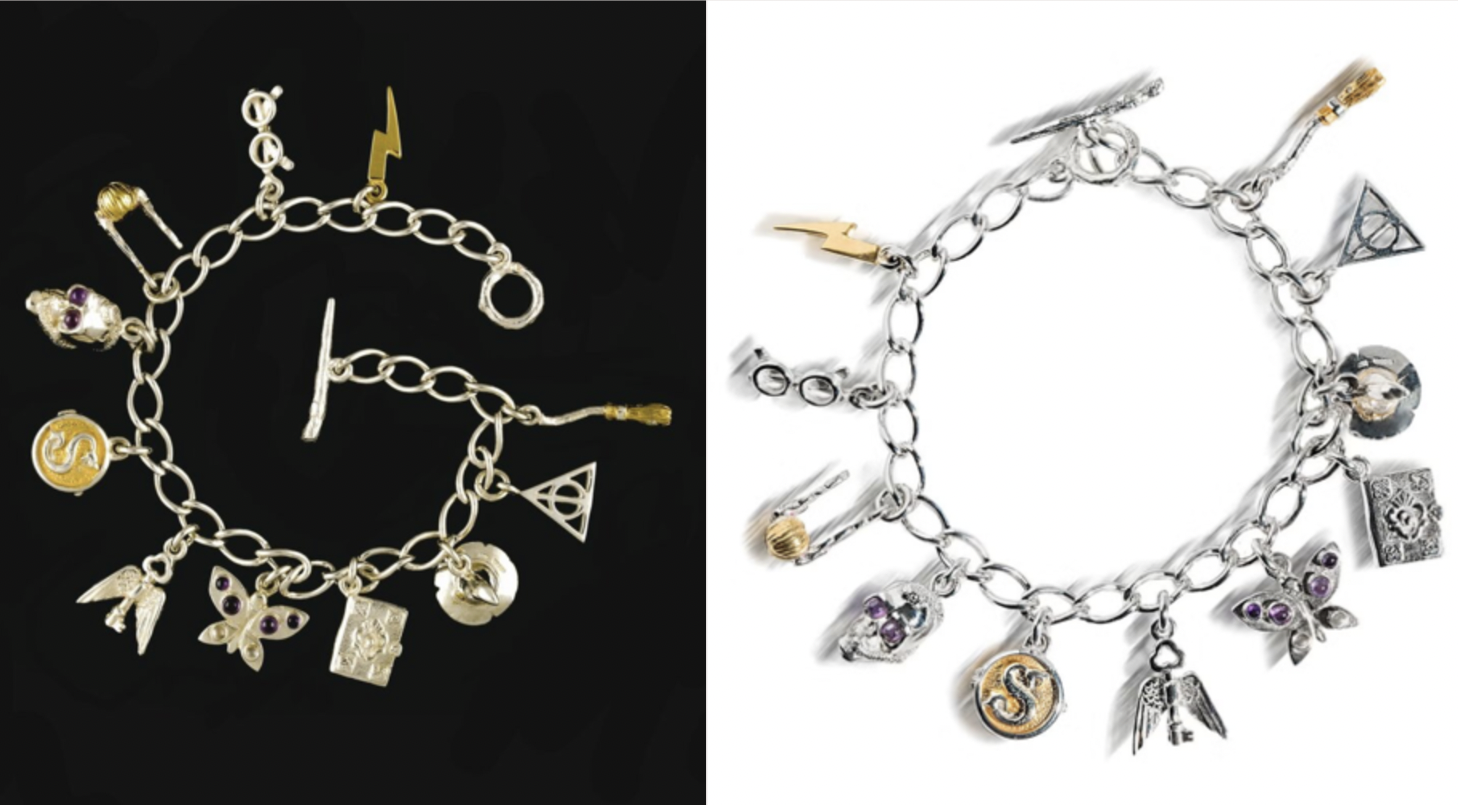
In this piece Rowling wrote that her first (much beloved) charm bracelet was given to her when she was five and included a donkey (Troubled Blood, anyone?) and a filigree egg that opened to reveal a tiny bird, which was her ‘favourite by far.’ Might this egg charm have influenced the egg on our golden clue-charm bracelet?
I was a plain and freckly five-year-old when I received the first and I had never been given anything more beautiful in my life. A heavy silver chain with a heart-shaped clasp, it was crammed with clinking charms including a wishing-well charm, a fat Spanish donkey and, my favourite by far, a filigree egg that opened to reveal a tiny bird. What other piece of jewellery is so imbued with memory and sentiment? Why do we call those little masterpieces ‘charms’ if not in allusion to their talismanic properties? They have meaning beyond the mercenary. They are personal amulets. I owned my adored and beloved bracelet for 20 years until one day a burglar broke into the flat where I was living in Manchester, emptied my old wooden jewellery box and smashed it apart for good measure. I lost not just the bracelet, but the modest collection of jewellery I had inherited from my mother, who had died a mere three months previously. Compared to the loss of my mother, it was nothing, and yet I was devastated. Jewellery does not change, it cannot decay; it is a way of holding tight to the past. To this day, I glance through shop windows at old jewellery in the vague hope that among the tarnished silver I will catch sight of that filigree egg.
This silver charm bracelet was Rowling’s first – stolen just as she was beginning to write Philosopher’s Stone, and it was Harry Potter that brought her the second:
On the day that the seventh Harry Potter book was to be released, my editor, Emma, and the head of Bloomsbury children’s books, Sarah, met me in London and gave me a small package to open. Inside was what would become (aside from my wedding ring) my most treasured piece of jewellery: a bracelet covered in gold and silver charms from the books. There was a tiny Golden Snitch, a silver Ford Anglia, a Pensieve and a stag Patronus. There was even a Philosopher’s Stone in the form of an uncut garnet.
I think we can feel confident that Robin’s charm bracelet, likewise, will become her most treasured piece of jewellery (aside from her wedding ring).
Rowling points out in this 2013 piece the link between the name given to charm bracelets and the magical world: ‘Why do we call those little masterpieces “charms” if not in allusion to their talismanic properties?… they are personal amulets.’ To charm someone is also to slightly to bewitch them, something Rowling plays with when Riddle exerts his charm on Ginny and literally possesses her: ‘If I say it myself, Harry, I’ve always been able to charm the people I needed.’ Witch Weekly’s Most-Charming-Smile Award is given to a smile that is both literally, as well as metaphorically, bewitching.
The word ‘charm’ comes, through French, from the Latin ‘carmen’ which means ‘song, verse, oracular response, incantation.’ Its first meaning in English, therefore, was the magical one: ‘the chanting or recitation of a verse supposed to possess magic power or occult influence; incantation, enchantment; hence, any action, process, verse, sentence, word, or material thing, credited with such properties; a magic spell; a talisman, etc.’ (Oxford English Dictionary). From the sixteenth century onwards, ‘charm’ meant ‘anything worn about the person to avert evil or ensure prosperity’ because such amulets might contain the text of such a charm. And thinking about this made me aware for the first time of how in the most important charms in Harry Potter – the Fidelius Charm and the Patronus Charm – the word is not simply a synonym for spell but encodes this original, protective meaning. These magical ‘Charms’ like the charms on charm bracelets encode what Rowling calls ‘talismanic properties.’
Psalm Charm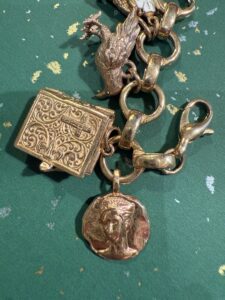
Charm first meant the incantation itself, and then the amulet that carried that incantation to protect the wearer and then – from the 19th century – the small ornamental trinkets, fastened to girdles, watch-chains and bracelets, that resembled those original, talismanic charms. This means that Rowling’s clue-charm of a Psalm book (which can actually carry a sacred text) circles back beautifully to the original meaning of the word – in which a charm was an amulet carrying a holy text. These charms do not always hold texts but Rowling has confirmed that this one does: ‘The book is a psalm book and holds real, miniature psalms’ I think this protective hinterland of charms make it likely that the specific psalm that such a psalm-book charm would carry would be the most comforting and talismanic of psalms – Psalm 23. This psalm famously describes the Lord’s love as protective, even unto the valley of the shadow of death:
The Lord is my shepherd; I shall not want.
He maketh me to lie down in green pastures: he leadeth me beside the still waters.
He restoreth my soul: he leadeth me in the paths of righteousness for his name’s sake.
Yea, though I walk through the valley of the shadow of death, I will fear no evil: for thou art with me; thy rod and thy staff they comfort me.
Thou preparest a table before me in the presence of mine enemies: thou anointest my head with oil; my cup runneth over.
Surely goodness and mercy shall follow me all the days of my life: and I will dwell in the house of the Lord for ever.
Nick Jeffery, brilliantly, has discovered a psalm-charm identical to that on Rowling’s bracelet (it has sold-out – did she buy it?!) which does indeed contain Psalm 23.
Psalm 23 is now, and has long been, the most famous and beloved psalm and has always been thought of as a particularly comforting and protective psalm. I am writing a book about sixteenth and seventeenth century psalm-readers and I have found an inscription, written in a 1587 Book of Psalms, which – highly unusually – records a betrothal. The bride-to-be has written out: ‘Elizabeth Proay and Daniel Peaf shall be joined together in matereymoney.’ The wildly unusual spelling of matrimony is one reason for thinking that it was Elizabeth rather than Daniel who inscribed this record, as early modern women (taught to read but rarely taught to write) had highly idiosyncratic spelling (one of my favourites is Mary Herrick’s rendering of “pomegranate” as “pounde garnyte”). I suspect that Elizabeth’s choice of where to inscribe her betrothal expresses her understanding of this scriptural text as a sacred and protective space. She chooses to record her future marriage in the margin of Psalm 23, just as one might wear it as a talisman: “Yea, though I walk through the valley of the shadow of death, I will fear no evil: for thou art with me.”
Frankly the idea that psalms might be turning up in Strike 9 is exciting enough (the Venn diagram of things I am writing books about will then be a circle!) but I am particularly intrigued by the idea that this is piece of jewellery might hide a psalm-text clue within it because just such a thing turns up in one of the best children’s books of all time. And it’s a book I’m confident Rowling read and loved as a child: J. Meade Falkner’s Moonfleet (1898).
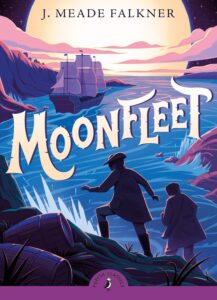
I spent lots of time in Dorset as a child (my grandparents lived near Corfe Castle) and so it was particularly exciting when Moonfleet’s hero, John Trenchard, reads about how the magnificent ruins of Corfe Castle have ‘a secret passage from the ruins to some of the old marble quarries, and perhaps to that very one that sheltered us.’ My favourite walk went down to these old quarries at Winspit – vast dark gouges in the cliffs roofed by great slabs of stone held up by pillars that looked frankly inadequate to the task. I used to walk into these in fearful excitement and imagine such secret passages and John Trenchard hiding there. I thought of them again when child-Strike longs to visit smugglers’ caves with Dave Polworth – and wondered, likewise, if the smugglers’ caves of Moonfleet might have been in Rowling’s mind as she wrote that line.
Moonfleet is a deeply evocative coastal romance of pirate treasure, smuggler’s caves and vanished folklore. John is told old myths of the place such as ‘when St. Aldhelm first came to Purbeck, he bound the old Pagan gods under a ban deep in these passages, but that the worst of all the crew was a certain demon called the Mandrive, who watched over the best of the black marble. And that was why such marble might only be used in churches or for graves, for if it were not for this holy purpose, the Mandrive would have power to strangle the man that hewed it.’ To keep off such creatures, John learns what he calls a ‘spell’ (the talismanic saying Abite a me in ignem etenum qui paratus est diabolo at angelis ejus). The sexton who teaches him explains that in English this ‘spell’ means ‘“Depart from me into eternal fire prepared for the devil and his angels,” but hath at least double that power in Latin.’ It is a traditional magical belief on which, of course, Harry Potter draws.
Moonfleet tells the adventures of the fifteen year old John Trenchard, who has been brought up by his aunt after the loss of his parents – an aunt quite as unpleasant as Aunt Petunia – and when he leaves her to live with Elzevir Block, Elzevir is as happy as Sirius would have been had Azkaban ended differently: ‘he said that I must come now and live with him… I should be to him a son in David’s place.’ Elzevir Block runs a pub called the ‘Why Not?’ – a great name as it is an encouragement to a ‘let’s have another drink’ mentality among its patrons but it is also a visual pun.

The pub is properly the Mohune Arms, and the heraldic symbol of the Mohunes is a cross-pall, shaped like a ‘Y’ – hence the ‘Why not?’ (Rowling also loves the pictorial language of heraldry – something that I looked at in depth here). But this bit of punning also has a plot function, for it introduces the reader to the heraldic symbol of the Mohunes and explains how familiar it is to the villagers of Moonfleet. And hence what might have seemed a secret and personal symbol to Colonel Mohune (when he marked the hiding place of his diamond with his family crest) belonged – unbeknownst to him – to John Trenchard likewise:
Now, however lightly a man may glance through a book, yet if his own name, or even only one like it, should be printed on the page, his eyes will instantly be stopped by it; so too, if his name be mentioned by others in their speech, though it should be whispered never so low, his ears will catch it. Thus it was with this mark, for though it was very slight, so that I think not one in a thousand would ever have noticed it at all, yet it stopped my eyes and brought up my thoughts suddenly, because I knew by instinct that it had something to do with me and what I sought… a letter of the alphabet, a plain ‘Y’, and would have passed for nothing more perhaps to any not born in Moonfleet; but to me it was the cross-pall, or black ‘Y’ of the Mohunes, under whose shadow we were all brought up.
There is lots in this novel that feels like it might have fed into Rowling’s own mental landscape and influenced Harry Potter: heraldic punning, riddles, solidly satisfying father substitutes with names like Elzevir Block, secret passages, rough pub landlords with hidden hearts of gold and evil aunts. But the links feel particularly close when (half a century before The Lord of the Rings) our hero wears a dangerous treasure in a locket round his neck and starts to get possessed by it. Harry’s secret hankering after the Hallows, as he is weakened by wearing the locket Horcrux, feels very close as John – unlike his lovingly stalwart companion – starts to be possessed by desire for the diamond:
But all the while a strange change was coming over us both… now it was he that seemed to set little store by it, and I to whom it was all in all. He seldom cared to look much at the jewel, and one night when I was praising it to him, spoke out: ‘Set not thy heart too much upon this stone.’… I did not know what made him speak like this, and was not willing, even in fancy, to agree to what he counselled…I never answered Elzevir, but took the diamond and slipped it back in the silver locket, which still hung round my neck.
The jewel is now hidden in the large silver locket which John found round the neck of Colonel Mohune – aka the pirate Blackbeard. When John first opens this locket he thinks it will contain the diamond, but finds instead five psalm verses: ‘look at it as I might, I could not see that these verses could ever lead to any diamond; and though I might otherwise have thought of ciphers or secret writing, yet, remembering what Mr. Glennie had said, that Blackbeard after his wicked life desired to make a good end, and sent for a parson to confess him, I guessed that such pious words had been hung round his neck as a charm… the locket I kept, and hung about my neck under my shirt; both as being a curious thing in itself, and because I thought that if the good words inside it were strong enough to keep off bad spirits from Blackbeard, they would be also strong enough to keep Blackbeard from me.’ This psalm-filled locket is, as John says, ‘a sacred charm’ in the traditional sense, recalling the psalm ‘charm’ (in the modern sense) of Rowling’s clue. For, despite what John thinks, these psalms are a clue to where Blackbeard’s ill-gotten diamond may be found.
Psalms are a brilliant place to hide clues, as in Moonfleet, because they are ubiquitous, numerous and they combine words and numbers – hence the much-loved tradition that Shakespeare hid his name within the King James translation of Psalm 46 when he was 46 by putting one part of his name 46 letters from the start and the other half 46 letters from the end. This, as you may have guessed, is a myth – but it has a certain attractive plausibility because people really did hide ciphers of their names in early modern texts – and, in one case, the psalms. The alchemist Thomas Norton, for example, left a cipher of his name in his Ordinal of Alchemy (1618), deciphered by Elias Ashmole who writes: ‘From the first word of this Proeme, and the Initial letters of the six following Chapters’ spells out ‘Tomais Norton of Briseto, A parfet master ye maie him call trowe.’ Rowling has only used this type of clue sparingly – in Creed’s letter in Troubled Blood and on her old website in which an instruction about repairing a clock was phrased as a poem with the acrostic ‘Reparo.’ This clue launched the W.O.M.B.A.T tests – and these, like O.W.L.S and N.E.W.T.S are, in themselves, a form of acrostic. Acronyms (in this case for Wizarding Ordinary Magic and Basic Aptitude Tests) are a kind of backwards acrostic – you have to work out the words from the letters rather than vice versa.
Acrostics are also present in the Psalms: most famously in Psalm 119 which is an alphabetical acrostic, with each section beginning with the correctly ordered letters of the Hebrew alphabet. Sixteenth century translators responded to this aspect of the psalms – Mary Sidney, for example, includes ‘Praise the Lord’ as an acrostic in her translation of Psalm 117 while Matthew Parker included a preface to Psalm 119 which explained how its acrostic worked and included an acrostic of his own name. Startlingly, Parker has hidden an important clue in this acrostic: it is the only evidence we have that this translation is, in fact, Parker’s work. So, from sixteenth century translators to Moonfleet and beyond, writers have been inspired by the psalms to create verbal games and riddles. Here’s hoping that Rowling follows in their footsteps and that the psalm charm points to some satisfying psalm-based clues in Strike 9!
In my next blog post I’ll look at another charm in detail – it is a charm that is not present on either of the Strike bracelets, nor (as far we know) on either of Rowling’s own, But it was present on the charm bracelet Rowling designed for Lumos and it is a symbol which she has told us will be important to Strike 9: a butterfly. 