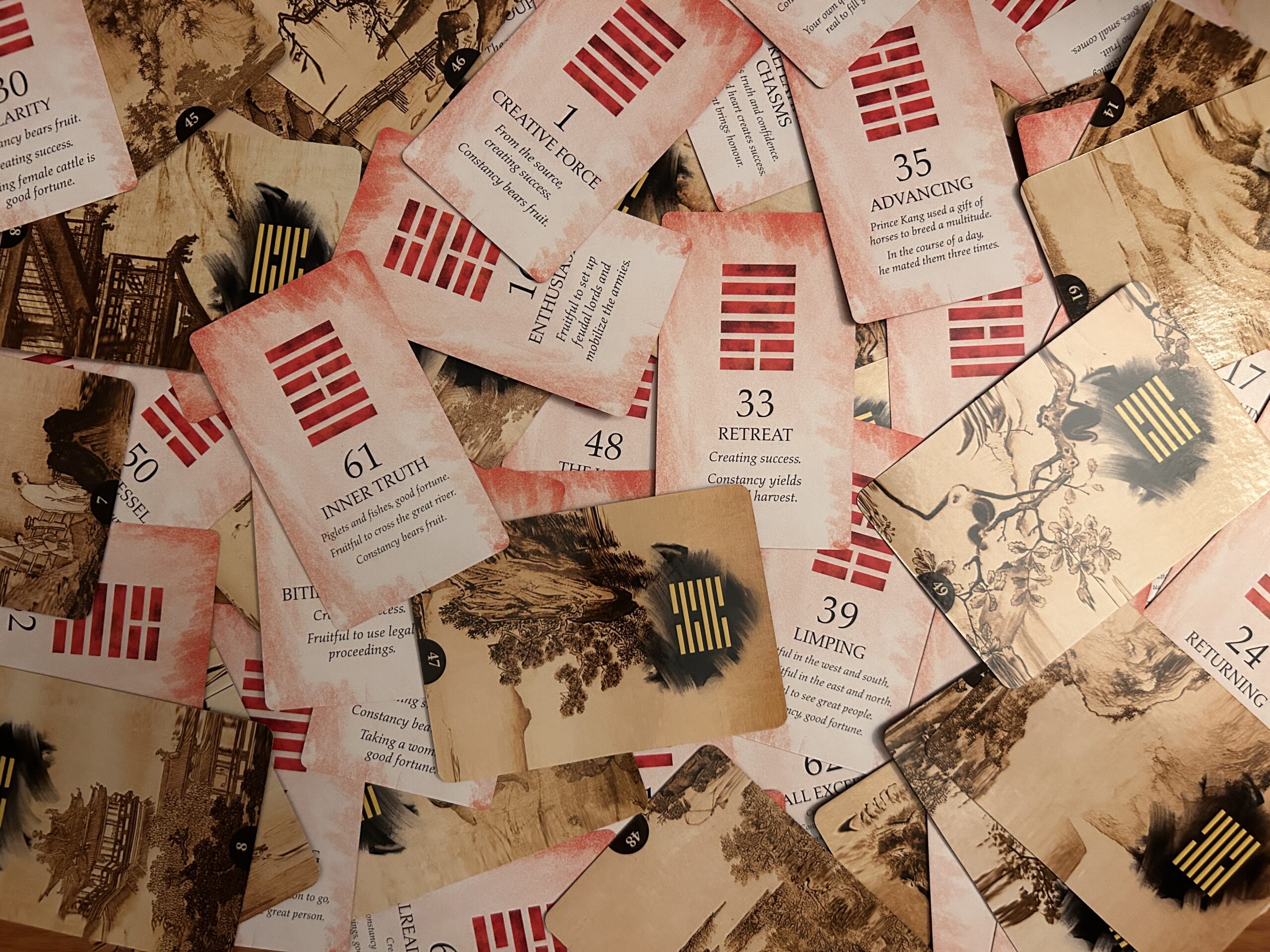
It’s no secret that here at TSEF, we LOVE discussing the epigraphs! What you’ll find below is a rough transcript of our epigraph discussions for The Running Grave, taken from our episode notes (so please ignore the punctuation and grammar).
WARNING that this post contains MAJOR SPOILERS for The Running Grave! We mean it! MAJOR! Do not keep scrolling if you haven’t finished reading The Running Grave!
Opening Epigraphs:
“When, like a running grave, time tracks you down…”
- Dylan Thomas, “When, Like a Running Grave”
“It took a long time for things to go so far. It came about because things that should have been stopped were not stopped soon enough.”
-
The I Ching, or Book of Changes
Lindsay:
I feel like the Dylan Thomas one really applies more to the case – I kind of like it as a sort of warning to the killer in this book. Time (and Strike and Robin) are about to track her down. She got away with this murder 21 years ago and her time is up! You could also say that to the Wace’s and all of the UHC.
Pools:
Oh absolutely! When I thought that Dylan Thomas’s poetry was going to feature more heavily in the book’s epigraphs, I was playing with all kinds of different ideas about the book based on his theme’s, etc. But since it’s only this one excerpt… yes. I think this poem might also speak a bit to Jonathan Wace’s personal obsession with bloodline; in my interpretation, the poem is about the inevitability of death and the desperate search for immortality through sex and reproduction – a way to live on from beyond the grave, which to me seems to fit with Wace.
Lindsay:
The I Ching one works for me on both levels though- the case and the personal. It works for the case because the disappearance/death of Daiyu is a 21 year old cold case that should have been resolved right away. Too many people knew what happened for it to have gone on that long, but no one did anything about it because it suited them to either make her into a prophet and fuel their disgusting cult or to not be convicted of murder.
Pools:
You’re so right about this. I think it also speaks to the larger problem of the cult – it should have been stopped a long time ago, but it was allowed to carry on and grow, its evil spreading. It also makes me think of the comparisons of the UHC to a cancer, and Robin’s pessimism at the end of the novel – at the close of this book, we think they’ve succeeded in finally stopping this cult. But have they? Robin thinks it’s only a matter of time before another five sided temple appears… perhaps the reason it was not stopped when it should have been was because *it cannot be stopped*.
Lindsay:
Well that’s depressing. Makes me think of the ending of the Keep Sweet doc. I was ready to celebrate that this monster is in jail and then, oh wait, he still controls everything and does sermons by phone! Someone take away that man’s phone privileges please. Or…hire a hit man. Am I allowed to say that?
Pools:
I’ll allow it. *bangs gavel*
Lindsay:
But I think it also works so well for the personal side of things because of all of the healing that Strike (and Lucy) do in this book in regards to Leda. All of the things that happened to them in their childhood have had major negative consequences on their adult lives, but in this case I think there’s a happy ending for both of them. It’s not as dreary as the passage suggests.
Kenz:
You said it best, Linds- this really is the book of changes for the Book of Changes, right?
Lindsay:
It really is! I have so many emotions about the changes and healing that Strike goes through in this book, but I really loved the stuff with Lucy and Leda.
Kenz:
Me too! The Strike family stuff in this book is so good.
Lindsay:
I was so interested to see Jo say on twitter the other day about coming across the I Ching book on her shelf, not knowing much about it and then deciding that it was perfect for this book because it really is.
Pools:
It definitely is – and can I say that I *loved* that little peek into Jo’s thought process when it comes to finding framing texts for her novels?
Back to this epigraph – This particular line of the I Ching comes from Book III: The Commentaries (the Wilhelm translation, which is the translation that all of the epigraphs come from), and it is in Hexagram 2: The Receptive. It was interesting to me that this was the hexagram that frames the entire novel, because it’s made up entirely of broken (Yin) lines – meaning it is the essential “feminine” hexagram. Remember when Taio tells Robin that she’s a “Receptive”? He states that the Receptive is female, the Creative male (ugh); this is the hexagram he’s referring to. But Robin hardly embodies the principle of the Receptive in this book – she’s the one who is the active force of this investigation out in the world for most of the novel; I would say that Cormoran embodies the Receptive much more than Robin does, and it’s why his growth is so beautiful – because he’s the “yielding, yet firm” of the hexagram. He’s the solid foundation for Robin, but he himself has opened his mind to change and renewal. Anyway, I know this is all kinds of nonsense, but I just feel like Jo is playing with the I Ching’s traditional patriarchal interpretations of the male/female here and in this book.
Lindsay:
I don’t think that’s nonsense at all- I love it!
PROLOGUE
Chapter Summary: epistolary section, background on case and UHC
Epigraph:
“All individuals are not equally fitted to consult the oracle. It requires a clear and tranquil mind, receptive to the cosmic influences hidden in the humble divining stalks.”
-
Richard Wilhelm, Introduction to The I Ching or Book of Changes
Lindsay:
What I think this is talking about is Will’s receptiveness to the UHC and how he got sucked in. In all these letters and emails, we’re told by Will’s father that Will is autistic and how he believes that played a role in his particular situation and susceptibility. Now, obviously, that’s not the only reason and as we see, anyone can be susceptible to this but it is laid out for us as an important part of Will’s character. What I like about this is that while it seems to have had a hand in why he went along (like his father saying he doesn’t understand evil or people being deceptive) I also think it’s a big part of what saved him from being fully indoctrinated.
Kenz:
I think you’re bang on the money tbh!
Pools:
I definitely think that you’re on the money about Will being “receptive to the cosmic influences” of the UCH! In this passage of the I Ching, being fitted to consult the oracle is a powerful good – but as we see for Will, this receptiveness was incredibly destructive when twisted to evil purposes (the evil hidden in what appeared to be the humble divin(ing stalks)!. It’s part of one of the larger patterns of the novel, where the Principals of the UHC appropriate traditions like the I Ching and misuse them to their own selfish, greedy, sadistic ends.
PART 1
Ching / The Well
THE WELL. The town may be changed,
But the well cannot be changed.
Lindsay:
I’m thinking that this one is talking about Strike because we see a lot of change in him in this first part. I’m kind of connecting the ‘town may be changed’ with the parts of Strike that have changed, but also connecting the well with his heart or who he is at his core which has not changed. I know the book uses the Wilhelm translation, but as we’ve talked about before, I have a couple other decks that Jo has posted photos of and I’ve been using those to help spark ideas or understanding when I’m struggling with one. (I feel like I’m going to call these the Header Deck and the Cake Deck so I know which is which. Because one she used in her header and one she had with her picture of her birthday cake)
And I just really liked the way the cake deck described the well as the ‘foundations of life that endure’ and the header deck asks the question: What is the ever present resource you draw from? For Strike, I think those things are his passion for his vocation, for truth, justice and for Robin. So I think this epigraph is saying to us, the readers, that there are things about Strike that are going to be different in this book, but the core of who he is, the well, is still there. I’m sure as we go through the rest of Part 1, we might see other ways to apply this, but this is what is standing out to me now.
Kenz:
Oh, I love this interpretation! I think you’re right.
Pools:
I absolutely love that you’re designating these decks “Cake” and “Header” by the way! It’s making me giggle. I love your interpretation of this hexagram in terms of Strike’s essential nature and the change he’s going through! In addition, I think that we can think about the UHC – which is introduced and explored for the first time in Part 1 – through this hexagram! This hexagram refers to the political structures that people create to organize their lives and meet their human needs – these structures can change their shape and form (like the town), but the well itself – the fundamental needs and nature of human beings – does not change. Any satisfactory organizing structure (government, CHURCH) needs to satisfy the deepest needs of the people living in it – the UHC claims to do this, but it does not; it claims to work for the benefit of the whole, but it absolutely does not. The UHC has poisoned The Well.
Also, I’d like to note this passage from the interpretation of 48: “True, if a well is being lined with stone, it cannot be used while the work is going on. But the work is not in vain; the result is that the water stays clear. In life also there are times when a man must put himself in order. During such a time he can do nothing for others, but his work is nonetheless valuable, because by enhancing his powers and abilities through inner development, he can accomplish all the more later on.” Is this not speaking EXACTLY to Cormoran’s inner growth in this novel? He’s lining his well with stone! He is the Superior Man! (Yes I’m going to be referring to Strike as the Superior Man A LOT. It’s a very sexy term for him.)
Lindsay:
Big same!!!
Pools:
Yes, I’m going to go absolutely batshit with my own insane interpretations of the meanings of each hexagram for every single epigraph in this book. I think we all knew that that would be the case. We should all buckle in.
Lindsay:
They’re SO MUCH FUN!!! I love these epigraphs!
CHAPTER 1
Chapter Summary: Christening of Nick and Ilsa’s son
Epigraph:
… the superior man is careful of his words
and temperate in eating and drinking.
-
Hexagram 27 (The Corners of the Mouth), BOC
Kenz:
I’m loving how much more straightforward the epigraphs are for this book! Pretty sure this is referring to Strike’s noticeable efforts to lose weight.
Lindsay:
Yeah, I agree. We learn right away how successful he’s been with his diet. 3 stone is a lot of weight- for those who don’t know a stone is 14 pounds so he’s lost about 42 pounds. Which is great! The epigraph also says that the superior man is careful with his words and I guess you can apply that to Strike not saying his thoughts about Murphy OUT LOUD!
Kenz:
Also, I dunno if anyone else has noticed this, but every epigraph in this book referring to “the superior man” are Strike chapters with the exception of one Robin chapter (46). It talks about someone having an “inner relationship with a superior man” which is appropriate since it’s the first time Robin mentions using Strike to keep a foothold in reality. (And I already need an emotions closet.)
Lindsay:
Well, YOU KNOW I noticed that and I texted you immediately when I realized it because it’s amazing. Yeah, the fact that the only time it’s not a Strike chapter is in the context you’ve explained, makes me absolutely certain that she did this intentionally. Who is Strike superior to? I mean… I think we know the answer to that! I will say that I did notice while I was listening to the book that there are some epigraphs that have the phrase ‘inferior man’ with a Strike chapter, but I’m almost positive that in context, it’s referring to a different man in that chapter. For example, I think one of those times is when he interviews Jordan Reaney and it’s clear that Reaney is the inferior man. But yeah, I really, really like Strike being called the superior man (obviously). It’s up there with Jo using the epigraphs to compare Strike to the champion of true justice in Troubled Blood. It’s just fun because she’s saying so much to us in the epigraphs about how she feels about these two, you know? How she sees them. At least, I think so!
Pools:
It really is SO much fun! The I Ching is all about providing judgements – these epigraphs seriously feel like the voice of the author judging her own characters for us. It’s beautiful. Also, can I just say that this hexagram is composed of Mountain over Thunder (the two trigrams that are arranged one on top of the other to form the hexagram). Just the image of Strike as a mountain of a man on top of the crashing power of thunder… I gotta say, it’s doing something for me ok.
CHAPTER 2
Chapter Summary: Robin and Ilsa have a chat, and Strike and Robin talk about the case
Epigraph:
Six in the fifth place means…
The companion bites his way through the wrappings.
If one goes to him,
How could it be a mistake?
-
Hexagram 38 (Opposition), BOC
Lindsay:
What do you think is the significance of the ones where it’ll say ‘six in the fifth place means…’ because she could just put the other part, right? Do you think there’s a reason she left that stuff in?
Pools:
My theory is that she leaves these in because, in the I Ching, they’re referring to *changing* lines; the lines of the hexagram can be stable or they can be changing – the changing lines indicate moments of tension, where change is coming. So perhaps she leaves these in because this is referring to some change that is happening, or is about to happen, rather than to a stable situation? Or just because the excerpt comes not from the main hexagram, but from the interpretations of the changing lines, I don’t know lol.
Lindsay:
I am having a bit of trouble making a direct connection between this particular passage and the chapter, but… When I looked at the other decks, the hexagram as a whole kind of makes sense to me. The Cake deck says, “When people have fundamental differences that cannot be compromised, opposition is inevitable. Small things may be accomplished with care, but expect no success in any great endeavor as long as the players remain the same.” And to me, that screams of Murphy and Robin because we’re introduced to a major fundamental difference in this chapter when we learn that he really wants kids. We’re seeing fundamental differences in this relationship and there’s no possibility for long term success here. I’m hoping that Pools can make more sense of the actual epigraph though!
Pools:
There are a lot of oppositions in this chapter – Robin/Ilsa, Robin/Murphy, Cormoran/Murphy, Robin/Cormoran! Each of these are separated in some way – refusal to open up, petty internal loathing, a slight estrangement (going in order there lol). Oppositions like this can be obstructions – when people have different points of view that diverge fundamentally, they cannot work together for a whole purpose (cough, Robin/Ryan cough).
But some oppositions can be fruitful when reconciled – the hexagram speaks specifically of the duality of heaven/earth, spirit/nature, man/woman – these opposites can work together to bring about creation. I think that the actual lines in the epigraph are referring to Strike and Robin – this line is explained with: “Coming upon a sincere man, one fails to recognize him at first because of the general estrangement. However, he bites his way through the wrappings that are causing the separation. When such a companion thus reveals himself in his true character, it is one’s duty to go to meet him and to work with him.” Cormoran is the sincere man here, with Robin. There is a slight estrangement between them, because of Murphy and the love they’re both hiding – but Cormoran is doing the work in this novel to reveal himself to her; and Robin must GO TO HIM. To meet him and work with him (and to love him, to reconcile their opposition and bring order to the world). Does that make sense?
Lindsay:
Yes….I have to go have a cry.
CHAPTER 3
Chapter Summary: Strike gets a call from Shanker and Charlotte
Epigraph:
To be circumspect and not to forget one’s armour is
the right way to security.
-
Hexagram 43 (Break-through / Resoluteness), BOC
Lindsay:
I think this epigraph is that Strike is considering his predicament of being in love with Robin and he’s thinking about what he might do, weighing his options, but at this point, he’s still wearing a lot of his armor, as the epigraph says. He’s still thinking about the fear he has of ruining their friendship and their business, but it’s so beautiful when you think about how this comes back later where, at the end, he’s no longer waiting around and hoping like he is in this chapter, but decides to make the effort and set his armor down and be vulnerable. So I love this chapter and I love how the epigraph is showing us that while he’s considering telling Robin how he feels, he’s still afraid, but I love it even more now that we can see how this chapter is resolved in the end.
Kenz:
Awww, that’s beautiful. I love that.
Lindsay:
This chapter is a great example of ring structure in the novel and it was one of the reasons I was completely convinced that he was going to tell Robin he was in love with her at the end.
Pools:
I love this interpretation! Because yes, keeping his armor on *is* the way to *security* – it’s safer. But in the end, it’s not the right way to *happiness* – reaching happiness requires risk and vulnerability. It’s not safe or secure (or at least, not in the moment of trying to attain it!) – but it’s so much more valuable than that.
There is one bit of the hexagram that I found *very* interesting when thinking about your reference to ring structure: “it refers to the time when inferior people gradually begin to disappear. Their influence is on the wane; as a result of resolute action, a change in conditions occurs, a break-through.” When we circle back to this, to Strike eventually taking off his armor, this is when the break-through/change in conditions happens; as a result of his resolute action! The “inferior people” can be read as the Ryan and Bijous of the novel – their influence is waning. They’re on their way out (some faster than others lol) – and Strike is being set up to have his big Break Through by the end of the book.
CHAPTER 4
Chapter Summary: Strike and Robin interview Will’s father Sir Colin Edensor
Epigraph:
Nine in the third place means:
When tempers flare up in the family,
Too great severity brings remorse.
-
Hexagram 37 (The Family / The Clan), BOC
Lindsay:
This one seems pretty straight forward as we meet the Edensor’s because there are a lot of tempers flaring not just with the brother, James, but Sir Colin talks about losing his temper when he met with Will. I don’t know if James regrets his temper, but it’s clear Sir Colin does. What’s interesting about this whole family dynamic is that even though I don’t really like James, especially after the coffee incident, I can’t fault his anger. I think Jo did a really good job of showing all the different reactions that people might actually have in this situation and anger is really understandable to me.
Kenz:
She really did- one thing that comes across plainly in these books is just how well Jo understands people and human nature, and it comes across particularly well in group interview settings.
Lindsay:
Actually, this might be a good place to put this- we got an email recently from someone named SwanFan17 that said the dynamic with the Edensor’s reminded them of the story of the Prodigal son from the bible and SwanFan summed up the story for us here in case you aren’t familiar. They said: The youngest son left home, wasted away his fortune, suffered and was made to care for pigs (!) and returned home thinking that he did not deserve to be his fathers son. And the eldest son resents his brother’s welcome, when the father rejoices in the younger son’s return…. So yeah, I liked that. Thanks for sending that email in. It seems very fitting.
Pools:
It is incredibly fitting! This hexagram talks a lot about the family as a microcosm of society; each member has their appropriate place, and the appropriate relationships between members is clearly defined. When the family fulfills these roles, there is order; failing to do so leads to disorder and breakdown. “When the family is in order, all the social relationships of mankind will be in order”. What is interesting to me is the part of this line that Jo deliberately leaves out – this specific line continues, “Good fortune nonetheless. When woman and child dally and laugh, It leads in the end to humiliation” meaning that too great a severity is preferable to too much indulgence; because at least severity results in discipline, whereas weakness leads to disgrace. This is the stance that James takes in this chapter – he is very much on the side of severity. But Sir Colin, and the Epigraph itself, take a different view – a wiser, more gentle perspective of understanding. I think it points to a different understanding of the family in general – not as a place of strict roles and hierarchies, but as a foundational unit built on love, acceptance, and care. That is what brings order to society.
Lindsay:
I don’t know if you meant it to be, but that sounds like such good parenting advice. It just made me think of my kids- don’t be so severe, teach love over everything else.
CHAPTER 5
Chapter Summary: Strike and Robin discuss the case and her going undercover
Epigraph:
Six in the fifth place means:
Giving duration to one’s character through perseverance.
This is good fortune for a woman…
-
Hexagram 32 (Duration), BOC
Kenz:
I’m wondering if this is speaking to Robin making the case for her being the person to go deep undercover to Strike.
Lindsay:
This hexagram is about marriage and it’s used again later on in a more direct way to Strike and Robin’s relationship, but I don’t think that’s really relevant here – I think it might literally be talking about the character of Rowena when it says ‘giving duration to one’s character… is good fortune’. Robin has spent so much time and given so much thought to this character and doing so will bring her success- not really with pitching it to Strike, imo, because we know he’s already come to the same conclusion that she’s the best for the job, but it will bring her success with the UHC and getting recruited.
Pools:
I think I agree with you, Lindsay! This is very much talking about the “character” that Robin is creating, and her perseverance in working this case (in every respect). In the actual interpretation for this line, it argues that it is right for the woman to “hold conservatively to tradition”, and the man to be flexible in being guided by his duty – well, Robin is definitely not conservative here – but she *is* holding fast in her argument that she should be the one to go undercover (as is traditional in these books, actually! LMAO). Strike is the one who needs to be persuaded, who bends under her persuasion and their duty. This is another example of what I talked about last ep – about Rowling playing with the patriarchal foundations of this text to give us an incredibly powerful woman in Robin, and an even more powerful partnership between Robin and Strike.
CHAPTER 6
Chapter Summary: Robin thinks about not thinking about Strike, as well as her relationship with Murphy
Epigraph:
Six in the fourth place means:
A tied-up sack.
No blame, no praise.
-
Hexagram 2 (The Receptive), BOC
Lindsay:
I had to think about this one for a bit because it’s a really shippy chapter, but not a very sentimental epigraph. So my first instinct is that Strike is the tied up sack, emotionally speaking. He’s kept his feelings for Robin hidden well enough that she doesn’t believe that he could ever feel the same or want the same thing as she does. Which is exactly what she’s thinking about in this chapter. My header deck says that at first, there’s confusion but ‘later gains a master’ and I just think that’s where Robin is right now. She’s very confused because of Strike being a tied-up sack.
Pools:
Ooh this is interesting, because I was thinking that this chapter was Robin basically double-knotting the ties of her *own* emotional sack! But she’s really only doing this because she’s following Strike’s lead – which is very much the receptive position.
Lindsay:
Interesting that this is the Receptive hexagram again. I was thinking about what you said last time, Pools, about Taio telling Robin she’s the receptive, but actually Strike is the one who embodies that more. I’m not quite sure if this makes sense, but if I’m right that this epigraph is actually talking about Strike and not Robin- I think that adds weight to what you were saying about Strike being the true receptive and Jo sort of flipping some of the male/female stuff of the I Ching.
Pools:
I’m wondering if, in playing with these positions, there is more fluidity than I assumed – basically, that there are the personal and professional realms – that in the professional, Robin is very much the Creative and Strike the Receptive. But in the personal realm, Robin is embodying the passivity and “being led” of the Receptive (and in doing so, she’s not actually “open” at all, but instead incredibly closed down – whereas by the end of the novel, Strike has stepped into the Creative power of the personal, and is taking action to control his own fate. Perhaps the genius of what Jo is doing with the Creative/Receptive dynamic is in making it *constantly shifting* – Robin and Strike move in and out of each role, balancing each other, each embodying both at different times. In the OG text, “the Receptive must be activated and led by the Creative; then it is productive of good. Only when it abandons this position and tries to stand as an equal side by side with the Creative, does it become evil.” – but in these novels, Strike and Robin *are* true equals, standing side by side, because their position in these roles is never static!
Anyway. In reference to this SPECIFIC line, I just have to say that the interpretation of it smacked me in the face: “he strictest reticence is indicated here. The time is dangerous… therefore a man ought to maintain reserve, be it in solitude or in the turmoil of the world, for there too he can hide himself so well that no one knows him.” If this is not Robin??? Keeping all of her feelings tied up in a sack, holding herself apart from Ryan (and from her own feelings for Strike!) to protect herself? And doing so because, up until now, Strike has been doing the exact same thing!! Honestly it is time for these two to just. Burst out from their sacks. Spill their feelings out to the universe (and each other). I bet alcohol would help.
Lindsay:
Yeah, I guess they’re both tied up sacks, but it’s a kind of chicken and egg situation? Is Robin doing it because Strike is doing it or is that kind of how Robin is? There’s a part in one of the Q&As where Jo says that she would tell Strike it’s his own fault that Robin is with Murphy since he’s made himself so unavailable so maybe that’s also playing into why I’m thinking Strike is the more emotionally tied up sack… I need to stop saying the word ‘sack’
CHAPTER 7
Chapter Summary: Strike reads about the UHC
Epigraph:
This hexagram indicates a situation in which the
principle of darkness, after having been eliminated,
furtively and unexpectedly obtrudes again from
within and below.
-
Hexagram 44 (Coming to Meet), BOC
Kenz:
This is Strike coming to the realization that the UHC is the same as the commune he, Lucy and Leda lived in, right?
Lindsay:
Yeah, I think so too. The way it talks about this dark situation ‘having been eliminated’ speaks to me about how Strike thinks this is something he’s eliminated from his life, but I don’t think it is. I don’t think he realizes just how much good it will do him to face this and how much healing it will bring to Lucy and their relationship.
Pools:
Yes this is definitely pretty straightforward – the horrors of Strike’s past, that he thought dead and buried, are rising up suddenly in front of him again. The hexagram states, “It is an unfavorable and dangerous situation, and we must understand and promptly prevent the possible consequences.” – which, I mean, it definitely IS a dangerous situation! But I’m so intrigued by your point, Lindsay, that this ultimately results in healing, because that speaks to the cyclical nature of the I Ching – everything changes. Order becomes chaos becomes order, dark becomes light and dark again, winter becomes spring and then winter. This darkness rising up is what allows it to be vanquished. I’m also interested to note that this hexagram focuses strongly on the darkness as the Yin (feminine); it says “the rise of the inferior element is pictured here in the image of a bold girl who lightly surrenders herself and thus seizes power”. I think this is definitely speaking to Mazu Wace, both in Kevin’s letters and, in a later chapter, Lucy’s memories.
CHAPTER 8
Chapter Summary: Strike meets up with Wardle
Epigraph:
Nine in the fifth place means…
It furthers one to make offerings and libations.
-
Hexagram 47 (Oppression / Exhaustion)
Kenz:
This is Strike taking Wardle out for food to get information out of him, I’m pretty sure.
Lindsay:
Yeah, I think that’s it exactly. And Strike makes sure that it’s a nice place, really buttering him up and it pays off. I like to think that Wardle would have helped Strike out either way, but it’s a nice gesture and we see Wardle return the respect (if you will?) later on. I also want to add to this that there’s a paragraph or two before Strike goes to meet Wardle about how Strike spent three hours tracking down Angel’s biological father for Shanker. It’s another offering, so to speak, that comes back to benefit him later. This whole chapter is him doing things for other people that ends up benefiting him in the long run.
Pools:
Definitely agree with both of you! I’m also wondering if this hexagram speaks to the general situation of both Wardle and Strike – both are facing adversity, which is what this hexagram describes (Wardle with April leaving “He enters his house and does not see his wife – six in the third place!); Strike with that smug prick Murphy… also six in the third place lol). The judgement advises that the superior man bends to adversity, rather than breaking; that he remains cheerful and strong within; that he “acquiesce in his fate and remain true to himself”. Strike is definitely taking this advice, and making offerings – is Wardle as well?
CHAPTER 9
Chapter Summary: Strike and Robin visit Prudence
Epigraph:
But in abolishing abuses one must not be too hasty.
This would turn out badly because the abuses have
been in existence so long.
-
Hexagram 36 (Darkening of the Light), BOC
Kenz:
I think this is speaking to Prudence’s warnings not to underestimate the UHC and its methods.
Lindsay:
Yeah, I agree. I think, at this point, Strike and Robin are a bit naive to what they’re really facing. The hexagram talks about “a man of dark nature is in a position of authority and brings harm to the wise and able man.” and that really feels like a warning about JW and the whole of the UHC to me. But I think the hexagram also talking about the light overcoming the dark or the good overcoming the bad. In pretty much all the interpretations of this hexagram, it talks about hiding your light to keep it protected and that really speaks to me about what Robin is about to do here: she is hiding her true self, hiding the fact that she’s an actual superhero in disguise in order to free Will and the rest of the world from this darkness that is Wace and the UHC.
Pools:
Your interpretation is absolutely spot on here, I have pretty much nothing to add!
CHAPTER 10
Chapter Summary: Robin attends a UHC meeting in Rupert Court
Epigraph:
Six in the second place means:
Contemplation through the crack of the door.
Furthering for the perseverance of a woman.
-
Hexagram 20 (Contemplation), BOC
Kenz:
Appropriate for the chapter when Robin gets her first glimpse into what the UHC is about, isn’t it?
Lindsay:
I’m actually going to go to the Q&As for this one because in the question What inspired you to explore the theme of religious cults in The Running Grave? Jo says, None of us can say for sure there is nothing beyond, but by saying I admit the possibility, the cult leader cleverly opens that door one inch and people want to come back. So really, I think that Jo herself is explaining this epigraph perfectly. ‘Contemplation through the crack in of the door’ We see JW get these people to just open the door a tiny bit and sometimes that’s all it takes.
It’s kind of funny how, Pools, you talked about how these epigraphs are flipping the patriarchal tone of the BOC because this one was a bit much, but you’re right because this crack in the door furthering for the perseverance of a woman is not in the way the I Ching says, but it’s how THIS woman takes them down. It’s instead giving Robin the power and almost like the UHC is the one who opens the door to HER. I don’t know- this might all be absolute nonsense.
Pools:
No no, this is beautiful!! There was a part of this judgement that really stood out to me – “All of this points to the power possessed by a superior personality. On the one hand, such a man will have a view of the real sentiments of the great mass of humanity and therefore cannot be deceived; on the other, he will impress the people so profoundly, by his mere existence and by the impact of his personality, that they will be swayed by him as the grass by the wind.” I mean. Is that not Wace?? But this hexagram is all about seeing and *being seen* – and he has not counted on *being seen* by someone as brilliant, badass, resourceful, and FIERCE as Our Robin, has he?? There’s a crack in his door, and Robin is insinuating herself through it to DESTROY HIM.
CHAPTER 11
Chapter Summary: Strike goes to Lucy’s house to tell her about the case’s connection to their past
Epigraph:
Six in the fifth place…
Shock goes hither and thither…
However, nothing at all is lost.
-
Hexagram 51 (The Arousing / Shock, Thunder), BOC
Kenz:
Something to do with Strike and Lucy’s relationship and the revelations that come up in this chapter?
Lindsay:
Just looking at this passage for the chapter, shock goes hither and thither is, I think, a reference to both Strike and Lucy facing a shock in this chapter. Lucy is shocked to learn about the investigation and by Strike’s honesty about Leda and Strike is shocked to learn about what happened to Lucy at the commune. But the second line is really the beautiful part of this- however, nothing at all is lost- because it speaks to the healing aspect of truth finally being spoken between brother and sister and it does not cause a loss in their connection, it instead strengthens it. The actual hexagram talks about shock bringing success- and that’s exactly what happens here. I just think that this is such a beautiful chapter and it’s a beautiful epigraph!
Pools:
I think you’re absolutely right about this! The image in this hexagram says “Thus in fear and trembling \ The superior man sets his life in order \ And examines himself.” That is just what this shock (and other shocks in this book!) cause the superior man – Strike – to do; to reflect inwards, to assess his beliefs and his actions, to correct his course and choose a better path.
CHAPTER 12
Chapter Summary: Strike thinks about his mother and Charlotte in the aftermath of Lucy’s revelation and hooks up with Bijou
Epigraph:
The inferior thing seems so harmless and inviting
That a man delights in it; it looks so small and weak
That he imagines he may dally with it and come to no harm.
-
Hexagram 44 (Coming to Meet), BOC
Kenz:
The ‘inferior thing’ the epigraph is referring to the temptation to sleep with Bijou, right?
Lindsay:
I don’t really know if it’s just about the temptation to sleep with Bijou, I was going to say that the inferior thing IS Bijou- but maybe you’re right and nicer than I am. But yes, whether Bijou or the temptation to sleep with her- Strike thinks it’s harmless. This was the same hexagram that was used a couple chapters back when Strike realizes the UHC was connected to the Aylmerton commune- if that gives any indication about how bad of a decision this is…
Pools:
Quite! The judgment states that “It is an unfavorable and dangerous situation, and we must understand and promptly prevent the possible consequences.” I don’t think that Strike is going to immediately succeed in doing that…
Lindsay:
The judgment of this hexagram says “The maiden is powerful. One should not marry such a maiden.” but my header deck made me a laugh a bit when I read it, it said “The woman is powerful. Do not take this woman.”
Pools:
Do not, Strike! Do not take her up against a wall! (why does this feel like a line from a very strange Dr Seuss book??) Do not take her in the hall, do not take her on a ball…
Lindsay:
My cake deck says that such a person needs to be confronted directly in order to stop the problem. It must be met and conquered- we’re not there yet but I do think that’s what Strike eventually does with her. Even though he created the problem, he does put a stop to it.
Pools:
He does! This epigraph is so incredibly straightforward that I have little else to add… time to facepalm while Strike goes to meet the “inferior thing”.
CHAPTER 13
Chapter Summary: Robin arranges an interview with Sheila Kennett
Epigraph:
Nine at the beginning means:
The footprints run crisscross.
-
Hexagram 30 (The Clinging, Fire), BOC
Lindsay:
This one is a bit tricky. Without looking at any interpretations or the actual BOC, the idea of footprints crisscrossing put the image in my mind of two people sort of going in the same direction and overlapping and since this is a very Franks heavy chapter- this is where we’re first introduced to them, we’re told that they’re not sure which brother is guilty of stalking. I’m wondering if this is a clue that they’re both involved. Their footprints are criss crossing because they’re both following the same woman.
Pools:
Ooh, I like that! Plus, Strike and Robin’s paths both cross with Well Edensor (and narrowly miss each other’s).
Lindsay:
There is something about the hexagram itself that stands out to me and that’s just the general idea to pay attention to what’s around you. The last line of this line judgment says “It is precisely at the beginning that serious concentration is important, because the beginning holds the seed of all that is to follow.” I liked that mostly because it seems like really good advice for reading these books, but I don’t know. Maybe you have something more here?
Pools:
In this line, the work day begins with the sun – activity and haste prevail, which is appropriate for this point in the novel for sure, as they work to get everything in order for the UHC case while juggling their other cases. I like that you point out that serious concentration is important – because the drama going on with Bijou is threatening to derail that serious concentration for both of them! But I also totally agree with the double meaning you point out, the meta lesson about reading these books; all of the seeds for the rest of the book are being sown in these chapters! Pay attention!
CHAPTER 14
Chapter Summary: Strike interviews journalist Fergus Robertson
Epigraph:
Nine in the second place means:
Penetration under the bed.
Priests and magicians are used in great number.
-
Hexagram 57 (The Gentle / Penetrating, Wind), BOC
Lindsay:
This one turned out to me a lot more interesting than I first thought it was going to be! This hexagram talks about really getting in there and influencing or changing something by being on the inside. It talks about the wind being a penetrating force and slowly moving the clouds away and that is what Robin does with the UHC. But I wanted to read this entire thing for this particular line judgment because I think it’s interesting in how it relates to Strike and Fergus Robertson.
“At times one has to deal with hidden enemies, intangible influences that slink into dark corners and from this hiding affect people by suggestion. In instances like this, it is necessary to trace these things back to the most secret recesses, in order to determine the nature of the influences to be dealt with. This is the task of the priests; removing the influences is the task of the magicians. The very anonymity of such plotting requires an especially vigorous and indefatigable effort, but this is well worth while. For when such elusive influences are brought into the light and branded, they lose their power over people.”
I feel like, in this instance, Strike and Robin and also Robertson are the ones infiltrating, they are the hidden enemies of the UHC. They’re the ones who are going to bring this to light and cause the UHC to lose their power. I’m trying to think of how to split Strike/Robin and Robertson up by these two categories that this is giving us- priests who trace things back and magicians who remove the influence. I would imagine that Robertson is the priest here and Strike and Robin are the ones working their magic to remove them, but I don’t know. I don’t know if that bit is important, but this sort of team effort says to me that Robertson is potentially a good contact and someone we can trust to have the same sense of right and wrong as Strike/Robin.
Pools:
Damn, this was exactly what I was going to say! You beat me to it lol. I see the hidden enemies, slinking in the shadows and influencing people by suggestion, as the UHC – this is very much their MO, with the anonymous phone calls and wiki articles. I would frame Strike and Robin as the priests; they need to investigate the nature of the evils at the UHC, while Robertson is the magician taking this info and making it public to bring them down in the eyes of the masses! Totally agree about the sense of a “team effort” here. (And what better profession that a journalist to pair with this hexagram, which “In the life of the community it is the powerful influence of a great personality that uncovers and breaks up those intrigues which shun the light of day”??
CHAPTER 15
Chapter Summary: Robin gets one step closer to being recruited for UHC, Strike and Robin look into talking to ex-UHC members
Epigraph:
In friendships and close relationships an individual
Must make a careful choice. He surrounds himself
Either with good or with bad company; he cannot
Have both at once.
-
Hexagram 17 (Following), BOC
Lindsay:
This seems really clear and straightforward. Because the other thing that happens in this chapter is that Ilsa tries to warn Strike about Bijou so I think this is a very Ilsa vs Bijou epigraph when it comes to who Strike is willing to surround himself with- whether physically or in the form of friendship over the phone- and of course Robin is also part of that since he’s lumping her in with Ilsa and since his anger is mostly coming from her talking to Murphy in front of him. He’s turning away from his true friendships to do something stupid with bad company. And he can’t have good relationships with either of these women when he’s making these kinds of decisions!
Pools:
Indeed!! The judgement says, “if he throws himself away on unworthy friends he loses connection with people of intellectual power who could further him in the good”. So you’re spot on with this I think.
CHAPTER 16
Chapter Summary: Robin and Murphy have their first fight and Robin interviews Sheila Kennett
Epigraph:
The line at the beginning has good fortune, the second
is favourable; this is due to the time.
The third line bears an augury of misfortune, the fifth
of illness…
-
Hexagram 25 (Innocence / The Unexpected)
Lindsay:
This one should have us all excited! I think this is actually referring to two different things. So we have the story that Sheila tells us, which is terrible and sad. She tells us that things were good at first, right? But slowly misfortune came and finally illness with the death of Brian and just the illness that is the UHC too.
The other major thing that happens in this chapter is, like you said, the first fight between Robin and Murphy and I think we should all be excited because this is hinting at misfortune and illness coming- not literal- but this is describing a breakdown of something and how it goes from good to bad. I want to read the interpretation from my header deck just because it feels a bit like Robin to me: Freedom from entanglement from what is not yours, such as others’ problems or events that are not your responsibility, brings extraordinary energy. It liberates the natural and spontaneous creative flow and grounds you in present reality. A good time to re-evaluate plans, dreams and goals from where you are right now.
Pools:
I love this interpretation, because I didn’t know where to start with this hexagram at all! You’re so right about that header interpretation being Robin, and I’m with you on the hope front haha. I was reading the line judgements for this hexagram, and a few things stood out to me: for nine at the beginning (the first line there!) it says: “The original impulses of the heart are always good, so that we may follow them confidently, assured of good fortune and achievement of our aims.” Hmm! Robin isn’t following her heart’s original impulse, is she! Thus comes the misfortune, me thinks…
And then the judgement on the third line, the “augury of misfortune” made me laugh because… just read it. “Sometimes undeserved misfortune befalls a man at the hands of another, as for instance when someone passes by and takes a tethered cow along with him. His gain is the owner’s loss.” OK I don’t want to say that this is Strike’s perspective on Murphy “stealing” Robin for most of this book… because obviously Robin is not a cow. But.. I mean…
And then just to quickly share one more line judgements that isn’t mentioned in this epigraph, just for funsies: “We cannot lose what really belongs to us, even if we throw it away. Therefore we need have no anxiety.” Am I crazy for feeling like… Strike is Robin’s. Even if she’s messing around with Murphy here, she’s not gonna lose Strike. Let’s not be anxious.
CHAPTER 17
Chapter Summary: Strike interviews Henry Worthington-Fields
Epigraph:
For youthful folly it is the most hopeless thing to
entangle itself in empty imaginings.
The more obstinately it clings to such unreal
fantasies, the more certainly will humiliation overtake it.
-
Hexagram 4 (Youthful Folly), BOC
Lindsay:
This one seems pretty straight forward to me- I think it’s talking about Henry’s story of almost joining the UHC. He’s telling Strike about a stupid thing he did when he was younger. I really like what my header deck says and I just want to read it even though I don’t think it says anything else about Henry in particular but it says: Don’t go running after answers, as if it is embarrassing not to know. Holding steadily to not knowing- and hence to learning- will bring good results. Then it asks the question: What if you didn’t need to know all the answers now? I just thought that was good advice that maybe young Henry could have really used- it’s ok to not know everything. You don’t need to run off to a cult to try and figure it all out.
Kenz:
You know, connecting the case to the personal, that reminds me of a few lines from Chapter 64 when Strike comes to that similar realization that there are some mysteries in this world – like love, death, and Charlotte – that are unsolvable and will never be fully understood, and that that’s okay. Young Strike could have used that advice as well!
Pools:
That’s such a beautiful connection, Kenz! It brings me around to one of the final thoughts of the novel – that we have to forgive who we were, when we didn’t know any better. The hexagram reassures us that “in the time of youth, folly is not an evil. One may succeed in spite of it, provided one finds an experienced teacher.” Unfortunately for the youthful characters in this novel… they found the wrong teacher in Wace. For Strike and Robin, only experience could teach them the lessons they needed to learn (long, long, long experience… and I’m not 100% sure that both of them have actually learned these lessons yet. Robin.)
CHAPTER 18
Chapter Summary: Charlotte intercepts Strike after his interview with Henry
Epigraph:
Thunder and wind: the image of DURATION.
Thus the superior man stands firm
And does not change his direction.
- Hexagram 32 (Duration), BOC
Lindsay:
Reading this epigraph for the first time was a little unique in that we were already told what was about to happen with that final line of the previous chapter telling us that Charlotte had walked in. So, I actually remember saying “THANK GOD” when I read this. Not that I ever thought he wouldn’t stand firm because he’s proven to us so many times that he will, but still it was nice to be told ahead of time.
Pools:
This epigraph is so tricky for me to grasp onto, because it represents “the institution of marriage as the enduring union of the sexes”. Which is definitely *not* what’s going on here with Corm and Charlotte lol! I suppose that Charlotte is the thunder and wind here – she’s chaos, but for Cormoran she’s always been predictable and familiar chaos, which is why he stayed with her so long. But Cormoran is the superior man, which means that though he’s stable he also changes; the inner laws of his being are guiding him away from Charlotte’s chaos and onto a new path, the *real* duration of marriage that this hexagram represents. Maybe??
Lindsay:
No, I think you’re totally right- Charlotte is the known chaos but Strike is holding firm in his decision to never go back to her. Yes, the hexagram is about marriage, but I think this is one of those times where the larger meaning doesn’t apply- probably an argument that it’s only the lines Jo chooses that apply…that won’t stop up from looking at them further but these lines are very fitting here.
CHAPTER 19
Chapter Summary: Robin gets recruited to UHC
Epigraph:
Nine at the top means:
The standstill comes to an end.
-
Hexagram 12 (Standstill / Stagnation), BOC
Lindsay:
This is another one that seems straightforward- Robin has been trying to get recruited and I can see how you could think of it as a standstill- they can’t really move forward that much until it happens and now it has. The judgment says that a standstill doesn’t just end of its own accord, that you have to work for it to end and I think we can apply that to Robin- she put a lot of work into getting recruited.
Pools:
Absolutely! The ending of this line is interesting as well – it says, “Continuous effort is necessary to maintain peace: left to itself it would change into stagnation and disintegration… This shows the creative attitude that man must take if the world is to be put in order.” which I think speaks to the fact that Robin’s work is NOWHERE NEAR done at this point. She’s just STARTING!
PART 2
Epigraph:
Shêng/Pushing Upward
Within the earth, wood grows:
The image of PUSHING UPWARD.
Thus the superior man of devoted character
Heaps up small things
In order to achieve something high and great.
-
Hexagram 46 (Pushing Upward), BOC
Lindsay:
This might be the one time where I think ‘the superior man’ is referring to both Strike and Robin- obviously since it’s for the entire Part 2 and this is the *real* beginning of their investigation. They might both feel like they’re only getting small things here, but all of these small things are going to add up to something great.
Pools:
Yup, I absolutely agree with you! This feels really straightforward (and funny that one of the “small things” is Strike meeting with Abigail, the murderer! Jo’s just messing with us here!)
CHAPTER 20
Chapter Summary: Midge and Barclay share intel about the area around Chapman Farm, and Robin and Strike get updates regarding witnesses Jordan Reaney and Niamh Doherty
Epigraph:
Over the earth, the lake:
The image of GATHERING TOGETHER.
Thus the superior man renews his weapons
In order to meet the unforeseen.
-
Hexagram 45 (Gathering Together), BOC
Lindsay:
Gathering together is a great image for this chapter since that’s what they’re here doing and I think I’m going to take back what I just said for the Part 2 epigraph because I think you could also apply this superior man to both Strike and Robin. I get that it could be Strike arming himself and the team for what’s coming, but that really should go to both of them, especially since she’s the one who needs to be armed.
Pools:
It is a really great epigraph for the whole team coming together. The hexagram states, “such great times of unification will leave great achievements behind them”, which, I mean, bringing down the UHC! A Global Cult! That’s a hell of a great achievement this team is coming together to accomplish!
Lindsay:
I also really like what my cake deck says: People are stronger when they are gathered together within the vessel of community. A shared history adds depth to their connection.
CHAPTER 21
Chapter Summary: Strike and Robin interview Niamh Doherty
Epigraph:
The danger of heaven lies in the fact that one cannot
Climb it… The effects of the time of danger are truly great.
-
Hexagram 29 (The Abysmal / Water)
Lindsay:
This is the hexagram that caused all of us to freak out a lot before the book came out, wasn’t it?
Pools:
Freak out? Us? Now that just doesn’t sound right.
Lindsay:
This hexagram being water on water and all about finding yourself in danger in water… I think it could be a clue about what happened to Deirdre, since in this chapter, Niamh says she never found out what happened to her mother.
Pools:
Oooh, that’s so smart! Yes
Lindsay:
I’m interested in this bit from the BoC but I’m not quite sure what it means: The whole line is: “The danger of heaven lies in the fact that one cannot climb it. The dangers of earth are the mountains and rivers, hills and heights. The kings and princes make use of danger to protect their realms. The effects of the time of danger are truly great.” and then it says: “danger serves as a protective measure—for heaven, earth, and the prince. But it is never an end in itself. Therefore it is said: “The effects of the time of danger are great.”
Pools:
I suppose that Wace is the king or prince using danger to protect his realm – the danger of heaven (the spirit world) and the danger of earth (the murder pool!). We learn more about the spirit dangers of the drowned prophet here – but we also, like you said Linds, get those hints about what happened to Deirdre.
CHAPTER 22
Chapter Summary: Strike and Robin debrief on their interview with Niamh and Strike gets a call from Jordan Reaney’s ex-wife Ava
Epigraph:
Nine at the top means:
Look to your conduct and weigh the favourable
Signs.
-
Hexagram 10 (Treading), BOC
Lindsay:
I think this might be about Strike and Robin choosing to not push things that they might want to push in this chapter so that they don’t have conflict on their last day together before she leaves. My cake deck says: Do not create conflict where none exists. I’m not saying this isn’t a real conflict, but they don’t need to have it right now…even though I wish they would!
CHAPTER 23
Chapter Summary: Robin takes the bus to Chapman Farm
Epigraph:
Nine at the beginning means:
Fellowship with men at the gate.
-
Hexagram 13 (Fellowship with Men), BOC
Lindsay:
I think the way this directly relates to this chapter is that Robin is meeting with the others ‘at the gate’ or not quite inside just yet but on the way. This line judgement talks about how no one has made any mistakes yet…it’s the beginning of fellowship even though this is the worst kind of it.
Pools:
This hexagram is so appropriate for the image of the church that’s being presented by Becca here – it says, “True fellowship among men must be based upon a concern that is universal. It is not the private interests of the individual that create lasting fellowship among men, but rather the goals of humanity.” And that’s just what the UHC claims to be, right? Concerned with the universal benefit of humanity?? It’s literally in the name! But here’s where it all goes wrong, because the hexagram says “in order to bring about this sort of fellowship, a persevering and enlightened leader is needed” – and though Wace appears to be this leader, he’s *actually* only in it for himself; the leader is rotten, so the whole core of the UHC is rotten. They cannot achieve true fellowship.
CHAPTER 24
Chapter Summary: Robin arrives at Chapman Farm and meets her fellow recruits
Epigraph:
The dark force possesses beauty but veils it. So must
A man be when entering the service of a king.
-
Hexagram 2 (The Receptive), BOC
Lindsay:
Pools, I’ll let you take the lead on the whole Hexagram and being receptive thing, but obviously being a receptive is to follow someone else’s lead, right? And that’s what all of these people are doing here as they enter the UHC. I think we can apply this especially to Robin, as we’re supposed to do, because not only is she following the orders of those in charge but she is veiling her true self.
Pools:
This is such a genius epigraph. Because Robin is absolutely posing as the Receptive, just like Taio said she was! The Receptive is what the cult wants, like you said it’s what everyone else is – but we know that Robin is *really* the Creative acting in this role to achieve her purposes. So she *is* veiling the beauty that she possesses, as a receptive would (beauty meaning purpose and skills and her true self here, of course); but she’s not doing it *as* a receptive, to allow someone else to take credit. She’s doing it to achieve her own active ends of burning this church to the ground!
CHAPTER 25
Chapter Summary: Jonathan Wace’s daughter Abigail Glover calls Strike back to arrange an interview
Epigraph:
The correct place of the woman is within;
The correct place of the man is without.
-
Hexagram 37 (The Family / The Clan)
Lindsay:
Initially I was thinking that it had to be about Strike and Abigail because they’re the main ones in this chapter… but I don’t know maybe this is a bit literal that Strike is on the outside of the cult working and Robin is working on the inside.
Pools:
I interpreted this as the latter – we just finished with Robin, who is within the cult; and now we’re looking at what Strike is doing without (on the outside). But this is one of those brilliant reversals that Jo is playing with, because the hexagram sees “within” as the place of the woman in the domestic sphere, providing the nourishment of the family within the house, and the “without” as the masculine place in the public sphere. Robin’s “within” is actually the active principle, the primary thrust of their investigation; and Strike’s “without” is at the fringes, investigating what he can while Robin is doing the primary work, and holding down the “home” – nourishing their children, the subcontractors… ok I might be veering a bit off course here. But my point is, they’re married, and Robin is a badass, and Strike would make a great Stay at Home Dad.
CHAPTER 26
Chapter Summary: Becca continues to lead Robin’s group through the farm, and Robin attends a Joyful Meditation with Mazu
Epigraph:
The Joyous is the lake… it is a sorceress; it is mouth
And tongue.
It means smashing and breaking apart.
Lindsay:
Sounds so strange to say Chapter! This is the first epigraph that doesn’t come from a Hexagram from the BoC
Pools:
Yes! It comes from the discussion of the trigrams – so the individual groups of three lines that are paired together to make the hexagrams. This image is referring to Tui, the Lake – which is actually coming up in the hexagram for chapter 28!
Lindsay:
I think the word ‘joyous’ here is a direct connection to the joyful meditation and then with our introduction to Mazu, we have our sorceress. Smashing and breaking apart might be a pointing at Mazu’s dangerous nature.
Pools:
Absolutely, yes!
CHAPTER 27
Chapter Summary: Robin experiences her first dinner at Chapman Farm, Jonathan Wace speaks to the group
Epigraph:
Thunder comes resounding out of the earth:
The image of ENTHUSIASM.
Thus the ancient kings made music
In order to honour merit,
And offered it with splendour
To the Supreme Deity…
-
Hexagram 16 (Enthusiasm), BOC
Lindsay:
The image of enthusiasm is absolutely connecting to the mood of the first dinner where Wace is there and bringing people up for recognition. I think Robin says something about the hysteria being unnerving. And it really feels to me like this Supreme Deity is Wace- they’re all acting this way because of Wace.
I think my cake deck has a really great interpretation for this chapter! It says: Effective leaders do not seek to shape opinion or change minds, but rather, they rouse popular sentiment into real action. Like rolling thunder, music can open a mystical gateway to emotions that draw people together with a united heart. The people then rise in enthusiasm for a cause, an undertaking, or even a war.
It’s fascinating, isn’t it? Because obviously Wace IS trying to shape opinion, but he’s doing it by using things like music and festivity to unite people against a common enemy- it’s so effective! I honestly think that this is one of the most relatable ways of getting people in. If you’ve ever felt that kind of excitement from being around people with a shared love for something- a concert, a conference, comic con…shared enthusiasm is powerful!
Pools:
Yes to all of this!! I don’t have anything to add at all, you nailed it.
CHAPTER 28
Chapter Summary: Strike interviews Abigail Glover
Epigraph:
This hexagram is composed of the trigram Li above,
i.e., flame, which burns upward, and Tui below, i.e.,
The lake, which seeps downward…
-
Hexagram 38 (Opposition), BOC
Pools:
So if I had paid attention to this epigraph the first time around, I feel like I would have immediately known that Abigail killed Daiyu! Abigail is the flame above, Daiyui is the lake below – it says in the image, “These two movements are in direct contrast. Furthermore, Li is the second daughter and Tui the youngest daughter, and although they live in the same house they belong to different men; hence their wills are not the same but are divergently directed.” Daiyu IS the youngest daughter, but Abigail comes second! The sibling jealousy is pointed out right here! They belong to different mothers rather than different men; but actually, the father that Abigail had before Mazu *was* different than the father she had afterward, or at least that’s how she sees it! The two girls are in opposition – that is the key point that we should be taking away from this chapter. The key to the WHOLE MYSTERY.
Lindsay:
I LOVE this! Not just because it’s interesting on its own but because I was genuinely hoping that the Abigail chapter epigraph would be a clue because there are times where I think the epigraphs are pointing us at the killer but we never pick it up on the first read and this one is even more hidden!
In SW, when Strike first interviews Tassel, the epigraph is: “I took the book and so the old man vanished.”
In TB, there’s a Janice chapter that says: “Aye me (said she) where am I, or with whom?
Among the living, or among the dead?” Which isn’t quite as on the nose, but once you realize Janice is living with all the photos and obituaries of people she killed, it feels more telling. Janice is also compared to Duessa, the witch with a mask.
CHAPTER 29
Chapter Summary: Strike does research into the death of Daiyu Wace
Epigraph:
Thus in all his transactions the superior man
Carefully considers the beginning.
-
Hexagram 6 (Conflict), BOC
Lindsay:
This is very straightforward. The hexagram itself is about having conflict or arguing, but I don’t really think that’s relevant here. Strike is going back and reading all the old news reports about what happened the day of Daiyu’s alleged drowning- he’s considering the beginning.
Pools:
Agreed! I think that the trigrams which make up this hexagram are interesting – it’s Heaven (The Creative) over Water (The Abysmal); the two move in opposite directions, causing conflict. The hexagram says, “The attribute of the Creative is strength, that of the Abysmal is danger, guile. Where cunning has force before it, there is conflict.” To me that really sums up the larger conflict that’s getting underway here – between Strike and Robin (Creative) and the UHC (Abysmal)
Lindsay:
You know, this really reminds me of chapter 14 of TB. The one where Strike and Robin go to The Three Kings and look at all the old articles about Margot’s disappearance. The epigraph for that chapter is: “In which there written was with cyphres old…” both of these chapters are about going back to the beginning and looking at old news reports.
CHAPTER 30
Chapter Summary: Robin meets Deirdre Doherty’s daughter Lin
Epigraph:
… a princess leads her maids-in-waiting like a shoal
Of fishes to her husband and thus gains his favour.
-
Hexagram 23 (Splitting Apart), BOC
Lindsay:
This epigraph reminds me of Lucy’s story where Mazu led her to Dr Coates so I don’t know if that’s connected here where she’s with Mazu and is then led to the doctor- it doesn’t fit perfectly but that was my strongest feelings about just these lines being applied to this chapter.
Pools:
I think this is *definitely* talking about Mazu, and the way she preaches to this group in this chapter (and to her larger function in the cult more generally); she’s drawing people in and keeping them in line, leading them to her husband for a share of his power (both in the general “recruiting cult members” sense, and the more specific “helping him rape women” sense).
Lindsay:
The hexagram as a whole talks about a crack in the foundation and that a wise person stays still at this time so applying this in a larger way, what Robin needs to do now in this moment is to just go along with everything and not ruffle feathers.
CHAPTER 31
Chapter Summary: Robin visits Dr Zhou, who assesses her ‘fitness to fast’
Epigraph:
Nine in the fifth place…
One should not try an unknown medicine.
-
Hexagram 25 (Innocence / The Unexpected), BOC
Lindsay:
This epigraph made me sooo afraid of what happens in the chapter because Zhou gives Robin something…I’m so glad that this ended up not being an issue but maybe this speaks to the larger issue of Dr Zhou in that he cannot be trusted as a medical professional.
Pools:
Do not go to Zhou for medical advice!! He is not qualified!!
No but seriously, I think Zhou is pretending to the “innocence” that the hexagram talks about, in the sense of being guided by the pure spirit of heaven: “By devotion to this divine spirit within himself, he attains an unsullied innocence that leads him to do right with instinctive sureness and without any ulterior thought of reward and personal advantage.”
He pretends that this sums up his medical practice. He’s a fraud. (green tea enemas are NOT what any kind of divine spirit wants!!)
CHAPTER 32
Chapter Summary: Strike confronts Littlejohn about working for Mitch Patterson
Epigraph:
The superior man is on his guard against what is not
yet in sight and on the alert for what is not yet within hearing…
-
Hexagram 43 (Break-through / Resoluteness), BOC
Lindsay:
This is another one that seems very straightforward. There’s a lot going on in this chapter that Strike is managing- he’s got the Franks being super creepy and kidnappy so he’s on his guard there, he’s got LJ being shady, and he’s setting up a meeting with Shanker to get to Jordan Reaney so he’s on his guard and alert all over the place from things that are to come.
Pools:
And he is, of course, The Superior Man. Resolute. Solid. Hairy. (that bit isn’t in the hexagram I don’t think)
CHAPTER 33
Chapter Summary: Strike meets up with Shanker and discusses a few key points of the case
Epigraph:
Slight digressions from the good cannot be avoided…
-
Hexagram 24 (The Turning Point), BOC
Lindsay:
I think this has to do with the path Strike has chosen to get Jordan Reaney to talk to him. He’s asking Shanker to have his friends in prison…convince him. This is a digression from good, possibly moral choices. There are probably people who don’t like that Strike did this, but as the epigraph implies, sometimes you don’t have another option.
Pools:
I agree with you. The line judgement goes on to say, “one must turn back in time, before going too far” and that when this is done there is no cause for remorse – all goes well. I don’t think Strike does go too far, but this makes me think about the consequences of their investigating Reaney and Cherie – an attempted suicide, and a completed suicide – these are digressions from the good… but they could not be avoided.
CHAPTER 34
Chapter Summary: Robin and her group discuss their struggles with Mazu, and we see the first manifestation of Daiyu
Epigraph:
It is a question of a fierce battle to break and to discipline
the Devil’s Country, the forces of decadence.
But the struggle also has its reward. Now is the time
to lay the foundations of power and mastery for the future.
-
Hexagram 64 (Before Completion), BOC
Lindsay:
I think this has to do with the argument that Wace and the UHC are presenting to the recruits in this chapter to get them to join. There’s a whole manipulation day leading up to the UHC baptism where they talk about battle against the bubble world and how they’re fighting this evil in battle. I feel like Wace could read this epigraph as part of his speech: Now is the time to lay the foundations of power and mastery for the future! Aka join us against evil.
Pools:
Yes, this is exactly what the UHC claims to be doing! Of course, we know what the real “Devil’s Country” is (hint: Robin is currently undercover there) and the forces of decadence… well, we’ve seen the hypocritical luxury the principles live in! SOMEONE is going to be disciplined by the end of this book… *sips tea*
CHAPTER 35
Chapter Summary: Robin officially joins the church
Epigraph:
Nine at the top…
One attains the way of heaven.
-
Hexagram 26 (The Taming Power of the Great), BOC
Lindsay:
I think this is referring to people joining the UHC and the baptism that happens. Obviously, this is anything but heaven though, but it’s presented that way.
Pools:
Yes, absolutely! This hexagram reminds me of Robin and her larger goals here – it’s about storing great creative powers, holding still in order to eventually burst forth and accomplish great things; which is exactly what Robin is doing her, in this first milestone as she goes passively along with this ceremony – she’d holding herself ready and preparing to burn this place to the ground!
CHAPTER 36
Chapter Summary: Robin receives her first note from Strike
Epigraph:
Nine in the third place means:
A halted retreat
Is nerve-wracking and dangerous.
-
Hexagram 33 (Retreat), BOC
Lindsay:
The retreat is over and it’s about to get REAL!
Pools:
The “nerve-wracking and dangerous” part DEFINITELY fits this chapter! Particularly Robin having to stop what she’s doing and hide on the ground in the nettles while Lin and Will are RIGHT THERE. I really liked this line from the hexagram: “The power of the dark is ascending. The light retreats to security, so that the dark cannot encroach upon it”. And isn’t that EXACTLY what happens when Robin retreats to the woods, to read Strike’s note?? She is the light, and he is her security; he’s fortifying her against the darkness of the UHC.
PART 3
Epigraph:
Chien/Obstruction
OBSTRUCTION means difficulty.
The danger is ahead.
To see the danger and to know how to
Stand still, that is wisdom.
-
Hexagram 39 (Obstruction), BOC
Lindsay:
I definitely remember my feelings when I read this epigraph for Part 3 because it made me very nervous for Robin! But I love what this epigraph is saying about standing still being wisdom because, in regards to Robin, it’s growth from the last book imo. Robin is very careful with how she goes about this… so much so that she realizes at some point that she’s going to have to ruffle more feathers if she wants to get the goods! But yeah…danger is coming. It feels very ominous.
Pools:
Yes, you’re so right! This is ominous AF! We’re getting into the meat of the investigation now, with Robin fully immersed at the Farm, and Strike on his own outside facing difficulty after difficulty. Obstructions to progress are going to abound, and danger! But we know that our favourite detectives will be able to overcome them. Eventually.
CHAPTER 37
Chapter Summary: Strike starts to notice something off about Littlejohn and Pat, and drives to Norfolk
Epigraph:
Through resoluteness one is certain to encounter
Something.
Hence there follows the hexagram of COMING TO MEET.
-
Hexagram 44 (Coming to Meet), BOC
Pools:
For some reason the “Something.” being on a line of its own here really tickles me, I don’t know why! I think that this hexagram might refer to the Pat and LJ situation – Coming to Meet is the one about darkness “unexpectedly obtruding from within and below” which to me definitely hints at LJ being a saboteur, and Strike’s resoluteness in noticing and questioning everyone about his behaviour! He knows that *something* is there, and he’s going to keep poking at it til he figures it out.
Lindsay:
Yeah, maybe that’s why the “Something” is written that way because it’s still unknown and could be anything.
CHAPTER 38
Chapter Summary: Strike interviews Alexander Graves’ parents and his sister Phillipa
Epigraph:
Six at the top…
Not light but darkness.
First he climbed up to heaven,
Then he plunged into the depths of the earth.
-
Hexagram 36 (Darkening of the Light), BOC
Lindsay:
I think this is speaking about Alexander Graves and the idea that he climbed up to heaven or went pure spirit within the cult and then plunged into the depths of the earth, or died and was buried.
I also thought that ‘first he climbed up to heaven’ could be referencing him literally going upstairs to hang himself but I think both interpretations work.
Pools:
Oooh I love that interpretation! The visual of “climbing up to heaven” being literally going upstairs is so creepy and excellent. I mean, not excellent for anyone in the BOOK but excellent in a purely symbolic, literary sense. The hexagram says, “here a man of dark nature is in a position of authority and brings harm to the wise and able man.” It’s certainly right about a man of dark nature being in a position of authority and bringing harm! This is very Wace – and this whole chapter is a narrative of how Allie’s light was darkened – first by mental illness, then by Mazu, then by Wace. He wasn’t able to escape this fate. But I think that this epigraph is also suggestive of what will happen to Wace, in the end – because the lines speak to evil containing its own downfall; the dark may be superior now, but it will always fall.
Lindsay:
I love that idea. I’m always here for evil meeting its downfall!
CHAPTER 39
Chapter Summary: Robin is forced to write a letter to Rowena’s fake sister Theresa, declaring her membership to the UHC
Epigraph:
Six in the fourth place means:
The finest clothes turn to rags.
Be careful all day long.
-
Hexagram 63 (After Completion), BOC
Lindsay:
It just feels like it’s speaking to the deterioration of everything, including Robin’s preparations for going undercover. She’s starting to feel like her plans are unraveling and she’s realizing the places where she isn’t prepared and now she has to be really careful about the things she’s doing.
Pools:
I think you’re right about this. It feels like a very clever reference to the preparations she made *literally* including fine clothes! But the fine clothes are gone and she’s in rags (aka tracksuit) now; like you said, she needs to be very careful to not be hurt by the holes in her preparations.
CHAPTER 40
Chapter Summary: Strike gets an update about his uncle Ted’s health, and does more background research on Cherie Gittins
Epigraph:
…the most sacred of human feelings, that of
reverence for the ancestors.
-
Hexagram 16 (Enthusiasm), BOC
Lindsay:
This is a very sweet epigraph for this chapter because it’s all about Strike’s feelings for Ted, right? It’s clear he loves his uncle and wants to do the right thing and feels guilty for the things he hasn’t done.
Pools:
Completely agree that this is about Strike loving and caring for Ted, and his guilt for where he feels he’s failed.
Lindsay:
I think it’s also possible that this could be about Joan, as well. There’s the part where it says that Strike had “paused in his pacing to contemplate the strip of sea just visible from Ted’s back garden. Joan’s ashes had been strewn there from Ted’s old sailing boat and some irrational part of him sought guidance from the distant, glittering ocean.”
Pools:
This moment is so beautiful. Yes. I love this particularly because Ted and Joan aren’t technically Strike’s literal ancestors – but they’re the ancestors (parents) of his heart.
CHAPTER 41
Chapter Summary: Robin writes Strike about the Revelation meetings, and notices tension between Becca and Emily Pirbright
Epigraph:
One is courageous and wishes to accomplish one’s
Task, no matter what happens.
-
Hexagram 28 (Preponderance of the Great)
Lindsay:
I think this might be directly speaking about Robin telling Strike in her letter that she isn’t ready to leave yet and obviously it’s taking a great amount of courage to remain there. There’s a part at the end of the chapter where she rips up the notes and releases them underneath the gate and onto the road and feels jealous of these scraps of paper as the wind takes them away. So clearly, she wants to leave but we know Robin- she wants to stay to finish what she’s there to do.
Pools:
Yes, absolutely agree! Robin is so incredibly courageous and dedicated. Also, the sentences right after this in the judgement blew my mind! It continues: “This leads into danger. The water rises over one’s head. This is the misfortune. But one incurs no blame in giving up one’s life that the good and the right may prevail. There are things that are more important than life.”
Yes… the water definitely does rise over one’s head! But I love the conclusion that “There are things that are more important” not just because it’s also a great Chenford moment, but because for Robin, yeah. She takes these risks because for her, the pursuit of justice IS more important. Also, this hexagram is all about how starting with caution and laying strong foundations when undertaking great endeavours is important, so very appropriate.
CHAPTER 42
Chapter Summary: Robin discovers an important piece of physical evidence after dropping off her letters
Epigraph:
Nine in the fifth place means:
A melon covered with willow leaves.
Hidden lines…
The melon, like the fish, is a symbol of the principle
Of darkness.
-
Hexagram 44 (Coming to Meet), BOC
Lindsay:
I think what this is talking about are the pictures that were hidden. So it seems like the melon is representing the pictures but I find it interesting that this is saying that the melon is a symbol of darkness like the fish because a symbol of a fish is like Mazu’s fish pendant. So I feel that symbols of darkness come from both Abigail and Mazu in this chapter. We see Abigail’s cruelty through the photos, although we don’t know it’s her yet, and we see Mazu’s cruelty when she punishes some young girls.
Pools:
Yes, such a good reading! This is that same hexagram from one of the Charlotte chapters, about darkness coming unexpectedly from below, and being represented by the feminine principle. Which 100% makes sense in terms of Mazu, but maybe should have been a hint that it was a woman who was behind the creation of the polaroids? Well, a girl actually. The judgement even says, “pictured here in the image of a bold girl who lightly surrenders herself and thus seizes power”….. Indeed.
Lindsay:
Ohh yes! I love it when there are clues in epigraphs. Of course, this one you have to go digging, but it’s still fun!
CHAPTER 43
Chapter Summary: News of Strike’s affair with Bijou makes its way into an issue of Private Eye
Epigraph:
Six in the fourth place means:
Entangled folly brings humiliation.
-
Hexagram 4 (Youthful Folly), BOC
Lindsay:
This one is pretty easy to interpret! Strike’s stupidest entanglement is about to bring him humiliation!
Pools:
I’m laughing that this hexagram is entitled “Youthful Folly” because the man is 41 years old and still out here being an idiot lol. Youthful folly is not reserved solely for the young!
CHAPTER 44
Chapter Summary: Strike meets with Bijou about the story about them in the press
Epigraph:
A man must part company with the inferior and
superficial. The important thing is to remain firm.
-
Hexagram 17 (Following), BOC
Lindsay:
Another one that is pretty straightforward. Strike is firmly parting company with Bijou who is inferior and superficial..and a whole lot of other things!
Pools:
Good for him.
Lindsay:
And for me, this epigraph very clearly referring to Bijou in that way tells me that Strike is in the right at this point of this Bijou issue. As I’ve said, he has responsibility here, but that does not minimize the bad behavior on Bijou’s part.
It’s interesting to me that this hexagram is concerned with how to acquire a following, that is how to be the superior man that other people are willing to follow – because we’ve just seen Dev give Strike a heads up about this, because Strike has surrounded himself with a team of good people; but his behaviour has put that team at risk (and he’s risked losing some of their respect too – he can tell Dev thinks he’s been an idiot, and he’s glad that Robin isn’t witnessing his fuck up). “If he throws himself away on unworthy friends he loses connection with people of intellectual power who could further him in the good”.
CHAPTER 45
Chapter Summary: Robin speaks with Penny Brown
Epigraph:
But every relationship between individuals bears
within it the danger that wrong turns may be taken…
-
Hexagram 54 (The Marrying Maiden), BOC
Lindsay:
Ok, so this is the chapter where Robin tries to confide in Penny, the teenager with the green hair, in order to try and get some information but it backfires when Penny is offended and ends up telling Mazu!
Pools:
This is the first time we’ve gotten this hexagram I believe, and it is interesting because it’s about a young girl who marries, and I think it’s very much framing Penny’s entrance into this cult as a twisted, destructive kind of marriage to Wace and his principles, in which she is completely lost as her own person. One of the line judgments says this: “A girl who is taken into the family, but not as the chief wife, must behave with special caution and reserve. She must not take it upon herself to supplant the mistress of the house, for that would mean disorder and lead to untenable relationships.” and isn’t that just what Penny is doing here? She’s terrified of offending the “chief wife”, so much so that she goes to her to tattle on Robin.
CHAPTER 46
Chapter Summary: Robin begins to struggle with the church’s indoctrination
Epigraph:
An individual finds himself in an evil environment to
Which he is committed by external ties.
But he has an inner relationship with a superior
Man…
-
Hexagram 23 (Splitting Apart), BOC
Lindsay:
Ok…this is going down as my favorite epigraph of the book so far! We’ll have to see how it compares to others as we keep going but for now, this is in the top spot!
Robin has found herself in an evil environment…but she has an inner relationship with the superior man, Strike! And, as we all probably know, this is the chapter where Robin first starts pretending to talk to Strike in her head in order to keep herself grounded and focused and it’s the only thing that helps her think straight- pretending to talk to him.
This is one of the sweetest things in this book…and there’s a lot of sweet things in this book!
Pools:
Yess! I absolutely LOVE that this directly speaks to the Strike that’s living in Robin’s head, keeping her sane in the face of the UHC’s evil. Bravo. No notes.
Oh except one, the judgement for this one says: “The inferior, dark forces overcome what is superior and strong, not by direct means, but by undermining it gradually and imperceptibly, so that it finally collapses” which is a very accurate depiction of the way the UHC is attacking Robin right now! They’re trying to undermine her – but Strike is shoring her up. He’s bracing her against all the pressure/
CHAPTER 47
Chapter Summary: Strike receives an alarming call from both Tasha Mayo and Charlotte
Epigraph:
Nine at the beginning means:
When ribbon grass is pulled up, the sod comes with it.
Lindsay:
This is a really good one! When you pull up grass, the sod comes with it meaning…you get to the root of the problem. This is when Strike tells Charlotte that the two of them were never friends and, while I think they have many roots of many problems, that’s a key piece that has to be there in a relationship and they never had that.
I just think it’s so sweet because implying that the root of the problem with Strike and Charlotte was that they were never friends and contrasting that with Strike and Robin who are BEST friends…JK Rowling has taken the time to build and deepen that friendship which is going to not the root of a problem but the foundation for the rest of their relationship.
Pools:
Wow that is a really good interpretation, I love it! It would seem ironic that this hexagram is about peace and harmony, when the phone calls in this chapter are anything but peaceful! But it’s like you said – he’s gotten to the root of the problem now, and this final break with Charlotte is going to lead him to peace in the end, finally.
Lindsay:
We’ll talk more about what I think this phone call does for Strike, but I do think there’s some peace in this call for HIM.
CHAPTER 48
Chapter Summary: Strike receives an update on Bigfoot from Dev, and does more research on Cherie Gittins
Epigraph:
… the inferior man’s wickedness is visited upon himself.
His house is split apart. A law of nature is at
work here.
-
Hexagram 23 (Splitting Apart), BOC
Lindsay:
This is the first time we get an ‘inferior man’ epigraph and I’m not trying to be petty…which is a lie of course I am…I had so wanted this to be about Murphy when I first read this book. But no, I think we have a few options for inferior men in this chapter!
Biggest one and I think probably most likely is Bigfoot. This is a Bigfoot heavy chapter where Dev gets the evidence that he needs against him and Bigfoot’s wife is thrilled. So that really fits here where his own wickedness is catching up to him and his house is split apart because now Mrs. Bigfoot is going to file for divorce and get her settlement.
Another man mentioned in this chapter although very briefly is Jonathan Wace. Strike sees a poster with Wace at the beginning of the chapter and his wickedness definitely catches up to him later and his house is split apart. So maybe this is a hint of what’s to come for him.
There’s also LJ because we find out Strike has sent Shanker’s friends to do surveillance on him so it’s possible that whatever he’s up to will catch up to him.
And then there’s Barry Saxon at the end of the chapter- who is Abigail’s ‘friend’ or acquaintance. This actually doesn’t apply to him because we now know that he’s telling the truth. But we were all set up to not believe him and with a chapter full of inferior men, I think that’s also priming us to not trust him. So, if this epigraph is at all speaking to him, I think it’s a red herring.
Having said all that, I think Bigfoot is the most likely inferior man here.
Pools:
I think they can ALL be the inferior man at the same time, for sure! But agreed – I have a special disgust for Bigfoot, I’m not gonna lie. His behaviour is a slander to the noble cryptid for which he’s named.
CHAPTER 49
Chapter Summary: Strike interviews Barry Saxon
Epigraph:
Nine in the third place means…
A goat butts against a hedge
And gets its horns entangled.
-
Hexagram 34 (The Power of the Great), BOC
Lindsay:
This image is making me think of someone who has tried to fight something bigger than they are and end up stuck and not knowing how to escape… I think on my first read, I was thinking that Barry or Baz was the goat and Strike was the hedge…meaning he’s trying to go up against Strike and then loses, but now that we know that he IS telling the truth, I think the hedge is actually Abigail. He’s entangled in this mess.
Pools:
Ooh! I love this double meaning, because yes! Barry’s horns are definitely entangled in Strike’s superior man-ness – but Strike hasn’t realized how much his own horns are entangled in his biases about Abigail. Just goats stuck in hedges all the way down. But part of this line judgement definitely resonates with Baz for me: “Whereas an inferior man revels in power when he comes into possession of it, the superior man never makes this mistake.” Barry does revel in the power he believes he has over Abigail, in all the “dirt” he has on her and his ability to stalk and threaten her. He is very different from Strike, who sees that behaviour for what it is. We just saw what Strike does when he has power over a woman – with Bijou, in an earlier chapter. He did what he had to do to protect himself, and then he walked away. He has none of this vicious desire for revenge. Because he’s superior man.
CHAPTER 50
Chapter Summary: Robin learns more about the church’s concept of spirit bonding, and speaks to Will Edensor
Epigraph:
Six at the beginning means:
When there is hoarfrost underfoot,
Solid ice is not far off.
-
Hexagram 2 (The Receptive), BOC
Lindsay:
This seems like another way of saying ‘where there’s smoke, there’s fire’ and this is one of the more anxiety-inducing chapters for me because it’s hinting at the really bad things that are about to come for Robin. We get the spirit bonding lecture and the CLEAR signs that Taio is expecting sex from Robin, we get the beginning of Robin being ‘in trouble’ happening here for not donating money, and we get Robin coming to the conclusion that she has to get in more trouble if she wants to accomplish anything. So…very scary epigraph and chapter.
Pools:
Absolutely, 100%. I know it’s probably not a thing but I found it so neat that this hexagram is The Receptive, which is made up of double Earth trigrams – and she’s working the vegetable patch (the earth!) for the first time at the farm! VERY appropriate choice.
But seriously, how ominous is the judgement for this line: “When the first hoarfrost comes in the autumn, the power of darkness and cold is just at its beginning. After these first warnings, signs of death will gradually multiply, until, in obedience to immutable laws, stark winter with its ice is here.” NO THANK YOU! I do not want Winter to be Coming! Let’s skip straight to spring (the rescue chapters)
Lindsay:
Winter is Coming! Ha, that’s all this cult needs- those creepy ice people from GoT- I don’t remember what they’re called.
Pools:
The White Walkers lmao… yeah the LAST thing Robin needs right now is them showing up!
CHAPTER 51
Chapter Summary: Strike speaks with Murphy about the possibility of guns at Chapman Farm
Epigraph:
Nine at the top…
There is drinking of wine
In genuine confidence.
No blame.
But if one wets his head,
He loses it, in truth.
-
Hexagram 64 (Before Completion), BOC
Lindsay:
Is this talking about alcohol? Drinking of wine but if one wets his head, he loses it? Could this be foreshadowing? Because neither of them drink too much.
Pools:
I’m intrigued by this possibility! The judgement says, “If in his exuberance a man gets drunk, he forfeits the favorableness of the situation through his intemperance.” We know Strike was hoping for a drunk Murphy – but alas, completely dry heads over here.
Lindsay:
Besides that, I think this is saying that they’re meeting up for a common goal and not blaming each other but really…not so much. They’re inside thoughts are not as cordial.
Pools:
Lol you’re not wrong!There is definitely no genuine confidence between them. The hexagram as a whole urges caution and deliberation – I think both men are quite cautious here, but Strike does later regret toying with Murphy a bit in this meeting, doesn’t he? Or he thinks it might turn out to have been a mistake? Maybe this hexagram was a warning to him not to have TOO much fun torturing the man.
Lindsay:
Yeah, although it doesn’t come to anything, so I’m going to enjoy the toying.
PART 4
Epigraph:
K’un/Oppression (Exhaustion)
There is no water in the lake:
The image of EXHAUSTION.
Thus the superior man stakes his life
On following his will.
-
Hexagram 47 (Exhaustion), BOC
Lindsay:
I think for these part epigraphs, we’re definitely supposed to apply the superior man to both Strike and Robin. The image of exhaustion fits completely with Robin who we see in the start of the next chapter is more physically exhausted than we’ve ever seen her and this carries on a bit. But of course, I think there’s also the emotional exhaustion of everything she’s facing taking a toll. And then there’s Strike- I don’t really think he has any physical exhaustion going on, but Part 4 is the biggest emotional Part for Strike because Part 4 ends with the death of Charlotte. But both Strike and Robin are pushing forward through all the different kinds of exhaustion they’re facing.
Pools:
Yes, absolutely. This hexagram is all about adversity, and how to make it through – unsurprisingly, it advises that “there is nothing a man can do but acquiesce in his fate and remain true to himself. This concerns the deepest stratum of his being, for this alone is superior to all external fate.” and that is exactly what both Robin and Strike are going to have to do to make it though what’s coming up next for them!
CHAPTER 52
Chapter Summary: Robin’s demotion starts to take its toll on her
Epigraph:
Nine in the second place means…
There is some gossip.
-
Hexagram 5 (Nourishment), BOC
Lindsay:
This is a really easy one- Shawna is like walking gossip.
Pools:
Yeah this isn’t very cryptic, is it lol!
Lindsay:
Also, how interesting that this comes from a hexagram titled Nourishment when this is the chapter where we see Robin at a very weak physical point. We read that she’s not getting the nourishment she needs, but I guess this kind of nourishment is the information she receives from Shawna.
Pools:
Yes! Very much so. This hexagram is all about waiting, because nourishment will come in its own time – it can’t be rushed. To be strong in the face of danger means waiting for that moment to come. Also, this specific line judgement says: “The danger gradually comes closer… He who stays calm will succeed in making things go well in the end.” Danger is DEFINITELY coming closer for Robin at the end of this chapter!
CHAPTER 53
Chapter Summary: Robin endures a Revelation meeting
Epigraph:
A yang line develops below two yin lines and
Presses upward forcibly. This movement is so violent
That it arouses terror…
-
Hexagram 51 (The Arousing / Shock, Thunder), BOC
Lindsay:
I think this is speaking to the Revelation session Robin is about to endure. It’s forcible, it’s violent, it arouses terror. It also speaks directly to the moment where the stage tilts- the movement that arouses terror of the pool.
Pools:
Yes, this!! I should also note that this hexagram represents the eldest son, “who seizes rule with energy and power” – and WHO do we find lurking at the edges here, waiting to take his chance? That’s right, Taio.
Lindsay:
Ew
CHAPTER 54
Chapter Summary: Taio attempts to spirit bond with Robin
Epigraph:
Six in the second place
Difficulties pile up…
He wants to woo when the time comes.
The maiden is chaste,
She does not pledge herself.
-
Hexagram 3 (Difficulty at the Beginning), BOC
Lindsay:
Obviously, I mostly hate this epigraph because this is talking about Taio trying to force Robin into sex when she doesn’t want it! However, it also kind of makes me think of the other time an epigraph talks about wooing- which is the chapter after the rescue scene where it talks about Strike NOT wooing at that time, right?
Kenz:
Yes! It’s the one where they shared a bed.
Lindsay:
There are just so many little instances like this that prove that while Strike is flawed, he is definitely the superior man and a good man. (A man…)
Pools:
I love the parallel you’ve drawn here, because the line that’s been cut out of this hexagram is “He is not a robber” – because of course Taio very much IS a robber!! But which line was left in Strike’s hexagram? That’s RIGHT: “He is not a robber, He will woo at the right time.” So. I think this is a deliberate juxtaposition, telling us which man we can trust and which one we can’t. (Although it’s not really like we need the hexagram to tell us that, lol…)
Lindsay:
I know but still!! Especially because both chapters have to do with the potential of something sexual- Taio forcing Robin into sex vs Strike worrying he’s taking advantage of her just by sharing a bed.
CHAPTER 55
Chapter Summary: Strike receives a call from Jacob Messenger’s brother and gets threatening voicemails from Charlotte
Epigraph:
Heaven and earth do not unite…
Thus the superior man falls back upon his inner
worth
In order to escape the difficulties.
-
Hexagram 12 (Standstill / Stagnation), BOC
Lindsay:
I really like this one! I think this is talking about the difficulties and allegations Strike faces in this chapter when it comes to Charlotte. All of the horrible things she’s accusing him of- he can’t let it bother him or be held hostage to her threats to spread lies anymore. He has to fall back on his inner worth and who he really is. And I like the implication that who he is is good, not what Charlotte is saying he is.
Pools:
Beautiful. Yes. No notes, it’s a perfect interpretation!
CHAPTER 56
Chapter Summary: Strike interviews Jordan Reaney
Epigraph:
Six at the beginning means:
Even a lean pig has it in him to rage around.
-
Hexagram 44 (Coming to Meet), BOC
Lindsay:
Very clever to put a mention to pigs in this epigraph- we already know that Jordan Reaney has nightmares about pigs so that’s a little nod to their importance in the crime being tied to Reaney, but I think this is also just referring to the deep anger and rage we see in this man. He is very quick to anger, he’s dangerous, and this interview fills him with rage.
Pools:
Yes, absolutely agree! The part about “even a lean pig” – Reaney is literally lean of course (gaunt) but he’s also metaphorically lean – in that he basically has nothing; no freedom, choice, he’s a prisoner etc. But even in his constrained, starved position – he can rage.
(Also the little nod to “lean” with Strike being almost at his goal weight in the beginning of the chapter lol! Of course, he’s the lean Superior Man.)
And of course, this is the hexagram we’ve seen a bunch of times, specifically in reference to Charlotte and Mazu – the dangerous feminine principle emerging unexpectedly from beneath. A sign that maybe it’s a woman that Reaney is afraid of?
Lindsay:
Ohh yes! We’ve already talked about how Abigail basically turned into Mazu without realizing it so that absolutely works. Both women have surrounded themselves with people to do their bidding but out of fear, not loyalty. Which…is another contrast between Strike and Abigail. Strike’s people are loyal and not afraid of him- even when he’s grumpy or snappy and frustrating. It’s not that way with Abigail and her people.
CHAPTER 57
Chapter Summary: Robin speaks with Mazu about making a donation to the UHC
Epigraph:
Nine at the beginning…
When you see evil people,
Guard yourself against mistakes.
-
Hexagram 38 (Opposition), BOC
Lindsay:
I don’t think there’s any doubt as to who the evil people are here, but I think this is interesting because I think both Robin and Rowena are guarding themselves against mistakes. The character Rowena is doing this by donating the money and telling Mazu that she’s really trying to overcome her false self and trying to improve. And Robin guards herself against mistakes by making a couple of really good judgment calls in this chapter. She backs away and pretends she didn’t overhear the conversation about Jacob and she recognizes the recording devices in Mazu’s office and doesn’t act- I had almost expected a moment here where she goes looking in Mazu’s office. I thought maybe she was going to find a gun, but she doesn’t do that because she knows she’s being watched.
I love that Robin’s experience comes into play here with those recording devices. Because had she not used these same things, she might not have realized. Gray area for the win there.
Pools:
Completely agree with you! Robin is face to face with an evil person here, and she does a great job guarding against mistakes! A++ for Robin here.
Also, yes I KNOW that this might be a stretch, but the description of the trigrams:
“This hexagram is composed of the trigram Li above, i.e., flame, which burns upward, and Tui below, i.e., the lake, which seeps downward. These two movements are in direct contrast…although they live in the same house they belong to different men; hence their wills are not the same but are divergently directed”
Robin (Fire!) above Mazu (lake/abyss/water!) in direct contrast? Robin and Mazu are absolutely living in the same house, and they certainly are aligned to different men – but Jo is again subverting the patriarchal foundations by pitting these two women against each other of their own accord, on their own missions – their wills are divergently directed, not because they belong to different men but because they direct their wills according to their passions (i.e. sadism/justice).
Lindsay:
Yeah and it’s also true that the men they’re each aligned with are also in direct contrast! We’ll see that confrontation later!
CHAPTER 58
Chapter Summary: Robin overhears a conversation between Becca and Emily Pirbright
Epigraph:
Two daughters live together, but their minds are not
directed to common concerns.
-
Hexagram 38 (Opposition), BOC
Lindsay:
This is very straightforward. We have two sisters- Becca and Emily who are about to have a big fight.
Pools:
It’s the same hexagram as last chapter! See above re: two women pitted against each other, and aligned to different men – Wace and Kevin.
Lindsay:
Oh interesting! So Robin/Mazu and now Becca/Emily.
CHAPTER 59
Chapter Summary: Strike learns that Charlotte has been arrested for assault
Epigraph:
… to the thoughtful man such occurrences are grave
omens that he does not neglect.
-
Hexagram 63 (After Completion), BOC
Lindsay:
I think there are quite a few bad omens in this chapter that Strike recognizes. So first, it’s the Franks and their kidnapping plot- Strike sees what’s happening there. Then there’s Charlotte’s escalating behavior when she’s arrested for assault and then there’s the woman who approaches Strike and almost blows his cover.
Pools:
Absolutely.
CHAPTER 60
Chapter Summary: Robin is intercepted by Lin while writing a letter to Strike
Epigraph:
Six in the third place means:
Contemplation of my life
Decides the choice
Between advance and retreat.
-
Hexagram 20 (Contemplation / View), BOC
Lindsay:
I think this is very clearly Robin making a choice whether to stay or not after Lin catches her in the forest.
I was just about to say that I wish she had left, but then I’m thinking…do I *really* want that? Not really because then we wouldn’t get you know what chapters!!
Pools:
This one made me laugh because it’s literally… Look at your life. Look at your choices. The meme epigraph lol!
But yes, while part of us wishes Robin could just escape – the story (and the EMOTIONAL CATHARSIS!!!) need her to stay. But she is giving it serious thought in this chapter.
Also, there is a neat little easter egg in this one – the hexagram is described as following: “A slight variation of tonal stress gives the Chinese name for this hexagram a double meaning. It means both contemplating and being seen, in the sense of being an example.”
Just funny to me that Robin is literally seen while contemplating in this chapter!
CHAPTER 61
Chapter Summary: Strike thinks about why he was intercepted during surveillance and receives more threatening voicemails from Charlotte
Epigraph:
Nine in the third place.
All day long the superior man is creatively active.
At nightfall his mind is still beset with cares.
-
Hexagram 1 (The Creative), BOC
Lindsay:
Aww, you know, Strike still needs a hug! I am still willing to offer my services.
Kenz:
So selfless!
Lindsay:
He has so many worries right now and problems. Kind of reminds me of that line in TB where he thinks about how troubles come all at once…do either of you know the line I mean?
Kenz:
Of course! It’s that one towards the end of chapter 42, after Charlotte texts him on Valentine’s Day, when it says “Then he closed his eyes, and like millions of his fellow humans, wondered why troubles could never could singly, but in avalanches, so that you became increasingly destabilized with every blow that hit you.” Definitely feels appropriate.
Pools:
I thought you might like this hexagram’s description as symbolic of Strike: “The first hexagram is made up of six unbroken lines. These unbroken lines stand for the primal power, which is lightgiving, active, strong, and of the spirit. The hexagram is consistently strong in character, and since it is without weakness, its essence is power or energy.”
CHAPTER 62
Chapter Summary: Strike interviews the Heatons, who are the witnesses from the day Daiyu died
Epigraph:
Nine in the second place…
To bear with fools in kindliness brings good fortune.
-
Hexagram 4 (Youthful Folly)
Lindsay:
This is getting the award for funniest epigraph- this is hilarious. Calling the Heatons fools is so appropriate. I don’t think they’re bad people, but I do think they’re very foolish. Starting with inviting friends over to an interview about a murder investigation and then the way they behaved throughout the whole thing…fools, all of em! But Strike is kind and smiles along and it brings him good fortune in the form of information that ends up really helping him solve the Daiyu mystery.
Let this once again be a lesson to us to not ignore what the annoying people have to say!
Pools:
There’s definitely a lesson here about tolerating idiots! I’m laughing at this hexagram being Youthful Folly, and where it says that folly is not an evil when you’re young… given that the Heatons are in their sixties, I think they’re well out of the acceptance zone for folly. (Actually, now that I think of it, the little aside about Leonard being excited for Brexit when he spends half the year in Spain and just relied on access to healthcare there for a broken leg… a peak demonstration of folly past one’s youth bringing about evil)
Lindsay:
I had a look at my I Ching decks and I thought the Cake deck said something interesting about ‘the inexperienced person seeks an experienced teacher. The teacher does not seek the student, who must approach with humility.’
This kind of reminds me of Strike having to seek out the Heatons to learn about what happened that day, but having to do it with humility even though in his head, he’s probably thinking…these fools.
CHAPTER 63
Chapter Summary: Strike thinks about Daiyu’s death in light of the Heatons’ interview
Epigraph:
The heart thinks constantly. This cannot be changed,
But the movements of the heart – that is, a man’s
thoughts – should restrict themselves to the immediate
situation. All thinking that goes beyond this only
makes the heart sore.
-
Hexagram 52 (Keeping Still, Mountain), BOC
Lindsay:
This epigraph is beautiful and sad. In this chapter, we see Strike struggling to focus on the case because of the things that are weighing heavily on his heart: Robin and Charlotte. I love the way this says the heart thinks constantly because it really portrays that even while Strike distracts himself with the case, his mood is so low because he can’t turn his heartache off. And of course, by the end of the chapter, his thoughts finally do go back to Robin and Charlotte and, just as the epigraph says, it makes his heart sore.
I need something to make his heart soar, not sore!
Pools:
You are so right, and this really is beautiful. It brings me back to the Grey’s Anatomy epigraphs in IBH, with their anatomical descriptions of the heart that worked metaphorically to describe his feelings…
This hexagram is about the difficulty of achieving a quiet heart. There’s one line in it that really speaks to what’s coming up soon for Strike, to me: “When a man has thus become calm, he may turn to the outside world. He no longer sees in it the struggle and tumult of individual beings, and therefore he has that true peace of mind which is needed for understanding the great laws of the universe and for acting in harmony with them.” Is that not the exact moment that’s coming up for him in chapter 64!
CHAPTER 64
Chapter Summary: Charlotte is found dead, and Strike has a serious moment of introspection at St. John the Baptist church
Epigraph:
Nine in the third place…
Darkening of the light during the hunt in the south…
One must not expect perseverance too soon.
-
Hexagram 36 (Darkening of the Light), BOC
Lindsay:
Alright, I have a small essay for this one! So this one stumped me a little at first, but I found it to be really touching the more I looked into it. The hexagram talks a bit about hiding away your own light during difficulties in order to prevail. It says that perseverance “must dwell in inmost consciousness” My cake deck says, “The work should be done in secret…thus strength is reserved and future success is more likely” and my header deck says “When no one is looking, who are you?”
This, to me, is talking about the way Strike handles Charlotte’s death. It’s very private and very personal, but not in the loner way we might have seen from him in the earlier books where he just avoids everyone and everything including his own thoughts. He does do the processing and the introspection that is needed, but it is a private thing for him and I think in this case, it was what he needed.
In the actual BoC, the part that comes right after this passage seems appropriate even though it’s not perfect. It says: “While the strong, loyal man is striving eagerly and in good faith to create order, he meets the ringleader of the disorder, as if by accident, and seizes him. Thus victory is achieved. But in abolishing abuses one must not be too hasty. This would turn out badly because the abuses have been in existence so long.”
I feel like that could have been written about Strike and Charlotte’s relationship – he seeks order, we know this, but he met the ringleader of disorder when he met Charlotte. This is flipped though because instead of order seizing disorder and achieving victory, she seized him.
And then…abuses being in existence so long. We all know that’s true. He wasn’t hasty about abolishing these abuses, but instead I think we are seeing him finally heal from the abuses he suffered that have caused him so much pain- from Charlotte and from Leda.
Pools:
Well, you’ve written exactly what I would have said, even down to picking out and analyzing the same quote that I had in my clipboard lmao!! So well done, brava, I absolutely agree! This is about introspection in a time of darkness, about maintaining inner strength and prevailing.
Kurt:
Strike and Charlotte’s on-again-off-again relationship was always characterized by sudden, dramatic, and often violent changes, so I like what you’ve said here. Strike is steady, meaning “rock solid” and sober-thinking here. Emotional at some level, but measured and reserved. As I read it, “darkening of the light” connotes death and “the hunt in the south” suggests soul-searching.
PART 5
Epigraph:
K’uei/Opposition
Above, fire; below, the lake:
The image of OPPOSITION.
Thus amid all fellowship
The superior man retains his individuality.
-
Hexagram 28 (Opposition), BOC
Lindsay:
I really like the idea of the superior man retaining his individuality. Of course, we’ve said before that in these Part Epigraphs we think both Strike and Robin are the superior man and it’s fitting! They’re both going through some struggles here where it might be easy to lose yourself a little, and they’re facing opposition. In this part, we see Taio becoming a little suspicious of Robin and Becca trying to frame her with the fish pendant and Strike is still dealing with the Bijou drama and the papers saying he illegally bugged Honbold’s office.
So all this opposition they’re both facing but they stay true to themselves and get through it.
Pools:
Yes, absolutely agree. This is a short part, but there are a lot of different clashes with people here (Strike and Midge get into it over Mayo in this one, too!). The advice that this hexagram gives is: “Here the important thing is to avoid mistakes. We must not try to shake off these evil men by force; this would give rise to real hostility. We must simply endure them. They will eventually withdraw of their own accord.” I think that they both do a pretty good job of enduring and avoiding mistakes here… the one dangerous moment is Robin pushing Will, which appears to backfire on her – but in the end, it wasn’t entirely a mistake, because Will does have goodness inside him: “When opposition begins to manifest itself, a man must not try to bring about unity by force, for by so doing he would only achieve the contrary, just as a horse goes farther and farther away if one runs after it. If it is one’s own horse, one can safely let it go; it will come back of its own accord. So too when someone who belongs with us is momentarily estranged because of a misunderstanding, he will return of his own accord if we leave matters to him.”
CHAPTER 65
Chapter Summary: Robin goes to Norwich with the UHC, and Emily goes missing
Epigraph:
The line is yielding and stands between two strong
lines; it can be compared to a woman who has lost
her veil and is consequently exposed to attack.
-
Hexagram 63 (After Completion), BOC
Lindsay:
My first thought is that this is talking about Robin answering to her real name. She’s lost the veil of Rowena and is exposed now, she’s compromised. But I also think about Emily. The fact that she started to leave but couldn’t follow through puts her in a really dangerous situation because she would have been severely punished had Robin not been there to come up with a cover for her- she was also exposed to attack.
But I’m wondering if there’s something more here with the two strong lines that will help explain this better.
Pools:
I think you’re right and that they are both definitely exposed to attack! The line thing is talking about the changing Yin in the second place; the trigram represents the middle daughter. I think in this context, it is about these women who are stuck between solid lines – the masculine threats and control of Wace and Taio. But the hexagram notes that though the woman is exposed, the attacks will not harm her, because she is correct; it counsels patience and waiting. So I think this is a little hint that Robin does make the right choice in staying!
CHAPTER 66
Chapter Summary: Robin finds Emily and gets information out of her about Becca and Daiyu
Epigraph:
DECREASE combined with sincerity…
It furthers one to undertake something.
How is this to be carried out?
One may use two small bowls for the sacrifice.
-
Hexagram 41 (Decrease), BOC
Lindsay:
Do you think the two small bowls here are directly referencing the two collecting tins? The one Robin has that she opens and takes money out of to put in Emily’s almost empty one?
Pools:
Ooh that’s a really neat interpretation of the image! I like it!
Lindsay:
But in general, it furthers Robin to undertake the burden of helping Emily. It causes her a lot of trouble later on, but is crucial when Emily later confides in her.
Pools:
Absolutely. The theme of the hexagram is that of decrease below and increase above; that is, the person at the top benefits from the loss of the person below, and how this can be accomplished without the entire structure collapsing. I think this is particularly relevant to the thoughts Robin has about how she could help Emily escape, but it would put her at great risk; she chooses not to act in this way, and brings Emily back – but it’s clear that this action, though possibly exposing Emily to more harm, serves the larger good, both for Emily and for the world as a whole: “To render true service of lasting value to another, one must serve him without relinquishing oneself”. Robin helps Emily here, but without exposing herself.
CHAPTER 67
Chapter Summary: Strike looks into Charlotte’s funeral and speaks with Jacob Messenger
Epigraph:
It is not I who seek the young fool;
The young fool seeks me.
-
Hexagram 4 (Youthful Folly), BOC
Lindsay:
There are a lot of people seeking Strike in this chapter. The woman who works for Patterson is spotted outside the office, Jacob Messenger calls and so does Amelia.
You might be able to argue that these attempts are all foolish- whatever Patterson is up to is definitely foolish, Jacob Messenger’s attempt to get Strike to do a reality show is also very foolish and hilarious! And then there’s Amelia. I wouldn’t call her a fool, but I think we know from the epilogue that she came to the conclusion to destroy the note and not show Strike on this trip she’s about to go on so this attempt at contacting him here was probably still done with the intention to show him the note- arguably a foolish choice.
Pools:
I think that this is a good interpretation, there are definitely foolish attempts to seek out Strike here! The actual context of the hexagram doesn’t really help here – it’s about the proper way for a student to seek a teacher.
I suppose if we’re interpreting this very literally, it could apply most to Jacob – he is a fool, and not the Jacob that Strike is looking for; but it turns out that he is very interested in seeking out Strike for his own foolish purposes….
CHAPTER 68
Chapter Summary: Jonathan Wace visits Chapman Farm with American recruits
Epigraph:
Nine in the second place means:
The abyss is dangerous.
One should strive to attain small things only.
-
Hexagram 29 (The Abysmal / Water), BOC
Lindsay:
I think the abyss, in this case, is referring to Chapman Farm itself. It’s now becoming an even more dangerous place for Robin since she is now a little under suspicion after what happened with Emily and striving to attain small things must refer to her list of things she wants to accomplish before she leaves.
Pools:
Absolutely agree! She’s having to walk very, very carefully now.
CHAPTER 69
Chapter Summary: Robin encounters Jiang while searching for the hatchet in the tree hollow
Epigraph:
In dealing with persons as intractable and as difficult
to influence as a pig or a fish… one must first rid
oneself of all prejudice and, so to speak, let the psyche
of the other person act.
-
Hexagram 61 (Inner Truth), BOC
Lindsay:
I think this is all about how Robin deals with Jiang in this chapter. She does rid herself of prejudice and pretends to like and admire him and she’s able to manipulate him by saying all the things he wants to hear.
Pools:
Absolutely! And this chapter is so important for what happens later, because it’s this conversation that brings Jiang onto Robin’s side just enough for her to later escape – “When a door has thus been opened, the force of one’s personality will influence him. If in this way one finds no obstacles insurmountable, one can undertake even the most dangerous things, such as crossing the great water, and succeed.”
CHAPTER 70
Chapter Summary: Strike meets up with Bijou, receives some important phone calls, and learns Pat’s real age
Epigraph:
Thus the superior man pardons mistakes
And forgives misdeeds.
-
Hexagram 40 (Deliverance), BOC
Lindsay:
Well, there are a couple of mistakes in this chapter Strike could forgive but I like to think this is primarily talking about Pat’s confession!
Pools:
Agreed! The judgement says, “A thunderstorm has the effect of clearing the air; the superior man produces a similar effect when dealing with mistakes…when failings come to light, he does not dwell on them; he simply passes over mistakes… just as thunder dies away. He forgives… just as water washes everything clean.” I thought the image of the storm and the cleansing water was interesting here, with Pat’s tears and considering the general water themes.
The hexagram itself says that this is the point at which obstacles begin to be resolved; the superior man is not yet out of the woods, but this is the turning point where everything that has been stressing Strike out is going to start to be solved.
CHAPTER 71
Chapter Summary: Robin speaks with Will while making dinner and notices him beginning to doubt the UHC
Epigraph:
Even in the midst of danger there come intervals of
peace…
If we possess enough inner strength, we shall take
advantage of these intervals…
-
Hexagram 5 (Waiting / Nourishment), BOC
Lindsay:
I think this might be talking about these moments of clarity Will is starting to show where his true self comes through. We see in this chapter that he’s having moments of doubt and Robin will use this to her advantage.
Pools:
Yes, I think so! And it might just be that I enjoy cooking, but the image of standing chopping a pile of onions with someone very much feels like a literal moment of peace to me… also, very clever that this chapter takes place in a kitchen and the hexagram is Nourishment!
CHAPTER 72
Chapter Summary: Robin witnesses the result of Lin’s attempts to terminate her pregnancy
Epigraph:
Nine in the third place…
The woman carries a child but does not bring it forth.
Misfortune.
-
Hexagram 53 (Development / Gradual Progress), BOC
Lindsay:
This is clearly talking about Lin using the plants to end her pregnancy and I wasn’t sure if she had succeeded, but I think the epigraph does tell us that she did.
CHAPTER 73
Chapter Summary: Robin has an encounter with Jonathan Wace
Epigraph:
We find ourselves close to the commander of darkness…
-
Hexagram 36 (Darkening of the Light), BOC
Lindsay:
This is pretty straight forward- JW is the commander of darkness and we do find ourselves close to him…
Pools:
Yup. The hexagram says: “here a man of dark nature is in a position of authority and brings harm to the wise and able [wo]man” and that is exactly what is happening here.
CHAPTER 74
Chapter Summary: Robin witnesses Barclay removing her letters from the rock
Epigraph:
Nine at the top means…
Perseverance brings the woman into danger.
The moon is nearly full.
-
Hexagram 9 (The Taming Power of the Small), BOC
Lindsay:
I think this is saying that Robin deciding to stay in this chapter is going to bring her to danger and the moon is nearly full means that we’re almost there.
Pools:
Yes, absolutely this. The judgement for this line says, “Success is at hand… This has come about through the accumulation of small effects produced by reverence for a superior character. But a success thus secured bit by bit calls for great caution. It would be a dangerous illusion for anyone to think he could presume upon it. The female principle, the weak element that has won the victory, should never persist in vaunting it—that would lead to danger. The dark power in the moon is strongest when the moon is almost full.”
CHAPTER 75
Chapter Summary: Strike discovers the real reason for Littlejohn’s odd behavior
Epigraph:
Thus the superior man controls his anger
and restrains his instincts.
-
Hexagram 41 (Decrease), BOC
Lindsay:
This is definitely speaking to Strike controlling his anger with LJ and restraining from his instinct to fire him immediately!
Pools:
Yes definitely! This hexagram (we’ve seen it before) is the one that’s about the transfer of wealth/power from below to above, and that’s sort of what’s happening here – Strike is taking the power back from LJ. He’s putting him in his place and getting control back.
The judgement for this line says “The lake at the foot of the mountain evaporates. In this way it decreases to the benefit of the mountain, which is enriched by its moisture. The mountain stands as the symbol of a stubborn strength that can harden into anger. The lake is the symbol of unchecked gaiety that can develop into passionate drives at the expense of the life forces.” and that’s kind of a good image for this yeah? The lake as LJ – his “gaiety” (gambling) has become an obsession that’s gotten him into trouble; he’s now evaporated after being caught, and Strike (stubborn strength hardened into anger!) is enriched by the knowledge he’s willing to give up.
CHAPTER 76
Chapter Summary: Robin finds a way to get Will alone and talk to him about his UHC beliefs
Epigraph:
Here every step, forward or backward, leads into
danger.
Escape is out of the question.
-
Hexagram 29 (The Abysmal / Water), BOC
Lindsay:
I’m pretty sure the first time I read this epigraph, I let out an actual UGH!! We all know what this means. Robin is in all kinds of danger and she can’t escape.
Pools:
And we’re back to The Abysmal too. That is NOT a good sign at all, I don’t think. The bit right after this says “Therefore we must not be misled into action, as a result of which we should only bog down deeper into the danger; disagreeable as it may be to remain in such a situation, we must wait until a way out shows itself.” which… well, Robin does NOT follow this advice. She acts… and it definitely does put her in more danger. But at the same time, it’s also the thing that saves Will, so… she fought the abyss and won!
CHAPTER 77
Chapter Summary: Robin speaks with Jonathan Wace after her altercation with Will and sees a manifestation of Daiyu
Epigraph:
Six at the top…
Bound with cords and ropes,
Shut in between thorn-hedged prison walls…
Misfortune.
-
Hexagram 29 (The Abysmal / Water), BOC
Lindsay:
I think this is reemphasizing Robin’s inability to escape. She’s not literally bound with cords and ropes or inside prison walls, but there’s people everywhere and they’re all a danger to her.
Pools:
AGAIN with The Abysmal! You’re 100% right, this feels so straightforward to me.
PART 6
Epigraph:
K’an/The Abysmal (Hexagram 29)
Forward and backward, abyss on abyss.
In danger like this, pause at first and wait,
Otherwise you will fall into a pit in the
Abyss.
Do not act in this way.
Lindsay:
This is our last Part in the cult, guys!! We’re almost there!!!! Woohoo!
Falling into a pit in the abyss does make me think of the bottomless pool, but maybe this is also just talking about waiting for the right time to leave? Pause and be cautious.
Pools:
Two Abyss chapter epigraphs leading into a whole ass Abyss PART epigraph… I think we should all be very worried. I think you’re right about the advice it’s giving Robin – she’s trying frantically to figure out a way to escape in this whole part, but needs to wait for the exact right moment. And even then she gets dragged down into the pit… but she survives it, and the “way out shows itself”
CHAPTER 78
Chapter Summary: Strike meets up with Andrew Honbold QC
Epigraph:
In the life of man… acting on the spur of every
caprice is wrong and if continued leads to humiliation.
-
Hexagram 31 (Influence / Wooing), BOC
Pools:
This hexagraph is generally concerned with courtship and marriage – the relationship between man and woman. It represents “the weak above, the strong below, and their powers attracting each other”. I think that this line is speaking to both Honbold and Strike – Honbold has run after his caprice, pursued his heart to Bijou – and that has not turned out well for him, and he’s been humiliated (even if he doesn’t know the extent of it…). Strike briefly did the same thing – but he’s realized his mistake, and strengthened himself, and how he’s exerting his quiet strength to “woo” Honbold to his side, and repair the damage done. It’s very Superior Man of him IMO.
CHAPTER 79
Chapter Summary: Strike listens to the Dictaphone tape with Farah Navabi’s interview with Kevin Pirbright
Epigraph:
Six in the third place means:
One is enriched through unfortunate events.
-
Hexagram 42 (Increase), BOC
Lindsay:
Lots of unfortunate events happening… This is probably mostly talking about the recording since that’s what takes up the bulk of the chapter. It was an unfortunate recording, and unfortunate for Kevin…it ends up helping Strike???
Pools:
Yes, I think you’re correct there! The judgement elaborates, “A time of blessing and enrichment has such powerful effects that even events ordinarily unfortunate must turn out to the advantage of those affected by them.” This recording was unfortunate for Patterson, the whole situation was unfortunate for Kevin, it’s unfortunate for Strike that Patterson Inc’s incompetence have left him with this mess of a recording that needs deciphering… but in the end, the whole solution to the mystery is on here! This is a dark time in the book generally – but everything that’s happening here is ultimately going to lead to the good ending we get.
CHAPTER 80
Chapter Summary: Strike receives an update from Dev that the plastic rock they use to communicate with Robin is gone
Epigraph:
External conditions hinder the advance, just as loss
of the wheel spokes stops the progress of a wagon.
-
Hexagram 9 (The Taming Power of the Small), BOC
Lindsay:
I think this is talking about things happening out of your control that stop you from moving forward. So Strike and Lucy can’t really move forward yet with a plan for Ted because they don’t have all the information yet and Greg’s being Greg and then Strike’s plans to interview Cherie and for Dev to have picked Robin up are completely thrown off when Robin doesn’t turn up to the rock.
Pools:
Yes, definitely, agreed. I think there’s a little pointer here towards the conflict between Greg and Lucy too – right after this line, it says “We do not yet heed this hint from fate, hence there are annoying arguments like those of a married couple”. The married couple is definitely arguing, and I’m annoyed (by Greg)!
CHAPTER 81
Chapter Summary: Robin attends the Manifestation of the Drowned Prophet and nearly drowns
Epigraph:
The upper trigram K’an stands for the Abysmal, the
dangerous. Its motion is downward…
-
Hexagram 3 (Difficulty at the Beginning), BOC
Lindsay:
I think ‘its motion is downward’ is talking about the pool pulling her under.
Pools:
Yes, I think you’re right! It’s interesting that this is the “Difficulty at the Beginning” hexagram, because we are nearly at the end of her time in the cult – but I think that speaks to the cyclical nature of the I Ching, because the end of the cult is the beginning of the next part, with Robin raining the thuner down on this place, and one of the lines from this hexagram speaks to that I think: “The situation points to teeming, chaotic profusion; thunder and rain fill the air. But the chaos clears up. While the Abysmal sinks, the upward movement eventually passes beyond the danger. A thunderstorm brings release from tension, and all things breathe freely again.”
CHAPTER 82
Chapter Summary: Robin is interrogated by Jonathan, Mazu, Taio and Becca and put inside of a box for punishment
Epigraph:
The trigrams Li, clarity, and Chên, shock, terror, give
the prerequisites for a clearing of the atmosphere by
the thunderstorm of a criminal trial.
-
Hexagram 55 (Abundance / Fullness)
Lindsay:
Robin basically faces a trial in this chapter where Wace is the judge and jury and we have Becca, Mazu and Taio all watching as well. He interrogates her about Will and Emily and condemns her to her punishment.
Wace also says that the punishment will purify her…it seems like clearing of the atmosphere fits with that.
Pools:
Yes, this hexagram feels like it’s a “From the POV of the UHC” kind of thing. It’s “Abundance” – they definitely feel like thye have it all, like they’re in full control of the situation. They’re at their peaks But, as the hexagram says… “ the fact that development has reached a peak suggests that this extraordinary condition of abundance cannot be maintained permanently.”
CHAPTER 83
Chapter Summary: Strike receives a call from Midge, and waits for Robin outside Chapman Farm
Epigraph:
Nine in the fifth place…
In the midst of the greatest obstructions,
Friends come.
-
Hexagram 39 (Obstruction), BOC
Lindsay:
I think there are a couple layers to this one. First and foremost, Robin is currently facing her greatest obstruction during her time in the UHC, which doesn’t feel like a strong enough word for what she’s actually facing, but her friend (her best friend) has come for her.
Kenz:
And thank fuck for that!
Lindsay:
But I also see this as Strike facing a great obstruction here where he doesn’t know what’s happened to Robin or what to do and Midge is there on the other end of the phone. She offers him company, if he needs it and they both apologize. Both Strike and Robin have friends there for them in this very dark moment.
Pools:
Completely agree! 100%. Just as a fun side note, the image for this hexagram says: “a dangerous abyss lying before us and a steep, inaccessible mountain rising behind us.” Which is just where Robin is – an abyss right in front of her that she’s being forced into, and her mountain of a man waiting for her but she can’t get to him!
CHAPTER 84
Chapter Summary: Robin is charged with taking care of a dying child named Jacob
Epigraph:
Six in the fifth place…
Persistently ill, and still does not die.
-
Hexagram 16 (Enthusiasm), BOC
Lindsay:
This seems clear that this is about Jacob…although there’s something about it that makes me think of the UHC as a whole. It’s been this horribly sick place for so long and hasn’t died…yet.
Pools:
This one does seem very straightforward, I agree. I was looking for other meanings in the hexagram itself – the meaning of the Enthusiasm hexagram as a whole seems to relate very much to Wace’s control over the members of the UHC, and the feelings of devotion he inspires… the judgement for this line reads, “A man is under constant pressure, which prevents him from breathing freely. However, this pressure has its advantage—it prevents him from consuming his powers in empty enthusiasm. Thus constant pressure can actually serve to keep one alive.” Which seems kind of relevant to this chapter, when we think about how Robin is at her lowest point, the moment where she is so afraid that she’s ready to comply and seek approval – but it’s at this point that she sees the embodiment of that ILLNES you’re talking about at the heart of the UHC – and the pressure that puts on her is what lets her snap out of the spell of compliance…
CHAPTER 85
Chapter Summary: Strike receives intel from Shanker about Jordan Reaney’s phone call
Epigraph:
Patience in the highest sense means putting brakes
On strength.
-
Hexagram 64 (Before Completion), BOC
Lindsay:
I think this is saying that Strike could break through that fence, storm the castle, throw his weight around, punch anyone who gets in his way until he finds Robin, but that might actually put her in more danger if she was hidden away and he couldn’t get to her…he has to be patient and keep waiting.
Kenz:
What a pity, keeping all of that strength held back. (I would like to see it!!)
Pools:
I too would like to see it, Kenz! But yes, you’re right. He’s got to wait. Right after this, the hexagram says, “Therefore he must not fall asleep and lose sight of the goal. If he remains strong and steadfast in his resolve, all goes well in the end.” Which is actually pretty funny to me, because there is no risk of him falling asleep lol!
CHAPTER 86
Chapter Summary: Robin speaks privately with Emily and gathers important information from her
Epigraph:
Six in the fourth place means:
Waiting in blood.
Get out of the pit.
-
Hexagram 5 (Waiting / Nourishment), BOC
Lindsay:
The idea of waiting in blood feels so appropriate for being in the UHC and what Robin has witnessed. I don’t know if this is going to make sense, but the phrase ‘having blood on your hands’ when someone is guilty comes to mind and Robin has been waiting in and has been a witness to their guilt, at one point literally waiting in Lin’s blood. And now, she’s seeing Jacob, which she thinks is the most horrific thing she’s seen and in this chapter is when she knows it’s time to get out. It’s time to go. It’s time to run.
Pools:
Get out of the pit! I cheered when I read that, that is a direct command to Robin! The judgement for this line: “The situation is extremely dangerous. It is of utmost gravity now—a matter of life and death.” Very accurate! (Although how horribly ironic that this is the “Nourishment” hexagram when she’s being forced to sit next to a child that this place is ltierally starving to death… “the gift of food comes in its own time, and for this one must wait” it’s not coming for Jacob
CHAPTER 87
Chapter Summary: Strike and Robin reunite and she escapes from the cult – we’re finally here!!
Epigraph:
Nine in the fourth place means:
Then the companion comes,
And him you can trust.
-
Hexagram 40 (Deliverance), BOC
Kenz:
“And him you can trust” – Could I melt any more over this epigraph?! How appropriate for the chapter where Strike rescues Robin.
Lindsay:
Yeah, I cheered to myself when I read this for the first time. I could have cried with the relief I felt reading this epigraph because I knew they were about to be reunited. That Robin was about to escape and that this nightmare was over.
But it’s just so perfect. He is her companion, her partner, her best friend and it’s him she can trust. It takes me back to the part of TB that I know I’m always going on about, but her thinking of him in Leamington Spa and how she could trust him on the big things. Strike is a good man. He has flaws, but so does Robin. And he’s an absolute saint compared to these men! An angel!
Kenz:
Absolutely! Though you could say…He’s not a saint any more than she is, but he’s a good person. :’)
Lindsay:
Also, how perfect is it that the name of this hexagram is Deliverance?
Pools:
So perfect! The hexagram reads, “Here the movement goes out of the sphere of danger. The obstacle has been removed, the difficulties are being resolved” and “Just as rain relieves atmospheric tension, making all the buds burst open, so a time of deliverance from burdensome pressure has a liberating and stimulating effect on life.” The image is of thunder over water – and the feeling of a thunderstorm relieving pressure feels SO accurate to me for this moment.
CHAPTER 88
Chapter Summary: Strike takes Robin to a hotel room
Epigraph:
KEEPING STILL means stopping.
When it is time to stop, then stop.
-
Hexagram 52 (Keeping Still, Mountain)
Lindsay:
I think this has to do with stopping at the hotel. There’s a part where Robin thinks that she had assumed they’d be driving back to London, but Strike points out that if she needs the police, they need to stop. And they both need to sleep…in the same bed. Holding hands for a bit.
Pools:
Yes, definitely! I think it can also symbolize Strike’s caring towards Robin here – the image is of the mountain, and the problem it addresses is how to achieve a quiet heart and tranquil state. I’m thinking of Strike just holding Robin for several long minutes – not pressing her for information, just keeping still for her (her mountain!) and slowly bringing her to a place of calmness in that way…
CHAPTER 89
Chapter Summary: Robin speaks the local police officers and shares the events of the last week with Strike
Epigraph:
Six in the fourth place means:
Grace or simplicity?
A white horse comes as if on wings.
He is not a robber,
He will woo at the right time.
-
Hexagram 22 (Grace), BOC (This is actually from Hexagram 22 – Grace) Cheers!
Kenz:
HE WILL WOO AT THE RIGHT TIME!! Y’all. Fuck me, this epigraph is great.
Lindsay:
Yeah, I know there’s a lot to talk about with this one. The thing that I like the most about this is the same as you, Kenz. He will woo at the right time. Even though it’s quite obvious in the chapter, I think this is telling us that Strike sharing a bed with Robin in this chapter- he doesn’t do this with any romantic intentions here. Yes, he’s in love with her, but it’s clear to me that he is mostly concerned about her well-being and her comfort. He would never use this moment to further what he wants romantically with her because she’s so vulnerable. He is being her support and her friend here- and a very good one.
I really like the line ‘he is not a robber’ in this context because it feels like to try to woo in this moment would be to steal affection from her that she’s not willing or able to give just now because of her emotional state. But…you know who kind of does do this when reunited with Robin? Yeah, not to be a Murphy hater, but I think he does woo by saying he loves her when she’s a bit vulnerable and in doing so, he does steal or rob that ‘I love you too’ response, right?
Any ideas about ‘grace or simplicity’?
Pools:
Well, the hexagram is about Grace meaning beauty of form, elegance; this line advises that when there is doubt, it is better to seek simplicity – the judgement says “one finds peace of mind in a true relationship with the friend who courts him. The winged horse is the symbol of the thoughts that transcend all limits of space and time” Which I think is speaking very much to the solid, simple friendship and support that Strike is providing for Robin in this chapter.
Lindsay:
I know you’ll want to talk about the white horse, Pools!
Pools:
I do!! Because I totally agree with your point about the “robber” – this is not the right time for wooing. But do you know what IS the right time for wooing?? I’m certain that it’s at the end of the book, that opportune moment where Robin is about to leave – and Strike, after wooing, goes to sit in The Flying Horse! I just think it has to be significant, the connection between this epigram about correct wooing and the horse on wings. Right? If we don’t get any time skip at the beginning of THM… I think there’s a possibility that Robin might find Strike at The Flying Horse.
PART 7
Epigraph:
Fu/Return – Hexagram 24 (The Turning Point)
Going out and coming in without error.
Friends come without blame.
To and fro goes the way.
On the seventh day comes return.
It furthers one to have somewhere to go.
Pools:
I think that this one is very clear! It’s quite literally the turning point of the novel, the big shift where Robin has left the farm to rejoin the outside world, and she and Strike can work together to take down the UHC! Like it says: “The time of darkness is past. The winter solstice brings the victory of light.” The lines are speaking to a time of natural movement, discarding the old and bringing together the likeminded friends. Just as they are doing in this part!
CHAPTER 90
Chapter Summary: Strike meets with Sir Colin for an update on the case
Epigraph:
Now is the time of struggle.
The transition must be completed.
-
Hexagram 64 (Before Completion), BOC
Lindsay:
I think this might be speaking to the update Strike gives to Colin Edensor. Now that they’ve completed the first part of their investigation and Robin is no longer at Chapman Farm, they still have a struggle on their hands and a big one. They have to transition to the next phase of the investigation and it’s not going to be easy.
Pools:
Yes, agreed. The judgement for these lines speaks of making oneself strong in resolution, preparing for a fierce battle, and “Now is the time to lay the foundations of power and mastery for the future.” They’re gearing up to take down the UHC.
CHAPTER 91
Chapter Summary: Robin’s parents visit, and Strike calls to debrief about the case
Epigraph:
Nine in the fourth place means:
Joyousness that is weighed is not at peace.
-
Hexagram 58 (The Joyous, Lake), BOC
Lindsay:
Ohh I think this is speaking to Robin’s parents (probably more Linda than Michael) trying to force relaxation and cheerfulness on Robin. She’s not relaxed! She’s not cheerful! This is not peace for Robin.
Pools:
Yes, absolutely. It’s not what she truly wants or needs.
CHAPTER 92
Chapter Summary: Robin is invited in for questioning by the police
Epigraph:
The power of the inferior people is growing.
The danger draws close to one’s person; already
there are clear indications…
-
Hexagram 23 (Splitting Apart), BOC
Lindsay:
Ohh this is a good one! You know when Strike is driving Robin away from the UHC and she’s afraid they’ll come after her, he tells her that they have no authority outside of the farm and that’s sort of true up until now where they’ve flipped her report about Jacob against her and now the people with authority (the police) are coming for her so, in a way, the UHC’s power over Robin is growing.
Pools:
Yes, it’s definitely about the UHC coming after Robin! This hexagram is appropriate, since it’s about dark forces attacking not directly, but by undermining the foundations to make the house crumble. We see the start of the UHC’s methods here, and it isn’t a direct attack – they’re using the police and the internet, not coming after Robin themselves.
Lindsay:
A direct contrast to what Abigail does!
CHAPTER 93
Chapter Summary: Strike receives several phone calls and interrupts the attempted kidnapping of Tasha Mayo
Epigraph:
The seeds are the first imperceptible beginning of
movement, the first trace of good fortune (or misfortune)
that shows itself. The superior man perceives
the seeds…
-
Hexagram 16 (Enthusiasm), BOC
Lindsay:
This epigraph kinda messes with you a bit. I think it’s probably about the Franks and Strike had been able to see the seeds being planted of what they were going to try to do and because of that they receive good fortune when they catch them at it, right? But that little ‘or misfortune’ in parenthesis could give the impression that what this epigraph is talking about is something bad- in which case, wouldn’t be catching the Franks because that’s good, but something to do with Robin. Does that make sense or am I all over the place?
Pools:
No that makes sense – Strike catching the Franks being the result of seeing the seeds. I was thinking this could also relate to all the phone calls he takes, from Fergus about Wikipedia, from Prudence about Flora – these are the first little rumblings of something, and we don’t know yet whether the results are going to be fortunate or unfortunate!
Also, this is the hexagram that’s previously been associated with Wace, who inspires enthusiasm in his followers – and it’s nice to contrast that to Strike in this chapter, who manages his subcontractors and client to catch these guys, and it’s because they trust him enough to follow his plan.
CHAPTER 94
Chapter Summary: Strike and Robin visit a pub to discuss the allegations against her
Epigraph:
There are secret forces at work, leading together
those who belong together. We must yield to this
attraction; then we make no mistakes.
-
Hexagram 45 (Gathering Together), BOC
Kenz:
Tell me these two are soulmates without saying they’re soulmates.
Pools:
Yes! Yield to each other! YIELD TO THE ATTRACTION!
Lindsay:
I can’t EVEN with this epigraph!! Strike and Robin weren’t supposed to be hanging out at a pub together tonight, but outside forces brought them together. Where they belong! This is a very clear instruction to both of them from the I Ching: yield to your attraction.
I find that last bit very interesting where it says ‘yield to this attraction; then we make no mistakes’ because both Strike and Robin have made some very serious romantic mistakes in the effort to ignore their attraction to each other and this is saying not to do that anymore. Of course, Robin is about to make a huge one in the next chapter.
CHAPTER 95
Chapter Summary: Murphy tells Robin he loves her and Strike and Robin share important case updates
Epigraph:
The undertaking requires caution… the dark nature
of the present line suggests that it knows how to
Silence those who would raise the warning.
-
Hexagram 43 (Break-through / Resoluteness)
Lindsay:
I think that this epigraph could be a clue. The bulk of this chapter is Strike and Robin driving to interview Cherie so I think that’s the undertaking that requires caution and someone in this chapter (Abigail) knows how to silence her- Cherie who could raise a warning or tell them what really happened.
Pools:
I absolutely agree, this one is a clue – the “evil that is to be rooted out” (from the commentaries) appears in this chapter, and can silence Cherie.
CHAPTER 96
Chapter Summary: Strike fires Littlejohn
Epigraph:
Punishment is never an end in itself but serves
Merely to restore order.
-
Hexagram 4 (Youthful Folly)
Lindsay:
I think this is probably talking about punishing LJ by firing him and restoring order to the agency.
Pools:
Yes, absolutely. This firing was necessary to fix the agency (although I will say… that Strike is definitely enjoying the punishment as an end in itself here. Just a bit. But you know what, he’s earned it. He can have a little fun punishing LJ. As a treat). Also, note that this is the “youthful folly” hexagram – but LJ’s folly cannot be excused by youth. He’s just an idiot.
CHAPTER 97
Chapter Summary: Strike and Robin interview Cherie Gittins
Epigraph:
K’an represents the pig slaughtered in the small sacrifice.
-
Hexagram 63 (After Completion), BOC
Lindsay:
You know what I think is really fun and definitely done on purpose? This epigraph mentions a pig and obviously we’re about to meet Cherie/Carrie so the reference to a pig is tying her to the crime and to Daiyu’s death, but remember that the epigraph for the Jordan Reaney interview, chapter 56, ALSO referenced a pig. That one said ‘even a lean pig has rage in him…’
So I definitely think that Jo picked pig related epigraphs for both of these people as clues that they were each involved.
Pools:
Goddammit, you’re totally right. Really wish I’d have picked up on this earlier!
Lindsay:
Sadly, this also does seem to warn us about Cherie’s fate. She’s going to end up being the one slaughtered or sacrificed.
Pools:
Yes, this is very foreboding. I think this hexagram, after completion, can also represent Cherie’s life a bit – because it says, “For it is just when perfect equilibrium has been reached that any movement may cause order to revert to disorder.” Cherie has a stable, happy life. She has managed to escape what happened at CF for all these years – but the smallest thing can bring the whole thing tumbling down.
CHAPTER 98
Chapter Summary: Strike and Robin debrief about their interview with Cherie
Epigraph:
K’an means something deeply mysterious…
-
Hexagram 16 (Enthusiasm), BOC
Lindsay:
I think this is just Strike and Robin talking about how mysterious everything surrounding Cherie is and what she said in their interview with her.
Pools:
It’s that Enthusiasm hexagram again, the one that’s represented Wace’s control over his followers before! Is this maybe a hint that there’s another Wace behind what Cherie did?
Another interesting thing here is that this bit is from the Commentaries on 16, and it’s referring to the nuclear trigrams. So remember when we broke down the I Ching, each hexagram has two trigrams (groups of three lines) that combine to form the hexagram? Those are called the primary hexagrams, and for enthusiasm they are Thunder above, and Earth below. But there are also the nuclear trigrams, made up of the middle four lines and overlapping. So lines 2, 3, 4 are one nuclear trigram, and lines 3, 4, 5 are the other. See? These nuclear trigrams represent a hidden theme that impacts the primary hexagram – a theme within a theme. So what this line is referring to is the nuclear trigram K’an – and which one is K’an? That’s right. Water: The Abysmal. The full bit that this is taken from: “The nuclear trigram Kên is a door, and the nuclear trigram K’an means something deeply mysterious; this leads to the idea of the temple of the ancestors.”
So let’s say that this hexagram generally represents Wace, the commander leading his armies through enthusiasm; but here, it’s referring to the secret hidden inside Wace, the door to something deeply mysterious/dangerous. He is the ancestor in the temple; and it’s his descendant who is the answer to the mystery in this chapter.
CHAPTER 99
Chapter Summary: Murphy and Robin watch the interview with Becca about the allegations against Robin
Epigraph:
This line is the representative of the evil that is to be
rooted out.
-
Hexagram 43 (Break-through / Resoluteness)
Lindsay:
I think this is referring to Becca. She is literally the representative of evil here, representing the UHC in this real world setting with the police.
Pools:
I think you’re definitely right about this! Especially because this line continues, “the dark nature of the present line suggests that it knows how to silence those who would raise the warning. However, its kind must not be tolerated; otherwise it is to be feared that from the neglected solitary yin line, evil will sprout forth as from a seed.” And that’s just where we end the book with Becca – with Robin’s fear that she will begin the whole evil cult again.
This hexagram also refers to the time when inferior people gradually begin to disappear… and we’re starting to see more cracks in the Robin/Murphy relationship from here on…
CHAPTER 100
Chapter Summary: Strike discovers that Cherie Gittins has been found dead
Epigraph:
Nine in the second place means:
Dragon appearing in the field.
-
Hexagram 1 (The Creative), BOC
Lindsay:
This one is a little trickier. When I think of the image of a dragon appearing in a field, it feels far off to me. There’s a danger, but it’s not quite reaching us yet. And maybe that’s what’s happening with Abigail trying to break into the office with a gun and Cherie’s death. I don’t know. What do you think?
Pools:
This one is tricky. In the I Ching, the dragon represents not danger, but the dynamic, arousing, creative force. In this hexagram, the dragon is the symbol for the great man – and this line specifically refers to the great man beginning to manifest his power and distinguish himself. It’s a positive sign.
Which clearly doesn’t make much sense with what is going on in this chapter! So I have to assume that this line was chosen more for the symbolism it would hold for a Western audience, where the dragon would be seen more as danger appearing (Abigail trying to break into the office; the revelation that Cherie is dead). Which is a convoluted way of saying, yeah I think you’re right.
Also, we later learn that the field where the UHC buries all of the bodies is the Dragon Meadow… so a sign of another death that appears to have been caused by the UHC?
PART 8
Epigraph:
Kuai/Break-through (Hexagram 43)
One must resolutely make the matter
known
At the court of the king.
It must be announced truthfully.
Danger.
Pools:
This part covers everything up through the moment Strike solves the case and figures out who killed Daiyu! It’s a pretty eventful part – including a ton of stuff with Will, Strike going to the big UHC event, and the car chase. I think this just refers to their efforts to get at the truth, people like Flora and Will speaking up, and the threat that their mysterious stalkers pose.
CHAPTER 101
Chapter Summary: Strike and Robin hold a team meeting
Epigraph:
Nine in the third place means…
Awareness of danger,
With perseverance, furthers.
Practice chariot driving and armed defence daily.
-
Hexagram 26 (The Taming Power of the Great), BOC
Lindsay:
To me, this feels like the team getting together here. They’re aware of the dangers and they’re practicing their defense.
Pools:
Yes, I think so. It’s a sort of gathering the troops, preparing to do what needs to be done. But the “practice chariot driving” is a cute little hint to what’s coming up later with the car chase!
CHAPTER 102
Chapter Summary: Strike helps Robin cope with her feelings of guilt after Cherie’s death
Epigraph:
Inquire of the oracle once again
Whether you possess sublimity, constancy, and perseverance;
Then there is no blame.
-
Hexagram 8 (Holding Together / Union)
Lindsay:
I think this is talking about Strike trying to reassure Robin that what happened to Cherie isn’t their fault. There is no blame.
Pools:
I love the use of this hexagram here, because the whole theme of it is finding strength in a union with others – it says, “What is required is that we unite with others, in order that all may complement and aid one another through holding together.”
Lindsay:
I have to say though, the mention of the oracle makes me laugh because in this chapter, they go to the Bar Italia and, if you remember, they went there in TB and were talking all about Talbot’s notebook and astrology and interview Amanda White over the phone. It’s the chapter where we get the line “If you look carefully…you might just see an asteroid passing through the house of bollocks.”
Pools:
I love this! And he tells Robin that her feeling like she’s an agent of infection for the church is bollocks in this chapter too. Strike’s place of speaking truth to nonsense is Bar Italia.
CHAPTER 103
Chapter Summary: Robin and Strike meet Will at the office
Epigraph:
In this hexagram we are reminded of youth and folly…
When the spring gushes forth, it does not know
at first where it will go. But its steady flow fills up the
Deep place blocking its progress.
-
Hexagram 4 (Youthful Folly)
Lindsay:
Is the spring mentioned here youthful folly? The way I’m reading this is that youthful folly springs up and doesn’t know where to go. So I’m thinking back to Will being a young man, in his early 20s and starting out at University only to be sucked into the UHC. But now this spring has filled up and its progress is blocked. So he’s out, but he’s still not quite sure where to go, but he gets an answer in this chapter with Pat.
Is that going too deep? It could just be that Will has been foolish and, at this point, he doesn’t have anywhere to go until that path is blocked and Pat takes over?
Pools:
No, you’re right about the image! The spring of water is the youth, and the key to success is the water continuing to flow until it fills the abyss and spills over to find its way. This hexagram talks a lot about youthful folly isn’t necessarily an evil; it just requires that one seeks out the right teacher. Will has, for a long time, been following the wrong teacher – but now he’s escaped, and sought out Strike and Robin; and they are the experienced guidance who will bring him to a better place, and help him back onto the right path.
CHAPTER 104
Chapter Summary: Robin and Strike debrief
Epigraph:
There are dangers lurking… pay especial attention
to small and insignificant things.
-
Hexagram 62 (Preponderance of the Small), BOC
Kenz:
Paying special attention to small and insignificant things – aka reading a JK Rowling novel 101, lol
Lindsay:
Originally, I wondered if there was going to be some small clue in this chapter pointing towards Abigail, but I don’t really think that’s what’s happening. These lurking dangers are probably the car that Robin notices is following them.
Pools:
Yes, I agree that this is about them being followed – there’s a bit that Jo cuts out with the ellipses here, the full quote reads: “There are dangers lurking for which they are unprepared. Yet such danger is not unavoidable; one can escape it if he understands that the time demands that he pay especial attention to small and insignificant things.” Obviously she just kept what she thought was necessary, but I think that the fact she specifically cut you “for which they are unprepared” makes sense, because actually… they are pretty prepared! Robin especially has been preparing ALL HER LIFE to absolutely kick ass in a car chase and save everyone’s lives. Strike is prepared with extra security. They are absolutely equal to protecting themselves from this danger.
CHAPTER 105
Chapter Summary: Strike and Robin give an update on the case to Will’s family
Epigraph:
Conflict within weakens the power to conquer danger
without.
-
Hexagram 6 (Conflict), BOC
Lindsay:
This is a great epigraph for this chapter! The conflict within the Edensor family is weakening not only Strike and Robin’s ability to do the job they’d like to do and protect everyone from this threat that’s now following them, but it’s also weakening their ability to rebuild their family.
Pools:
It absolutely is perfect here! The judgement that this line is from advises that “If a man is entangled in a conflict, his only salvation lies in being… ready to come to terms by meeting the opponent halfway. To carry on the conflict to the bitter end has evil effects even when one is in the right, because the enmity is then perpetuated.” This too really speaks to how James and Ed are acting in this chapter – neither are willing to see any other perspective, both pushing what they think is right until they end up shouting at each other (and Robin’s poor blouse ends up as collateral damage! They need to listen to what the I-Ching is telling them, but they aren’t. Luckily, the next direction of the judgment is being followed: “It is important to see the great man, that is, an impartial man whose authority is great enough to terminate the conflict amicably or assure a just decision.” Sir Colin is the wiser, cooler head prevailing over his sons here, and he puts his foot down to end this. (Something of which the I-Ching would approve, since the patriarchal family structure with the powerful father at the head is the essential foundation of an ordered society in its philosophy)
CHAPTER 106
Chapter Summary: Robin and Prudence discuss Flora Brewster over dinner
Epigraph:
It is true that there are still dividing walls on which
we stand confronting one another. But the difficulties
are too great. We get into straits, and this brings
us to our senses. We cannot fight, and therein lies
our good fortune.
-
Hexagram 13 (Fellowship with Men), BOC
Lindsay:
I really like this one. Robin and Prudence are on dividing walls in this chapter, confronting each other. But their argument never gets out of hand, they keep the respect for eachother so they don’t end up really fighting and all of this leads them to good fortune.
Pools:
Yess, this is so good! This hexagram is called Fellowship with Men, and it is very much concerned with men in the specific – women aren’t relevant to this hexagram, because in the I-Ching’s conception of the world women aren’t supposed to have a universal fellowship – their place is in their father or husband’s home, not in public society. (One of the favourite tools of patriarchal control, by the way – isolating women from each other so that they cannot build strength in alliances with other women. This is why consciousness raising groups were so important, we need to bring them back.) Anyway, this is why I like so much that Jo uses it in an argument between two women, because again she’s flipped it! Once again she’s taken a text embedded with a patriarchal view of society, and said to hell with that, basically. She’s made Robin the Superior Man – the judgement says that “to bring about this sort of fellowship, a persevering and enlightened leader is needed—a man with clear, convincing, and inspiring aims and the strength to carry them out.” and isn’t that exactly Robin in this chapter??
CHAPTER 107
Chapter Summary: Robin talks to Strike about her dinner with Prudence
Epigraph:
Nine at the beginning means:
Waiting in the meadow.
It furthers one to abide in what endures.
No blame.
-
Hexagram 5 (Waiting / Nourishment), BOC
Lindsay:
I think this might be about Strike’s reaction to finding out about Robin’s dinner with Prudence. She thought he was going to be angry, but there’s no blame because what she did furthers them in their investigation.
Pools:
Oh, interesting interpretation! I was a bit confused about this one, because this hexagram is about patience and biding one’s time, knowing that success will come eventually (just like rain from the clouds will eventually nourish the soil). And I’m still not quite sure, but I think the judgement from this line maybe helps me – it says, “The danger is not yet close. One is still waiting on the open plain. Conditions are still simple, yet there is a feeling of something impending. One must continue to lead a regular life as long as possible. Only in this way does one guard against a premature waste of strength”. After reading this part, I felt like maybe this is referring both to Tasha in the clinic, needing to be patient and bide her time in order to find Lin – and also Strike, sitting in his office knowing that someone is outside watching him – but not going out to confront him or anything; just waiting until he has more information, until the time is right. Maybe?
Lindsay:
I could see the waiting bit of this fitting with that, but I still think the bit about there being no blame and it furthers to abide in what endures speaks more to me about their conversation about what happened with Prudence and Strike not being mad…but I don’t know, maybe there are different ways it fits.
CHAPTER 108
Chapter Summary: Robin interviews Rufus Fernsby
Epigraph:
…one must move warily, like an old fox walking over
ice… deliberation and caution are the prerequisites
of success.
-
Hexagram 64 (Before Completion), BOC
Lindsay:
This has to be talking about how Robin has to walk on eggshells with this ridiculous man!
Pools:
Yes, absolutely! But I love the full version of this proverb (because Jo has cut bits out to fit it in), which is: “The caution of a fox walking over ice is proverbial in China. His ears are constantly alert to the cracking of the ice, as he carefully and circumspectly searches out the safest spots. A young fox who as yet has not acquired this caution goes ahead boldly, and it may happen that he falls in and gets his tail wet when he is almost across the water.” One, because foxes are SO cute and the idea of a little fox puppy getting his tail wet… I want to see the funny little video on tiktok. But more importantly, Robin is the old fox here, not the young one. This is speaking specifically to the expertise she has, to her experience – she knows she needs to be careful with this guy because she is fully mature in her professional life now. She is no longer the junior partner, she is a fully realized Sherlock and her instincts and experience pay off in her knowing how she needs to approach this asshole.
CHAPTER 109
Chapter Summary: Strike tells Robin about his plan to speak with Jonathan Wace
Epigraph:
…there are annoying arguments like those of a married
couple. Naturally this is not a favourable state of things…
-
Hexagram 9 (The Taming Power of the Small), BOC
Kenz:
Aww, she’s comparing them to a married couple! You’re really lucking out with all of the really good epigraphs the past couple of episodes, Pools.
Lindsay:
Yeah, this epigraph made me smile. I knew it meant we’d be getting an argument, but it’s very true, isn’t it? We joke when we say that they’re so married, but they act like it! Especially this argument, which they’ve had so many times about safety. It’s not as bad as they have been in the past, but it’s very married of them to have this same argument all the time.
Pools:
I was SO excited that I got to read this one, because you know I am absolutely a sucker for anything that frames these two as married. GodHusband and GodWife, it’s legal now remember. Ilsa made sure of it.
But so much yes to what you said Lindsay, the fact that they KEEP HAVING this EXACT SAME ARGUMENT is very married of them. But there really are kind of two arguments in this chapter, and they switch sides for them – Robin argues that it’s dangerous for Strike to go to the super service, Strike argues that it’s dangerous for Robin to use public transport and be out working alone. They’re both arguing to try and keep the other safe.
Lindsay:
Aw, I didn’t even realize they had this reversal here! Robin arguing to keep Strike safe is sweet.
CHAPTER 110
Chapter Summary: Strike attends the UHC meeting
Epigraph:
Nine in the fifth place means:
Flying dragon in the heavens.
It furthers one to see the great man.
-
Hexagram 1 (The Creative), BOC
Lindsay:
I’m interpreting this in two ways. One, you can think of the great man as JW in the way that the Wizard in The Wizard of Oz was a great man- just by reputation, but actually a fraud. And it will further Strike to get this confrontation.
OR Strike could be the great man. Flying dragons in the heavens could mean that you’re about to enter all this UHC nonsense and if you can see through it all if you look at the great man, Strike.
I tend to think it’s the first one though. Wace is a fraudulent great man. Just like there’s no real flying dragon, there’s no great man on the stage….just one in the audience.
Pools:
Eyyy it’s the dragon again! We just got a dragon one from this hexagram recently, didn’t we? But I do think that this one is about Wace – all of these people are going to see who they think is a great man. But this line is second from the top – the whole hexagram moves from the bottom, where the dragon lies hidden, then emerges, begins to fly, reaches the peak of the heavens (as here) – but then in the final line comes the fall: “Nine at the top means: Arrogant dragon will have cause to repent.” The hexagram, like the I-Ching in general, shows the rhythms of nature – and that anything which soars up will eventually come down. Wace is at his peak of arrogance and self-assurance at this point – he believes that nothing can touch him. But he is WRONG, and like Icarus flying too close to the sun (Strike) his wings are going to melt and he is going to crash.
CHAPTER 111
Chapter Summary: Robin arranges a meeting with Will and Flora
Epigraph:
… the second place may be that of the woman,
active within the house, while the fifth place is that of
the husband, active in the world without.
Lindsay:
I think this is pretty literal that Robin is working inside the office and Strike is out at the UHC service. Although…let’s talk about how, again, this makes them married! He’s the HUSBAND.
Kenz:
I love when Jo does us a favor and calls him Robin’s husband so we don’t have to. She knows, lol.
Lindsay:
It’s really very thoughtful of her.
Pools:
This one is interesting because it’s not from a specific hexagram, but rather from the explanation of how the structure of the hexagrams works at the end of book two – specifically, it’s talking about the “place” of each line and what it generally means – the four middle lines being ranked in a hierarchy, with the fifth line (the line at the top, the last active line before it gets to 6) is the place of the “ruler” (fifth line is always the husband relative to the wife, who can be represented in the fourth or second places.) I mean once again this is where Rowling is playing with or transforming the inherent patriarchal philosophy of the I Ching – Robin is technically “within” – but the house is their office (their home!), a place where we see they are fully equal partners, and the place that Strike has occupied while Robin has been “without” for so much of this book. Jo has changed the meaning of “the house” and continued to show that the roles the I-Ching precsribes for men and women are, for Robin and Strike, fluid and changing; they’re not fixed into a hierarchy, they are truly complementary and equal.
CHAPTER 112
Chapter Summary: Strike meets with Jonathan Wace
Epigraph:
Nine in the fourth place means:
He treads on the tail of the tiger.
-
Hexagram 10 (Treading / Conduct), BOC
Lindsay:
I like this one because JW is the tiger, he’s a dangerous predator and Strike treading on his tail means he’s putting himself in danger by challenging him.
Pools:
This one is so interesting to me, because “he treads on the tail of the tiger” shows up TWICE, in those exact words, in this hexagram. The first time, it says: “A lame man is able to tread. He treads on the tail of the tiger. The tiger bites the man.” and the explanation says, “A lame man can indeed tread, but not enough to make progress. If in spite of such defects a man considers himself strong and consequently exposes himself to danger, he is inviting disaster, for he is undertaking something beyond his strength. This reckless way of plunging ahead, regardless of the adequacy of one’s powers, can be justified only in the case of a warrior battling for his prince.” I just think this is relevant because 1) Strike’s leg – the I Ching would absolutely consider him a lame man and 2) I feel like this line is Robin’s worries about Strike doing this; her fear that he’s exposing himself to danger, that Wace will harm him. (also, point 3, he’s totally a warrior battling for his wife which is basically the same thing ok)
Because ACTUALLY, the line that this hexagram is from is the next one, which says: “He treads on the tail of the tiger. Caution and circumspection Lead ultimately to good fortune.”and the explanation says, “… a dangerous enterprise. The inner power to carry it through is there, but this inner power is combined with hesitating caution in one’s external attitude.” This line contrasts with the preceding line… “Here one is sure of ultimate success, which consists in achieving one’s purpose, that is, in overcoming danger by going forward.” – this is what is ACTUALLY happening in this chapter! Strike has the inner power, and he has the external caution (i.e. making sure not to mention anything that might incriminate someone who’s still at the mercy of the cult). Really he holds ALL the power here.
CHAPTER 113
Chapter Summary: Strike finds Robin sleeping in the office
Epigraph:
… one may spend a full cycle of time with a friend of
kindred spirit without fear of making a mistake.
Kenz:
I don’t think I will ever tire of the epigraphs in this book that dwell on Strike and Robin’s compatibility.
Lindsay:
I know…and I love what this is saying that these two don’t need to be afraid of making mistakes in front of each other because, even if they do, it’s ok. They’re still going to trust and respect each other.
Pools:
I love love love that this calls them kindred spirits. Because they ARE (and it speaks to my Anne of Green Gables love. Kindred spirits!!). This hexagram (and this line specifically) link together “clarity” and “energetic movement” – it says, “To bring about a time of abundance, a union of clarity with energetic movement is needed. Two individuals possessed of these two attributes are suited to each other” and like most of the “attributes” that are variously applied to Strike or Robin in these epigraphs, I feel like they both possess clarity and movement, but that the expression of each flows between them – like here, I feel like Robin’s just had a night of clarity (re: case stuff at least. Ideas about tracking down Rosie, the decision to stay in the office where it’s safe) and Strike’s just come home from energetically threatening to burn down Wace’s cult. But it’s never static, the two energies always flow and shift between them in complementary ways.
CHAPTER 114
Chapter Summary: Robin and Strike speak to Will at Pat’s house
Epigraph:
What has been spoiled through man’s fault can be
Made good again through man’s work.
-
Hexagram 18 (Work on What Has Been Spoiled / Decay), BOC
Lindsay:
I don’t think we’ve had this hexagram yet, have we? It doesn’t seem familiar.
Pools:
We definitely haven’t, this one is brand new!
Lindsay:
I think this is most likely about Will. He’s made a lot of mistakes by joining the UHC and then all of the things he did while there, but he’s doing what he can in his currently limited way to make up for it.
Pools:
Yes, I totally agree that this is Will. And more generally also that Strike and Robin working together can bring down this great evil that Wace has built – they can make good. The advice given is to “not recoil from work and danger” – very relevant for all three of them considering what’s coming in a couple chapters!
CHAPTER 115
Chapter Summary: Robin and Murphy have a fight about her spending the night at the office
Epigraph:
At such times when hidden divergences in temper
Make themselves felt and lead to mutual misunderstandings,
We must take quick and vigorous action
To dissolve the misunderstandings and mutual distrust.
-
Hexagram 59 (Dispersion / Dissolution)
Kenz:
I sure wish Robin and Murphy’s relationship would dissolve, lol.
Lindsay:
I feel like this epigraph is a really sugar coated epigraph for this chapter- it would almost feel more appropriate for an argument between Strike and Robin where they truly dissolve a misunderstanding.
I think Murphy is appeased in this chapter, but mostly because Robin lies to him both outright that Strike is dating someone AND by omission that there isn’t reason to be jealous.
Pools:
100% that Robin, by lying to Murphy to appease him, is NOT following the advice of this epigraph! And that does NOT bode well for their relationship – the advice that this line is giving is that it is necessary to actually overcome disunion at the beginning – disperse the clouds before they bring storm and rain. But Robin isn’t doing this – and so that storm is going to eventually show up and rain down on her (and that relationship is going to dissolve like the Wicked Witch of the West! Sugar MELTS) *Please see Outtakes 2 for The Running Grave when Pools realizes that the Wicked Witch of the West is not made of sugar!*
CHAPTER 116
Chapter Summary: Strike receives a phone call from Midge about Lin
Epigraph:
Nine at the beginning means:
Hidden dragon.
Do not act.
-
Hexagram 1 (The Creative), BOC
Lindsay:
I think this is about the hidden car that ends up following them at the end of the chapter. I imagine that the whole time they’re in the office, that car is just sitting there, waiting for them to leave.
I wonder how much time Abigail is putting into following them. It seems like a lot of work!
Pools:
It must really be cutting into her gym hours. She’s gonna lose all her gains!
Lindsay:
If we wanted to stretch this (and we usually do) we can say that there’s another hidden dragon (or hidden danger) coming in regards to Robin contemplating all the Murphy stuff because that is going to come and bite her.
Pools:
I’m laughing because we just had that epigraph with a tiger. Crouching Tiger, Hidden Dragon. Lol
But yes – that hidden car is a DANGER! But also, perhaps Strike advising Midge to just stay close to the spa, and not go in to rescue Lin?
But again, in the I Ching the symbolism of the dragon is totally different from ours. Where we see danger, the I Ching actually states that the “hidden dragon” is “a great man who is still unrecognized. Nonetheless he remains true to himself. He does not allow himself to be influenced by outward success or failure, but confident in his strength, he bides his time.” Which, given the opening of the chapter, I can only interpret as representing Strike (and Robin’s love for Strike that she’s deliberately hiding from herself) biding his time, waiting for the right moment (to declare his love, of course)
Lindsay:
I do think we’re meant to read these dragon ones out of context and see the danger though.
CHAPTER 117
Chapter Summary: Robin and Strike interview Flora with Will and Prudence
Epigraph:
K’an represents the heart, the soul locked up within
The body, the principle of light enclosed in the dark –
That is, reason.
-
Hexagram 29 (The Abysmal / Water), BOC
Lindsay:
This seems like it’s all about Flora. Her heart and soul are trapped, her light is enclosed in the dark… I’m stumped by the ending though. Is it that reason is what finally sets that final bit free?
Pools:
Completely agree that this is about Flora (or possibly also about Will) – what it’s saying (I believe) is that “the principle of light” is Reason. At least, that’s what the Yin-Yang dichotomy says – Yang is light, energy, the creative (masculine) force, representing heaven (and, though it doesn’t say it explicitly, given the nature of patriarchal binaries I’m going to assume reason as well, as opposed to – Yin, which is the dark, receptive, passive, (feminine) – representing the earth (and the body and emotion as opposed to reason, again I assume because that’s how these binaries tend to work lol).
But Jo is divorcing this duality from the sex binary, and instead it becomes much more literal: the light and beauty of Flora’s true character buried within the darkness and fear of all her trauma. (And really, isn’t Will a bit opposite? He’s trying to use “reason” to argue Flora back into her fear – but all that does is make her stronger. Will believes that he is being 100% rational – but he isn’t, and by the end Flora has grasped onto her actual reasoning power to beat him at his own game. I feel as though I’ve trailed off into nonsense here.
CHAPTER 118
Chapter Summary: Robin and Strike are shot while driving with Will
Epigraph:
In danger all that counts is really carrying out all that
Has to be done…
-
Hexagram 29 (The Abysmal / Water), BOC
Lindsay:
This makes me think of what Robin does in this chapter, how she drives to get away. Robin is usually a very safe, cautious driver. She follows rules, but here…traffic laws don’t matter. All that counts is doing what she has to do to get them away. That means speeding, sharp turns that lift the BMW on its side, all the crazy cool driving she does.
Pools:
Yeah I think this epigraph is definitely talking about the danger they’re in this chapter – and it’s fitting, because The Abysmal has been associated with so much of the danger Robin’s been in in this book! She absolutely embodies what the hexagram says water does to make it through danger – flows on and on, not shrinking from danger, staying true to herself under all conditions. This line continues, “and going forward, in order not to perish through tarrying in the danger” – Robin DEFINITELY does not tarry here, she JAMS her foot on the gas to go forward!
CHAPTER 119
Chapter Summary: Strike and Robin speak to the police about the shooting
Epigraph:
Nine in the fifth place means:
Resolute conduct.
Perseverance with awareness of danger.
-
Hexagram 10 (Treading / Conduct), BOC
Lindsay:
I think this is just about Strike and Robin trying to persevere and make the police aware of the danger that they’re now aware of. They’re pushing forward even though they’re not getting a ton of help.
Kenz:
And despite the fact they were both just shot at and nearly killed!
Pools:
Yes, this is absolutely about Strike and Robin having the right conduct! And they’ve BEEN resolute about going to the police this whole time despite what SOME in this chapter seem to imply. They are absolutely taking the hexagram’s advice.
CHAPTER 120
Chapter Summary: Robin tells Strike about the UHC’s involvement in child trafficking
Epigraph:
If we are not on guard, evil will succeed in escaping
By means of concealment, and when it has eluded
Us new misfortunes will develop from the remaining
Seeds, for evil does not die easily.
-
Hexagram 43 (Break-through / Resoluteness), BOC
Lindsay:
Ohh this is a good one!
Pools:
This is the PERFECT hexagram for this scene – Breakthrough is the hexagram that refers to “a breakthrough after a long accumulation of tension” and “the time when inferior people gradually begin to disappear” – and this is when they are finally having their own breakthroughs! In this chapter with the trafficking revelation that will bring down the UHC, and in the next chapter with the mystery of Daiyu’s murder. But this epigraph in particular comes from the last line of the hexagram, six at the top, where it says “victory seems to have been achieved” – but that comes with the warning in this line, where they have to be thorough and cautious. Which is just what they do in the next part.
Lindsay:
I just love the way it’s talking about evil escaping and not dying easily because that’s been the case with the UHC and with Abigail for so long now, but luckily Strike and Robin are on guard! This evil is about to face justice because of them.
CHAPTER 121
Chapter Summary: Strike and Robin piece together the Dictaphone interview
Epigraph:
Six in the third place means:
Whoever hunts deer without the forester
Only loses his way in the forest.
-
Hexagram 3 (Difficulty at the Beginning), BOC
Lindsay:
I like this one because it’s basically saying that in order to do something, you need a professional. You could also say: in order to fix that toilet, you need a plumber! So Strike and Robin are hunting deer in this chapter by reviewing all the evidence they have, everything they’ve learned. But they are professionals! So by the end of the chapter, they’ve caught their deer. They know who did it.
Pools:
I like the subtle shade that this is throwing to Patterson and Navabi – they were clearly NOT professionals, lol. But it’s appropriate that this is “difficulty at the beginning” because they are going back to the very beginning of this book – Kevin talking about what he’s suffered, and the horrors of this cult – to solve the murder.
PART 9
Epigraph:
Wei Chi/Before Completion (Hexagram 64)
BEFORE COMPLETION. Success.
But if the little fox, after nearly completing
The crossing,
Gets his tail in the water,
There is nothing that would further.
Pools:
This is the perfect hexagram for this part! It’s the final hexagram in the I-Ching, for the culmination of their murder investigation – they know who did it, now they just have to carefully gather the evidence to prove it. This line is warning them to be careful, like the elder fox, but it’s very promising: “The conditions are difficult. The task is great and full of responsibility. It is nothing less than that of leading the world out of confusion back to order. But it is a task that promises success, because there is a goal that can unite the forces now tending in different directions.”
CHAPTER 122
Chapter Summary: Strike catches up with Robin about the case and tries to get police help
Epigraph:
At the beginning of a military enterprise, order is
imperative. A just and valid cause must exist, and the
obedience and coordination of the troops must be
well organized, otherwise the result is inevitably failure.
-
Hexagram 7 (The Army), BOC
Lindsay:
This is Strike and Robin organizing their troops. Midge is headed up to Chapman Farm (even though we don’t know why), Barclay is on some sort of job, Dev is in Birmingham, Robin is working on finding Isaac Mills and Strike is gathering all their police contacts.
Pools:
Yup, absolutely! I should note that this hexagram emphasizes the importance of a strong leader, a superior man who “captures the hearts of the people and awakens their enthusiasm”. Just saying.
Lindsay:
Well he’s done that with me!
CHAPTER 123
Chapter Summary: Strike and Robin have a meeting with their police contacts along with Flora, Will and Ilsa
Epigraph:
Strength in the face of danger does not plunge
ahead but bides its time, whereas weakness in the
face of danger grows agitated and has not the
patience to wait.
-
Hexagram 5 (Waiting / Nourishment), BOC
Lindsay:
I feel like this has to be talking about who, in this chapter, has strength in the face of danger and who is weak.
Weakness is growing agitated and not having patience…mmmm Murphy is definitely agitated.
Maybe not, maybe it’s just about the strength they have as this larger team where they are biding their time and plotting to take the UHC down.
Pools:
I think that this is definitely referring to Strike and Robin (and the team!) being smart about going after the UHC, biding their time and collecting their resources – they have the discipline to succeed here. But I LOVE the connection you make with Murphy because he IS agitated! And he’s not going to get the nourishment he wants (aka Robin’s love)! (Although tbf no amount of patient waiting would work for him in this situation, but still).
CHAPTER 124
Chapter Summary: Robin interviews Isaac Mills
Epigraph:
The inferior man is not ashamed of unkindness and
Does not shrink from injustice. If no advantage beckons
He makes no effort.
-
Hexagram 21 (Biting Through), BOC
Lindsay:
Oh, this is very clearly about Isaac Mills. He is an inferior man because he doesn’t care about kindness or justice. He only cares if it benefits him…I hope he doesn’t get that liver.
Pools:
Most definitely about him! Very much a straightforward explanation of his character, I don’t know that there’s even anything more to read into it lol. (Probably worth noting to those who like to look up the epigraphs that this actual part doesn’t come from the hexagram itself, but from Book 2, Part 2, Chapter Five – “Explanation of Certain Lines” – the part of the IChing where it takes a broader look at the material to explain it. But it IS referring to a specific line in hexagram 21.)
CHAPTER 125
Chapter Summary: Robin finds out from Strike that Chapman Farm is raided
Epigraph:
The way opens; the hindrance has been cleared
away.
-
Hexagram 26 (The Taming Power of the Great), BOC
Lindsay:
It might be weird, but this kind of gets me in my feels a little bit because they’ve done it. By the end of this chapter, there’s nothing stopping them. Everything is resolved basically. The only thing left to do is to confront the baddies.
Pools:
Yup, there’s nothing else to say! All their efforts have paid off, and the hindrance to their success – the power of the UHC – has finally been swept away.
CHAPTER 126
Chapter Summary: Robin decides to wait at the Rupert Court Temple alone
Epigraph:
In the royal hunts of ancient China it was customary
to drive up the game from three sides, but on the
fourth the animals had a chance to run off.
-
Hexagram 8 (Holding Together / Union)
Lindsay:
I like that this is talking about hunting because in the chapter, it describes Becca as Robin’s prey. I’m just trying to think of how this hunting strategy fits here unless it’s talking about the possibility of Becca escaping in this chapter. We see that she’s left the temple so the possibility of her escaping is still there.
Pools:
I think you’re right about this signifying that the chance of escape is still possible for Becca (and even Mazu) – the hexagram itself goes on to explain this, saying that the way the hunt was set up, only those animals who chose not to flee, but who entered the gate in front of the king were shot. The ones who ran off were allowed to escape. And obviously Robin is NOT letting any escape happen – she’s not the passive king waiting for the animals to cross in front of her, she’s the active huntress setting up her ambush.
Lindsay:
She’s Artemis.
CHAPTER 127
Chapter Summary: Strike begins his interview with Abigail
Epigraph:
Heaven has the same direction of movement as fire,
yet it is different from fire…
-
Hexagram 13 (Fellowship with Men), BOC
Kenz:
This starts the alternating fire and water epigraphs!
Lindsay:
Ok, tell me if I’m nuts here! I think this could be talking about the similarities between Strike and Abigail but then pointing towards the differences? So they move in the same direction because they both have childhood trauma, lost their mothers, absent or neglectful fathers, etc, but they’re different. As we’ve discussed and as is obvious, they’ve chosen very different paths.
Pools:
I can absolutely see this! Heaven is the creative force, the pure Yang, so aligning it with Strike makes absolute sense.
Lindsay:
I know we’ve talked about this idea that Strike is the fire and Robin is the water in these alternating epigraphs, but I kind of get the sense that Abigail might be the fire more than Strike is which would be ironic given she’s a firefighter! Or maybe there’s a way they’re both connected. Just throwing this out there to see how it plays out as we keep going.
Pools:
I agree that Abigail is the fire, the confrontation with her makes up the “fire” chapters – but actually, Strike’s tactics in the first part of this confrontation are much more water than anything else – he’s using deception, passing time as he waits for the confirmation he needs – just like water slowly filling up all the cracks until it overflows and overpowers (which is really the role that Robin’s been playing for a lot of the book, which fits with the general fluidity and back-and-forth of their positions this whole book).
CHAPTER 128
Chapter Summary: Robin infiltrates Rupert Court Temple
Epigraph:
Through repetition of danger we grow accustomed
to it. Water sets the example for the right conduct
under such circumstances… it does not shrink from
any dangerous spot nor from any plunge, and nothing
can make it lose its own essential nature. It
remains true to itself under all conditions.
-
Hexagram 29 (The Abysmal / Water), BOC
Lindsay:
This is a great epigraph for Robin and her bravery! Robin has grown accustomed to danger, but she’s not shrinking from it, she’s seeking it out in this chapter to confront it.
I really like that water has been so dangerous and ominous in most of the epigraphs we’ve had so far, but this is very different. This water is not dangerous, but fearless, and persevering and powerful. Nothing is going to stop this water doing what water does.
Like we talked about in the last epigraph, I really wanted to try and apply the fire to both Strike and Abigail, but now I’m thinking…why not apply the water to both Robin AND Mazu because we know both women have been associated with water but one good and one bad.
This one is a little hard to apply to Mazu because it seems so genuinely GOOD, but there are a couple ways I could make it work lol The first line “through repetition of danger we grow accustomed to it.” Maybe Mazu wasn’t always this bad- maybe if she had been removed from the farm at a younger age, she wouldn’t have grown so accustomed to its danger and then began repeating it herself.
But by the end of the epigraph, it’s too late. ‘Nothing can make it lose its own essential nature. It remains true to itself under all conditions’ And while we love that for Robin because it means that she won’t be brainwashed by this cult while she’s in its danger, for Mazu it means there really isn’t hope of changing her true evil nature. She is what she is and what she’s been for so many years.
CHAPTER 129
Chapter Summary: Second part of Strike’s confrontation with Abigail
Epigraph:
The fate of fire depends on wood; as long as there is
wood below, the fire burns above.
-
Hexagram 50 (The Caldron/Cauldron), BOC
Lindsay:
If we’re thinking of fire as a dangerous thing that burns and destroys, then this is Abigail and the wood beneath her is everything that’s helped her get away with this for so many years: her father, the people she’s manipulated and scared into compliance, whatever else you can think of that has kept Abigail out of trouble and kept this fire burning. So as long as she has that support, she’ll keep going.
But then I think about Strike and in this instance fire is warmth, it’s light, it’s a lifesource (if you’re a survivalist-purifying water and cooking food) and for Strike, the wood beneath him would be truth, justice, the people who support and are working with him, evidence , etc. As long as he has those things, his flame will keep burning.
And here is where I really like this idea of fire being both Strike AND Abigail because fire can be equally as devastating and destructive as it is necessary and beneficial and good but it depends on the nature of the fire. And all fire needs a support system and a way to keep burning.
Pools:
Your comparison to Strike makes me think about the next line of the hexagram, which elaborates on the image of wood generating fire – “It is the same in human life; there is in man likewise a fate that lends power to his life. And if he succeeds in assigning the right place to life and to fate, thus bringing the two into harmony, he puts his fate on a firm footing”. Just because in the ending of this book, Strike is bringing justice – he’s putting right the fact that Abigail has been able to escape the punishment for her actions. He’s putting her fate to rights. But he also decides at the very end to take his own fate into his hands, and take action to have the life he wants. He’s going to be putting himself on firm footing, in the correct position.
CHAPTER 130
Chapter Summary: Robin discovers Yixin and Mazu
Epigraph:
… flowing water, which is not afraid of any dangerous
Place but plunges over cliffs and fills up the pits
that lie in its course…
-
Carl Jung’s foreword to Wilhelm’s translation of the BOC
Lindsay:
This is more of Robin being fearless water. The thing is though that Robin does feel fear, but she dives in anyway, which is exactly what makes her so brave.
If we’re looking at it as Mazu, her water overtakes and envelopes everything in its path, drowning all life and covering everything that tries to stop it…until it meets its match in Robin.
CHAPTER 131
Chapter Summary: Third part of Strike’s confrontation with Abigail
Epigraph:
As water pours down from heaven, so fire flames up
from the earth.
-
Hexagram 30 (The Clinging, Fire), BOC
Lindsay:
In our last episode, I talked about how the fire felt like Strike AND Abigail to me, but this one feels much more like Strike and teaming him up with Robin’s water. Water is pouring down from heaven while fire flames up from earth…both of these give me the sense of overwhelming something else or conquering something else the way Strike and Robin are. So while Robin’s water is pouring down and dealing with Mazu in the temple, Strike’s fire is flaming up and overwhelming Abigail. And I like that idea because she’s a firefighter-she’s being overwhelmed by something that she’s been fighting for years and she’s finally not able to beat it.
Pools:
This is a strong interpretation of the hexagram, particularly because this one is made up of two flame trigrams. The hexagram is fire, doubled.
Lindsay:
If I still wanted to apply this to Abigail, which I do, when I think of fire burning on earth but water pouring down I think of fire eventually being extinguished by the water. So Abigail’s fire is still burning- and for some reason I’m also imagining that the anger she’s feeling inside is making these flames rise higher and higher as she starts to feel more threatened- but that water is still coming for her. So in this instance, Strike could also be the water putting out these flames.
CHAPTER 132
Chapter Summary: Robin confronts Mazu and Becca
Epigraph:
Water flows on uninterruptedly and reaches its goal:
The image of the Abysmal repeated.
-
Hexagram 29 (The Abysmal / Water), BOC
Lindsay:
Robin has reached her goal, or her prey! She confronts both Mazu and Becca. I really like thinking of Robin as water here because with water, nothing really can stop it flowing (assuming no one comes in and builds a dam or something) but it will keep flowing, going around whatever obstacle it faces to reach the end.
Pools, I might have to leave it to you to explain why this includes the bit about the image of the Abysmal being repeated.
“THE IMAGE
Water flows on uninterruptedly and reaches its goal:
The image of the Abysmal repeated.
Thus the superior man walks in lasting virtue
And carries on the business of teaching.
Water reaches its goal by flowing continually. It fills up every depression before it flows on. The superior man follows its example; he is concerned that goodness should be an established attribute of character rather than an accidental and isolated occurrence. So likewise in teaching others everything depends on consistency, for it is only through repetition that the pupil makes the material his own.”
Pools:
I believe that “the abysmal repeated” is referring to the fact that this hexagram is made up of double water trigrams – just as the previous chapter was double fire trigrams. Robin and Mazu are mirrored – both water, but Mazu is the dark, drowning pool and Robin is the flowing strength.
Lindsay:
Ohh ok, so this might be confirming this idea that water and fire apply to both hero and villain! Maybe?
I guess for Mazu in this one, she has been allowed to flow uninterruptibly for so many years…I do think this one works better for Robin- Robin, as water, has now overtaken Mazu’s water. And given that this is the last of these water ones, it makes sense that the superior water woman has won.
CHAPTER 133
Chapter Summary: the final part of Strike’s confrontation with Abigail, who is arrested
Epigraph:
Nine at the top means…
One sees one’s companion as a pig covered with
dirt,
As a wagon full of devils.
-
Hexagram 38 (Opposition), BOC
Lindsay:
I would guess that this is putting Abigail as Strike’s companion, but not actually, more like his counterpart. The one he related to this whole time and now we’re seeing how he sees her now that he’s realized her true nature. She’s the one in the pig mask, covered with dirt.
Pools:
Yes, you’re right about this one I think. They’ve been framed in as parallel characters so often in this book, but here is where their true, essential opposite natures are revealed – and that’s what the opposition hexagram is about: “although they live in the same house they belong to different men; hence their wills are not the same but are divergently directed”. Strike and Abigail may have appeared to be similar in some respects, but they could not be more different. Abigail is truly Wace’s daughter; Strike is the son of JUSTICE. Or something.
Also, the line that this is from is the same line as the “He is not a robber; he will woo at the right time” one. Just a fun note.
EPILOGUE
Epigraph:
T’ai/Peace (Hexagram 11)
No plain not followed by a slope.
No going not followed by a return.
He who remains persevering in danger
Is without blame.
Do not complain about this truth;
Enjoy the good fortune you still possess.
Kenz:
This one to me says that life is cyclical and has ups and downs scattered all around it, and frames persevering through dangerous or challenging periods quite positively. Towards the end, it reads like you might as well accept that sometimes life is easy, sometimes life is hard, and often cycles back and forth but toughing it out and being grateful for what you do have rather than focusing on what’s causing you trouble or difficulty is the key to having a happy life.
Pools:
Beautifully said Kenz!
Kenz:
What a great epigraph for this epilogue!
Lindsay:
I completely agree with you! They have gone through big challenges in this book. Obviously, Robin being in the cult (that goes without saying!), but there’s also the personal growth and hardship Strike has faced in this book with Ted’s health, being without Robin, Charlotte’s suicide, watching Robin with Murphy. The last line that says ‘enjoy the good fortune you still possess’ is a reminder that there is still good out there no matter how bad things might seem.
That obviously also works well for people in the UHC…
Pools:
Very much so! This hexagram is a very positive one – “The Receptive, which moves downward, stands above; the Creative, which moves upward, is below. Hence their influences meet and are in harmony, so that all living things bloom and prosper. This hexagram belongs to the first month (February–March), at which time the forces of nature prepare the new spring.” Strike and Robin are the Creative and Receptive meeting – it’s time for a new spring (coincidence that the next book takes place partly in February?? NO)
And part of the explanation for these lines really speaks to Strike in these chapters to me – “As long as a man’s inner nature remains stronger and richer than anything offered by external fortune, as long as he remains inwardly superior to fate, fortune will not desert him.” I mean that says it all doesn’t it. Strike is taking control of his fate. His inner nature is strong and rich. Fortune will not desert him.
CHAPTER 134
Chapter Summary: Will is reunited with his family
Epigraph:
Evil can indeed be held in check but not permanently
Abolished. It always returns. This conviction
Might induce melancholy, but it should not; it ought
Only to keep us from falling into illusion when good
Fortune comes to us.
Kenz:
The epigraph for the epilogue flows well into this one!
Pools:
Quite literally, because this is the explanation for the lines from the previous epigraph! It’s the same hexagram, there’s only a sentence missing between the two.
Lindsay:
I think this is speaking to Robin’s fear we see in this chapter about the UHC reforming with Becca. Evil is currently held in check right now, but it could return. What I think this hexagram is saying is don’t let that get you down, let it make you aware. Let’s learn from the evil we’ve seen so that we can spot it when it comes back around and so we aren’t fooled.
Pools:
Agreed, that’s exactly what it’s saying – and not just that evil could return, but that it will always return, it’s inevitable – because everything always movies in cycles. But we can avoid mistakes if we remain mindful to it -which is exactly what Robin hopes for. The people pay more attention the next time someone throws up a five sided temple.
CHAPTER 135
Chapter Summary: Strike meets up with Charlotte’s sister Amelia
Epigraph:
…if one is intent on retaining his clarity of mind,
Good fortune will come from this grief. For here we
Are dealing not with a passing mood, as in the nine
In the third place, but with a real change of heart.
-
Hexagram 30 (The Clinging, Fire)
Kenz:
Awww, I really like this epigraph. I think it speaks to the profound, permanent, and positive changes that are coming as a result of Strike processing Charlotte’s death and all that she represented to him. The bit that mentions that “We are dealing not with a passing mood, […] but with a real change of heart” really gives me the ol’ emotional one-two, because remember that conversation S&R had while they were in Skegness in TB?
“Well, there’s nothing wrong with wanting to be better, or different, is there?” asked Robin. “Nothing wrong with wanting to improve things?”
“Not at all,” said Strike. “But people who fundamentally change are rare, in my experience, because it’s bloody hard work compared to going on a march or waving a flag.”
Have I mentioned how proud I am of this 41 year old fictional man yet today? Because I very much am. It really has been the book of changes for the book of changes for this guy, hasn’t it?
Lindsay:
He’s exceptional! And you know what I love? That this, in particular, is talking about the romantic aspect of his life! It’s great and wonderful that he’s lost the weight and quit smoking, but that’s not the change of HEART we’re talking about here.
Wasn’t there a Q&A where Jo talked about age and learning from grief? This is the kind of thing I think she’s talking about. Where we can change because of these hard things and losses we might face.
Kenz:
There is, and I think it was on the episode where we talk about Charlotte’s suicide in chapter 64- which is a funny coincidence, because this particular chapter has a few callbacks to it.
CHAPTER 136
Chapter Summary: Strike tells Robin that he’s in love with her (!!!!!!)
Epigraph:
Confucius says…Life leads the thoughtful man on a
path of many windings.
Now the course is checked, now it runs straight
again.
Here winged thoughts may pour freely forth in
words,
There the heavy burden of knowledge must be shut
away in silence.
But when two people are at one in their inmost hearts,
They shatter even the strength of iron or of bronze.
-
Hexagram 13 (Fellowship with Men), BOC
Kenz:
This epigraph reminds me a bunch of the last bit of the final epigraph of TB!
“[…]
For as the soule doth rule the earthly masse,
And all the [service] of the bodie frame,
So [love] of soule doth [love] of bodie passe,
No lesse then perfect gold surmounts the meanest brasse.”
Now, admittedly, they’re not exactly alike but hear me out. In TB’s final epigraph, there’s an emphasis on love of another person’s soul being superior to physical attraction, much like gold is a superior metal to brass. In TRG’s final epigraph, the general gist to me seems to be that being open and honest with the right person at the right time can help you overcome any obstacle or difficulty that gets in your way (the difficulties in this case being represented by iron and bronze- I guess that’s Murphy, huh?).
While these epigraphs aren’t exactly alike, they do seem to touch on a common theme- that this deep, almost spiritual connection that they’ve cultivated over the years being friends is not only something they need to continue to nurture, but something that’s going to be key in not only getting them together but keeping them together.
In any case, I just find these metal mentions funny because THM seems to be all about silver!
Lindsay:
I like what you’re saying about the connection to TB because yeah, I see what you mean and, of course, we’ve been pointing out connections to TB! They’re each other’s person and in both of these really romantic final chapters, we get these very romantic epigraphs.
I want to break this down!
Confucius says…Life leads the thoughtful man on a
path of many windings.
Now the course is checked, now it runs straight
Again.
This makes me think of Strike’s life as a whole. His life has led him on many winding paths, but now his course is checked and it’s running straight, meaning now he’s on the right path, he’s where he’s supposed to be. Not to say that Strike (or anyone) can’t always continue to grow, but I think in terms of the series, Strike has defeated the relationship demons he’s always had and he’s done the healing he needs to do to be with Robin, but next it’ll be Robin’s turn.
Here winged thoughts may pour freely forth in
words,
There the heavy burden of knowledge must be shut
away in silence.
In this chapter, his thoughts pour freely in his words!! I’m less sure about the other line. Gotta think.
But when two people are at one in their inmost hearts,
They shatter even the strength of iron or of bronze.
Oh this line!! I think it’s been a really long time since JKR even tried to pretend that these two aren’t in for a happily ever after. It’s woven into everything in these books and I love when she does this with epigraphs because it’s a way she can be a little more direct with it. We’ve had a few epigraphs in this book that refer to them as husband and wife, this one that’s so romantic, even back in TB where they’re paired with Artegall and Britomart, a couple who end up married. Strike and Robin are at one in their inmost hearts and so they will shatter the things that are currently holding them back. This is one of those epigraphs that promises it’s going to be ok.