One of my favorite topics is the humor in both the Harry Potter and Cormoran Strike series. Although the realistic Strike series is not as equipped for regular laughs as is the Wizarding world (read more here, here, and here), there are certainly great laugh-out-loud moments, from farcical elements (death threats arriving in kitten-bedecked envelopes) to Barclay’s ever-ready wisecracks (“Sherlock Bigcock, I presume?”), to Strike’s tension-breaking jokes (“Maybe you should put that on your next employee satisfaction review. ’Not as bloody annoying as the woman who shagged by husband.’ I’ll have it framed,”)we readers regularly get to laugh along with our fictional heroes and our fellow fans. Honestly, one of the disappointing aspects of The Hallmarked Man was the relative lack of humor, particularly between Strike and Robin, given that they were on the outs for so much of the book. Even the moments we got, like Lucy’s hilariously awful Christmas party, had a significant cringe factor. Previous books have had a lot of banter that made us wish we were there; in The Hallmarked Man we often laughed because we were relieved that we weren’t.
Harry Potter, of course, became such a huge phenomenon that other creators started producing parody media, from videos like Potter’s Puppet Pals to full theatrical productions like Potted Potter and Puffs. While these creations clearly poke a bit of fun at the Potterverse, they are created by fans, for the enjoyment of fans, both between and after the books and movies. Genuinely clever humor requires genuine love for the original product.
So far, Cormoran Strike has not achieved the fan base necessary for professionally produced parody media, but there are plenty of fans creating their own online content to share and enjoy between books. Take, for example, “Why the Sofa Farts,” a hilarious bit of fan-fiction giving the late great Farting Sofa’s take on books 1-6.There are also some parody Twitter accounts from a variety of Strike supporting characters, from Lucy to Ciara Porter to a Deadbeats account which is apparently maintained by the notorious Peter Gillespie. @SuperkingPatC’s is the most consistently active, though I have a special fondness for master potter @Mrs_Hook12.
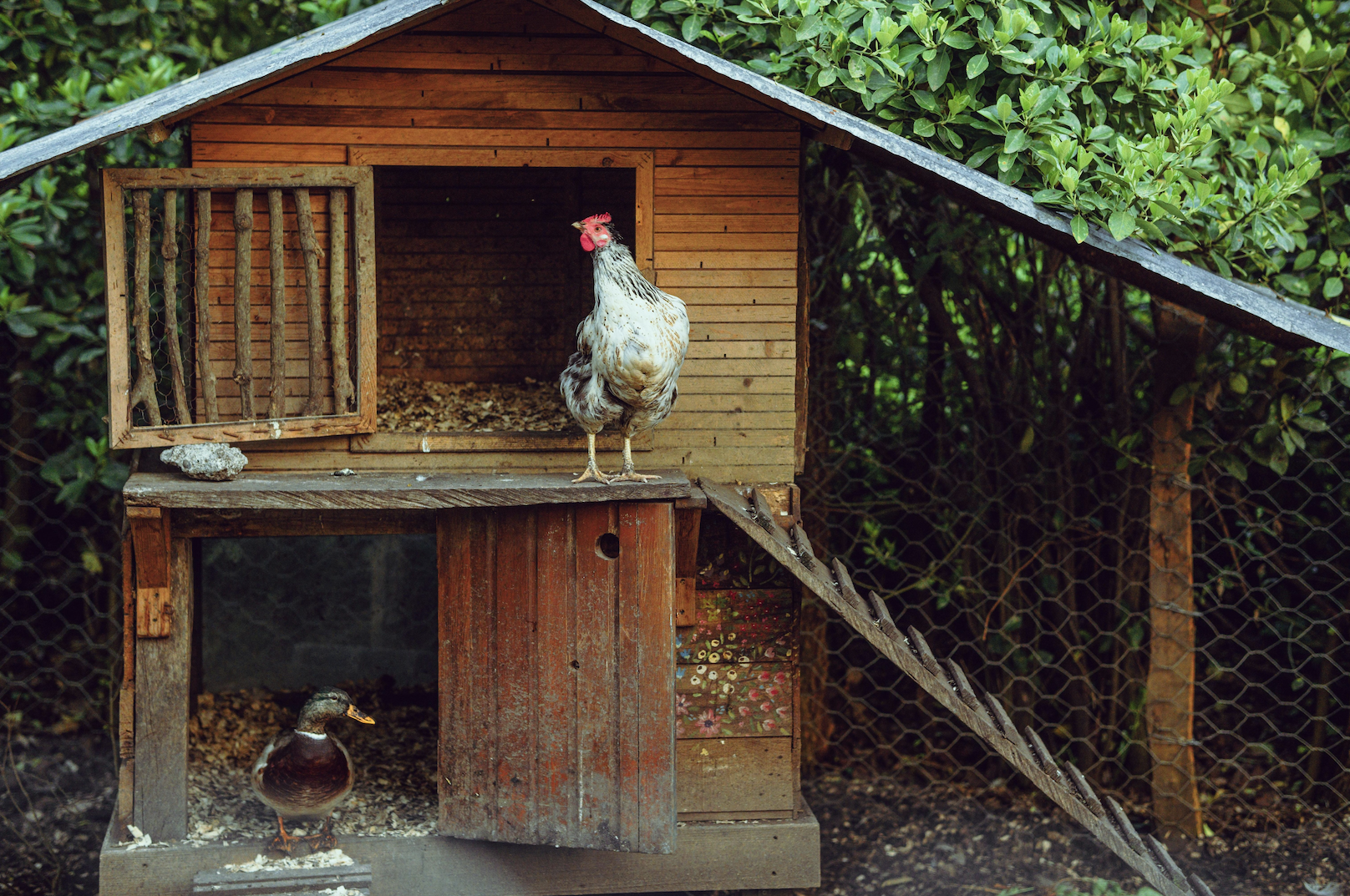
So, when the Harpy Eagles of the Strike and Ellacott Files were chatting about Strike’s “chickens coming home to roost” in last week’s podcast and issued a challenge for listeners to find pictures of chickens that looked like Cormoran Strike’s assorted girlfriends, I had to give it a try.Thus, I present to you, Cormoran Strike’s Henhouse, featuring every bird he slept with during the series to date, and a couple with whom he hasn’t.
Charlotte Campell (a.k.a. Milady Berzerko and ex-Viscountess of Croy) was dark, tall and monochromatically elegant, by far the most beautiful woman Strike has ever seen. She was also, per Dave Polworth, “f*cked to the core.”This Black Sumatra chicken is runway-ready, with its long black tail feathers both turning heads and rendering it perpetually off-balance. Though Strike broke up with her shortly before The Cuckoo’s Calling opened, she’s a perpetual presence, with her shade lingering even after her suicide.
Of course, it was a mistake for a Black Sumatra chicken to marry a dissolute arctic fox, even if he is a Viscount, right?
Ciara Porter, the alabaster-fair supermodel who got a literature degree from Cambridge in her spare time, was Strike’s one-night stand in The Cuckoo’s Calling. This white hen, sleek, perky and ornamental, seemed to fit her. While she seemed pretty cool in the first book and was nice enough to laugh in the faces of tabloid journalists in The Running Grave, she turned up again at God’s Own Junkyard in The Hallmarked Man, repeating Charlotte’s horrible “PP” nickname for Robin.
Strike claimed not to fancy small women, but that didn’t stop him from shagging Roper Chard editor Nina Lascelles three times in The Silkworm, twice as thanks for insider information on Bombyx Mori and Owen Quine, and once as a distraction from Charlotte’s wedding to Jago Ross. This choice made trouble for him in The Hallmarked Man, when her cousin Dominic Culpepper decided to trash Strike’s reputation in the tabloid press. Like this little Bantam, the Honorable Ms. Lascelles favored strappy black evening wear and was quick to challenge any lower-class dude she thought might be trying to gate-crash her party.
Elin Toft, former violinist, wealthy BBC presenter and Cormoran’s girlfriend during most of Career of Evil was also fair and beautiful like Ciara, but I pictured her with much bigger hair and fluffier plumage, making this fancy albino chicken the obvious choice.
In Lethal White, disgruntled that Robin chose to go on her honeymoon with Matthew, Strike drinks nine cans of lager and has an ill-advised one-night stand with Coco, Wardle’s wife’s best friend and a burlesque dancer with tomato-red hair, who was difficult to shake off afterwards. This Rhode Island Red seemed persistent, and also like the type to dump a glass of wine over the next chicken in our flock if she tries to swipe the rooster on which she’s set her eyes.
In addition to delivering the best parting line of any of Strike’s girlfriends, Lorelei Bevins was known for her jewel-toned vintage wardrobe and for wearing her hair over her eyes. She was Strike’s longest post-Charlotte relationship, dating him for about a year in Lethal White, but, when she asked him if he wanted the relationship badly enough to “try another way,” the answer was “no.”
Jewelry designer Madeline Courson-Miles looked a lot like Robin with her red-gold hair, but was very thin, relatively flat-chested and a mean drunk. Convinced Robin was repulsed by him after the Ritz, Strike kissed Madeline at a club on a New Year’s Eve to console himself over Robin’s jetting off to Zermatt with Hugh Jacks. He dated her for a few months in The Ink Black Heart but ditched her after perpetual jealousy over Robin and a lot of sh*t- stirring by Charlotte. Her stiletto heels could deliver a very painful kick.
Even though Strike never slept with Marguerite, it wasn’t for her lack of trying. After a failed attempt by Lucy to match-make them in The Silkworm, she re-appeared at the dreadful Christmas party in The Hallmarked Man, delighted to find Strike single again, so I had to include her. This bird’s outfit seems the closest to a silver caftan that a chicken can achieve and it absolutely seems to be trying too hard to make itself attractive.
Finally, no collection of Strike’s women-as-chickens would be complete without Bijou Watkins, a.k.a. “Her with the Fake Tits” and “Man-hungry Pain-in-the-arse.”She crashed Benjamin Herbert’s christening and had two quickies (one standing up against a wall) with Strike in The Running Grave, which led to an angst-producing paternity test in The Hallmarked Man.
So, do I have a chicken representing Robin Ellacott?Of course not. She and Cormoran Strike are the swans destined to swim alongside each other.
I hope you enjoyed these little nuggets of humor.
Louise M. Freeman is a retired psychology professor and a licensed behavior analyst. Her writings on Strike, Potter and other books can be found at The Farting Sofa Faculty Lounge, at www.fartingsofafaculty.substack.com.
In my previous blog, I noted that on the charm bracelet Rowling designed to auction for Lumos – a ‘sister’ bracelet to her own Harry Potter charm bracelet and based on her own sketches – included a butterfly charm. Rowling wrote about this charm bracelet:
It carries a collection of unique handmade charms that allude to stories and magic, including: a winged key, a tiny spell book and (for Harry) a bolt of lightning. The most precious charm of the lot is a little jewelled butterfly, which is the logo of Lumos – a symbol of transformation and liberation, of the beauty that can emerge from dark confinement.
There is a butterfly, likewise, in our trail of clues for Strike 9 – a butterfly that we are all hoping will also symbolise transformation, liberation and the beauty that emerges once you leave your own ink-black confinement and finally open your eyes to whom it is you truly love. Knowing that butterflies will be important for Strike 9 seems a good moment to have a look at how this ‘symbol of transformation and liberation, of the beauty that can emerge from dark confinement’ have functioned in Strike, and some of the literature on which it draws.
Primarily, of course, lepidoptera form the underlying metaphor for The Silkworm. The novel-within-the-novel is called Bombyx Mori – which is the name Rowling wanted to give her own novel likewise (although this was not something Galbraith was able to swing with his publishers!). Silkworms are the caterpillar of the Bombyx mori moth and another name for a silkworm is the “imago” of its moth. ‘Bombyx’ is the image/imago of Quine – like the silkworm he is a spinner of stories – and (or so Quine claims) full of the ‘essential innocence and purity’symbolized in the whiteness of both silkworm and moth. But there is also a butterfly in this dark, mothy novel and it not only belongs to one of its most innocent characters, Orlando, but also holds a clue:
A sheaf of crumpled pictures came out, on an assortment of different sized and coloured papers. Neither Strike nor Robin turned them over at first, but made admiring comments as Orlando spread them out across the table, Robin asking questions about the bright starfish and the dancing angels that Orlando had drawn in crayon and felt tip. Basking in their appreciation, Orlando dug deeper… [and] laid out a picture of a butterfly through which could be seen traces of untidy adult writing on the back…. There was a list of scribbled names on the back of the butterfly picture: Sam Breville. Eddie Boyne? Edward Baskinville? Stephen Brook?
This butterfly-clue (the names being such ordinary names show that another hand is present in Bombyx Mori) appears from the dark depths of Orlando’s bag and, just like a butterfly new-born, the pictures come out crumpled. Robin will smooth out the crumpled paper of thebutterfly’s wings to try and read those names just as a butterfly straightens out its wings as it emerges from its chrysalis. It is beautifully fitting that Rowling has placed a transformative clue on the back of this crumpled butterfly.
‘Chasing her own cheerfulness like a butterfly’
William Blake wrote a very short poem called ‘Eternity’ which I copied into my ‘learn-by-heart’ poetry-book as a child:
He who binds to himself a joy Does the winged life destroy He who kisses the joy as it flies Lives in eternity’s sunrise.
It seemed to me then (as it seems to me now), a good attitude to cultivate towards joy and Blake’s insight is borne out by modern happiness research, which suggests that we are happiest not when trying to be happy but when fully engaged in something else of which happiness is a by-product. In LethalWhite, this truth about the evanescence of joy is symbolised by a butterfly. It is a moment of reflection in a garden when Robin, gaining a free hour to think after chucking her therapist, chases her cheerfulness like a butterfly. I love this scene (and have written about a different aspect of it before), and Robin telling herself some home truths in this rose-scented churchyard prefigures the breakthrough Strike will achieve sitting alone in the St John the Baptist church in three novels’ time (I wrote about that, the greatest chapter of the series, here).
Chasing her own cheerfulness like a butterfly, because she was afraid it might escape, she turned up a quieter street… Peering through the opening, Robing saw a church and mossy tombs lying amid an empty rose garden in full bloom. (Lethal White)
‘Chasing her own cheerfulness like a butterfly’ is reminiscent of Blake’s winged joy and suggests that Robin is going the wrong way about things. Refusing to acknowledge what it is really is that brings her joy, she reflects in this Deptford churchyard – the churchyard where the author of one of Silkworm’s epigraphs Christopher Marlowe is buried (I love that!) – about her choice to stay with Matthew. The reader knows she needs to sit a little longer with the discomfort of her own decisions. Robin plays at being her own therapist here – understandably, given the uselessness of her first therapist. But real therapy needs another person, not just the person who is ineluctably predisposed to agree to the half-truths we tell ourselves. We have reason to believe that the Prudence-chosen sweary therapist, Dr BroccoliTM TSEF will lead to Robin truly spreading her wings in Strike 9.
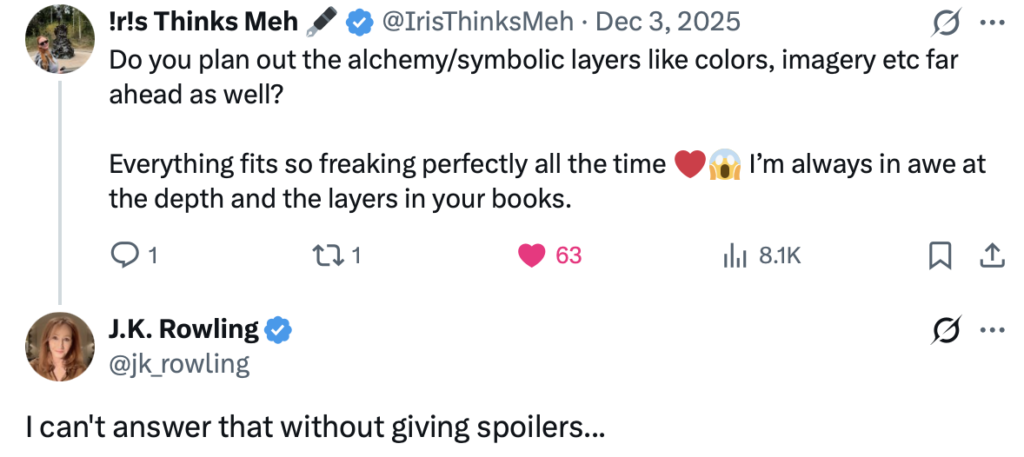
We know Rowling is a meticulous planner of imagery such as these two perfectly placed butterflies. Recently, we’ve had a nice bit of confirmation (thank you @IrisThinksMeh !) that this aspect of the books comes from Rowling’s Shed – her conscious writerly craft – not simply her Lake – her creative subconscious. When Iris asked Rowling on 3 December 2025, ‘Do you plan out the alchemy/symbolic layers like colors, imagery etc far ahead as well? Everything fits so freaking perfectly all the time. I’m always in awe at the depth and the layers in your books,’ Rowling replied ‘I can’t answer that without giving spoilers…’ So, has Rowling been planting clues leading to Strike 9 with her butterflies throughout the series?
We know that Rowling uses cratylic names with intention so it is interesting that Vanessa – a character who has rather flitted out of the story of late – is named for a butterfly. It is a name with impeccable literary credentials having been invented by Jonathan Swift from the name of his friend Esther Vanhomrigh – combining the affectionate diminutive ‘Essa’ for her first name with the start of her surname and inverting it. The name gains further literary and lepidopteral links via a Vanessa in Nabokov (as discussed here) and has likewise beengiven to a genus of butterflies.
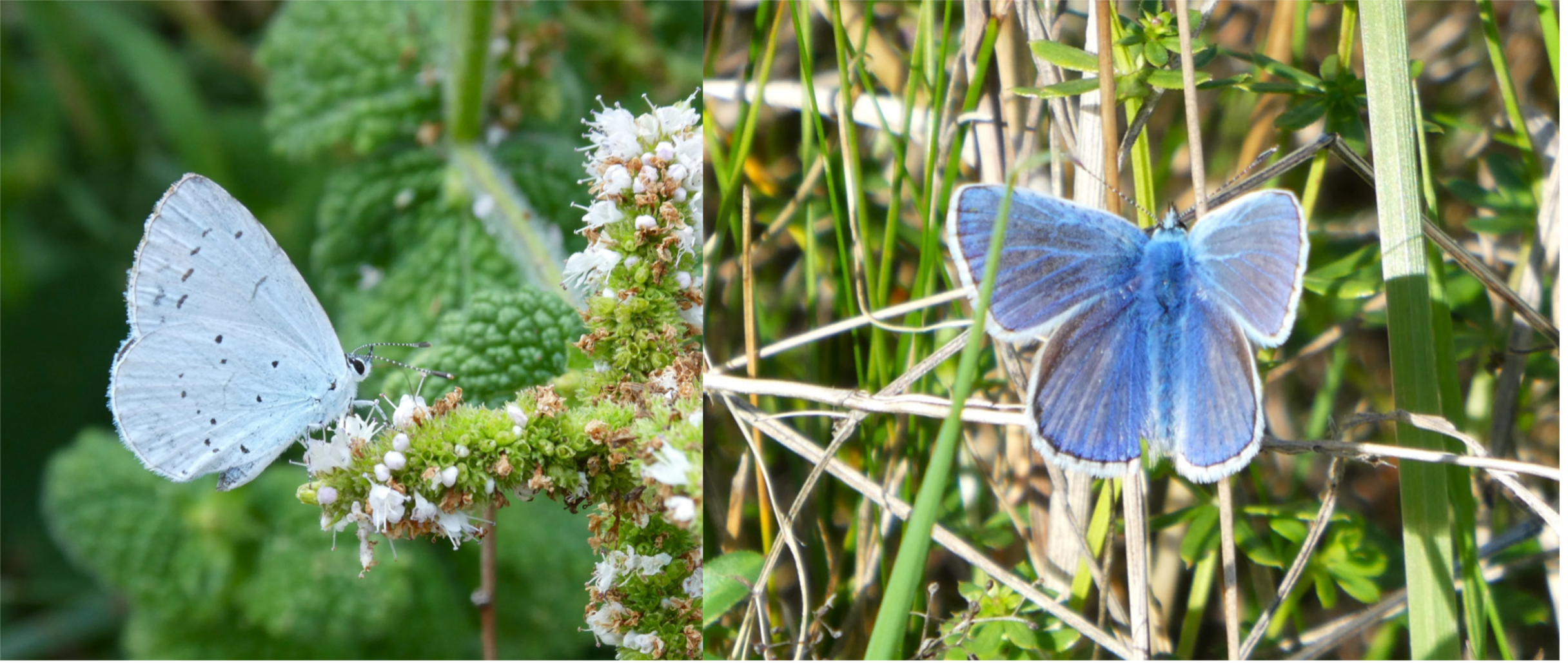
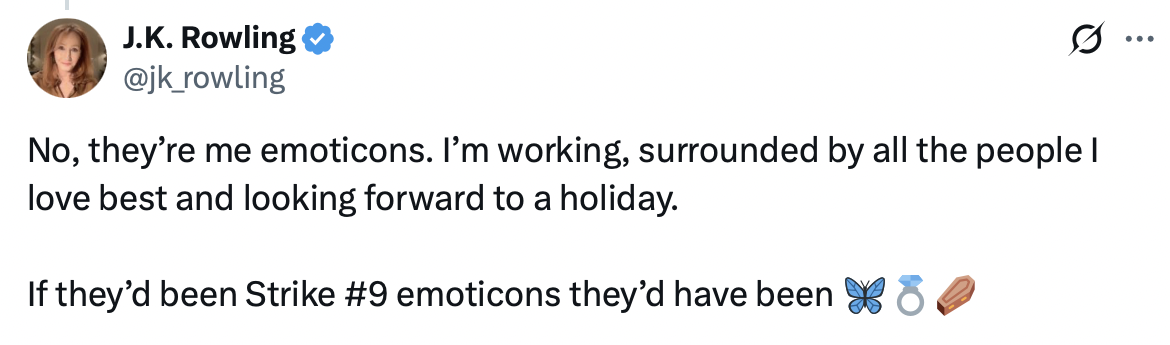
The Nabokov link is interesting for our purposes because he is not only linked with butterflies in general (he was even more passionate about entomology than writing) but with blue butterflies in particular. We can’t read toomuch into Rowling’s choosing a blue butterfly as her emoticon given that if you want to do a twitter butterfly emoji blue is the colour that you have … nonetheless, it is tempting! Partly, of course, because this is Cormoran Blue Strike’s colour, and likewise because he carries specific memories that Rowling has couched in lepidopteral terms: ‘He carried memories like this from his childhood, especially those parts of it that he had spent in Cornwall: the glitter of the sea as you first saw it on a morning as blue as a butterfly’s wing’ (Career of Evil). It is the morning, not the sea, which is as blue as a butterfly’s wing, but the simile circles back to the glittering ocean, for a butterfly’s wing is covered in tiny reflective scales, sparkling like the sea. And, as we know, the sea speaks to the depths of Cormoran’s soul: ‘it just adds something to his character because he’s drawn to the sea but that has such a strong association of childhood for him. So I always see it that way, when he heads for the coast we normally find out something character wise about Strike, that’s the significance for me.’
(Photos of some beautiful blues I saw this summer)
But another reason the blue of this emoticon butterfly feels resonant is because it is ‘Nabokov blues’ with which the novelist is most closely associated, and Nabokov is someone whom Rowling has placed along with Jane Austen, Colette and E. Nesbit as a writer whose style represents an ‘untouchable ideal’ to her.
I know about this link between Nabokov and blue butterflies because in 1922 the novelist attended my own alma mater – Trinity College, Cambridge – and a recent Art’s Week at the college was beautifully advertised with Nabokov’s blues:
The most famous of the ‘Nabokov Blues’ is the Karner Blue – described thus in his novel Pnin (1957): ‘A score of small butterflies… revealing the celestial hue of their upper surface … fluttered around like blue snowflakes before settling again.’ Nabokov’s connection with the Karner Blue has been credited with ‘helping to motivate conservation efforts to prevent its demise.’ And, Nabokov’s research into the Polyommatus blues has also recently borne particular fruit: ‘In a speculative moment in 1945, Nabokov came up with a sweeping hypothesis for the evolution of the butterflies he studied, a group known as the Polyommatus blues. He envisioned them coming to the New World from Asia over millions of years in a series of waves… On Tuesday in the Proceedings of the Royal Society of London, they reported that Nabokov was absolutely right.’ Eric Overbey notes, which may likewise be relevant to Rowling’s butterfly emoticon: ‘Blue butterflies can have some of the shortest life spans of any species, and Nabokov seemed particularly fascinated by this quality of ephemeral metamorphosis.’
‘His Psyche true’
‘The poor grub… expands into a beautiful form with rainbow wings. The Greeks called it Psyche, a manifest emblem of the soul’ (R. W. Emerson, 1906)
The most famous of Nabokov’s blues was first described by Nabokov in his paper ‘The Nearctic Forms of Lycæides’ which was published in 1943 in the journal Psyche. And, of course, the name of that august entomological journal – established in 1874 by the Cambridge Entomological Club – creates a delightful connection with something else we know about Strike 9. The meanings of ‘psyche’ as both butterfly and soul are linked together in the person of the mythic Psyche, whose name has more recently has been taken by Jung and transformed into the modern meaning of the word (if Dr Broccoli is, like Prudence, a Jungian this meaning of the word will also be in play in Strike 9). The Oxford English Dictionary explains the etymology of ‘psyche’ thus:
Ancient Greekψυχή breath, life (identified with or indicated by the breath), the animating principle in man and other living beings, the source of all vital activities, rational or irrational, the soul or spirit (as distinct from its material vehicle, the body, σῶμα), sometimes considered as capable of persisting in a disembodied state after separation from the body at death, (also) a butterfly or moth
Compare classical LatinPsȳchē, Psyche, the name of an allegorical personification of the soul, especially as occurring in the central episode of Apuleius Metamorphoses (2nd cent. a.d.). In classical literature, Psyche was personified as a beautiful mortal with whom Cupid fell in love: Venus was jealous of Psyche’s beauty and set her a series of superhuman tasks, after the last of which Psyche and Cupid were allowed to marry and Psyche was brought to heaven; she is represented in works of art as having butterfly wings, or as a butterfly. The name was extended by Plato and other philosophers to the anima mundi (see anima mundin.), conceived as animating the general system of the universe, as the soul animates the individual organism. Developing a distinction between ancient Greekπνεῦμα breath or spirit (see pneuman.; corresponding to Hebrewrūaḥ) and ancient Greekψυχή soul (corresponding to Hebrewnepeš), terms often used interchangeably in Greek-speaking Judaism, St Paul used ψυχή for the lower or merely natural life of man, shared with other animals, in contrast with the πνεῦμα or spirit, used as an anthropological term in relation to the divine πνεῦμα conceived as a new eschatological gift.
As Bulfinch’s Mythology (1881) – a work of popular mythology – explains it, the meaning of soul and butterfly are beautifully intertwined.
The Greek name for a butterfly is Psyche, and the same word means the soul. There is no illustration of the immortality of the soul so striking and beautiful as the butterfly, bursting on brilliant wings from the tomb in which it has lain, after a dull, grovelling, caterpillar existence, to flutter in the blaze of day and feed on the most fragrant and delicate productions of the spring. Psyche, then, is the human soul, which is purified by sufferings and misfortunes, and is thus prepared for the enjoyment of true and pure happiness.
Bulfinch could be writing about our heroes.
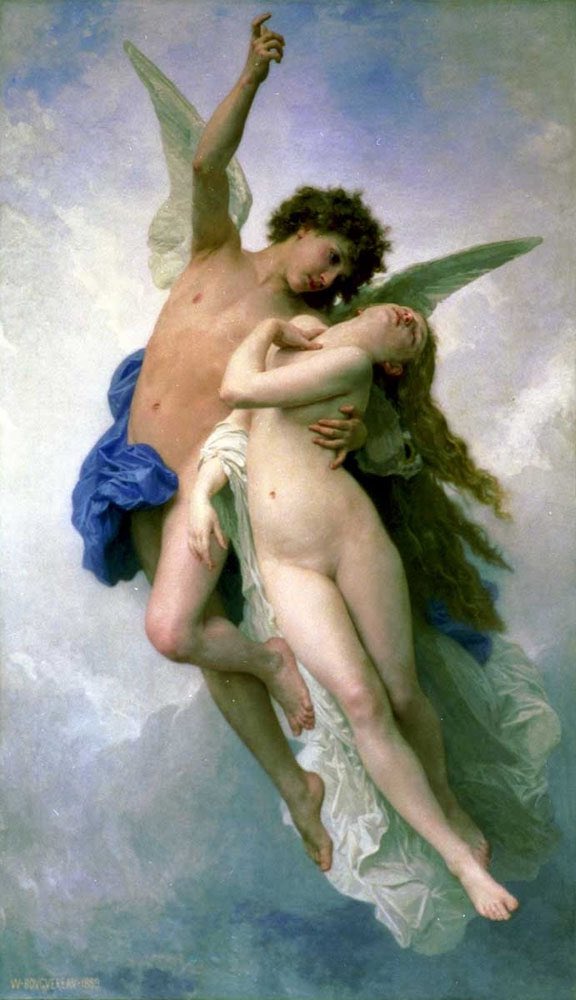
As Bulfinch likewise notes ‘in works of art Psyche is represented as a maiden with the wings of a butterfly’ and if you look closely at the painting Rowling has tweeted Psyche does indeed have a perfect pair of butterfly wings.
One of the reasons I am delighted by Rowling’s posting of this Psyche picture is thatKeats wrote a famous poem called ‘Ode to Psyche’ and we now know that Rowling studied Keats for A-level and remains a fan. It is a poem I’ve long loved – like Rowling I studied Keats at school, and I learnt ‘Ode to Psyche’ by heart and was asked to perform it front of the class (the subject of one of the most perfect back-handed compliments I have ever received when a teacher later gushed, ‘I will never forget your recitation of ‘Ode to Autumn’).
Keats’s knowledge of Psyche’s myth is drawn from Lempriere’s Classical Dictionary (1788):
Psyche, a nymph whom Cupid married and carried into a place of bliss, where he long enjoyed her company. Venus put her to death because she had robbed the world of her son; but Jupiter, at the request of Cupid, granted immortality to Psyche. The word signifies the soul, and this personification of Psyche first mentioned by Apuleius is posterior to the Augustan age, though still it is connected with ancient mythology. Psyche is generally represented with the wings of a butterfly, to intimate the lightness of the soul, of which the butterfly is the symbol, and on that account, among the ancients, when a man had just expired, a butterfly appeared fluttering above, as if rising from the mouth of the deceased.
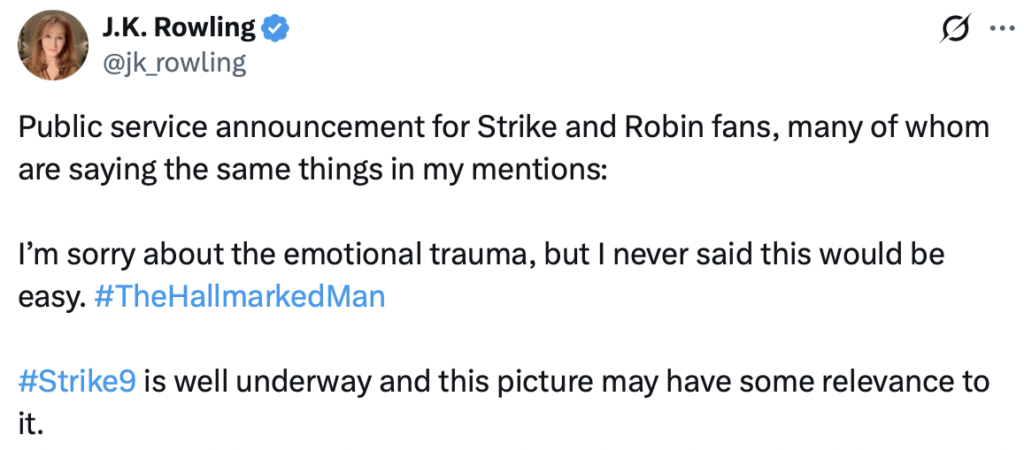
William-Adolphe Bouguereau – whose L’Amour et Psyché (1889) Rowling posted on 8 September 2025 – is one of those who depicts Psyche with butterfly wings, and Keats likewise stresses the winged-ness of Psyche – calling her ‘the winged Psyche,’ noting how her ‘pinions’ embraced those of her beloved ‘the winged boy’ and ending with a reference to her ‘lucent fans’ (shining wings). In both painting and poem the link between the two meanings of ‘psyche’ are made very clear.
Bulfinch’s Mythology notes that, in addition to Keats’s famous poem, ‘The allegory of the story of Cupid and Psyche is well presented in the beautiful lines of T. K. Harvey’:
“They wove bright fables in the days of old,
When reason borrowed fancy’s painted wings;
When truth’s clear river flowed o’er sands of gold,
And told in song its high and mystic things!
And such the sweet and solemn tale of her
The pilgrim heart, to whom a dream was given,
That led her through the world,–Love’s worshipper,–
To seek on earth for him whose home was heaven!”
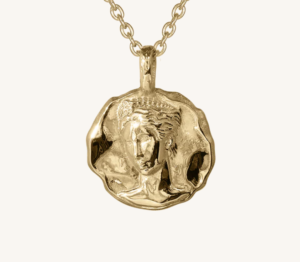
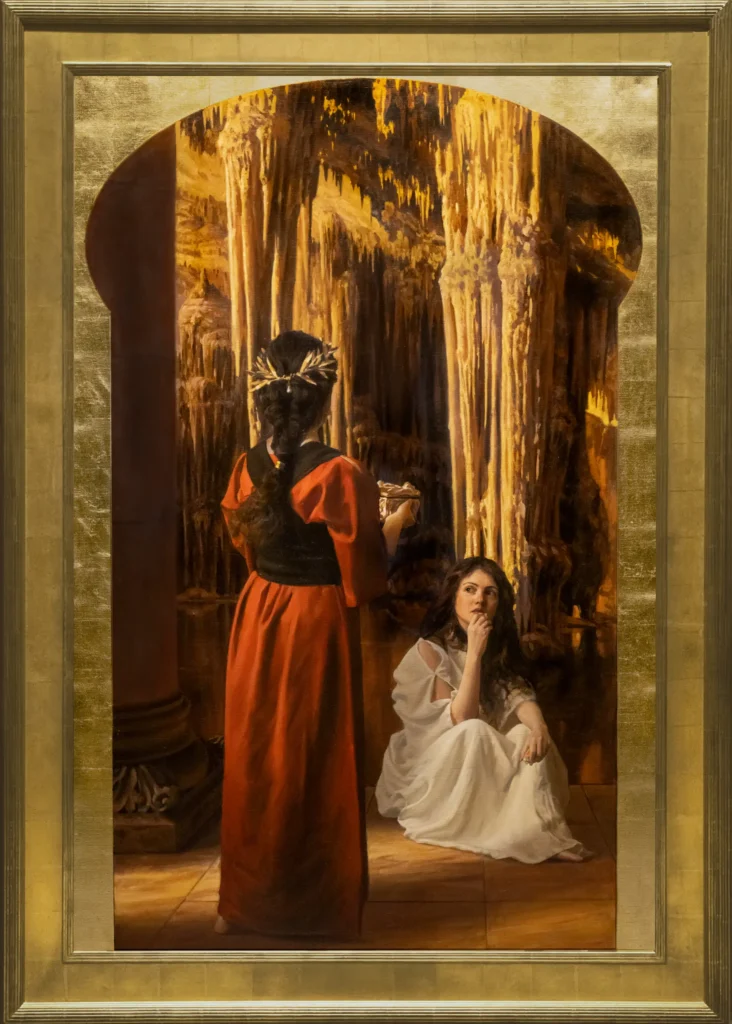
‘The pilgrim heart’ is a lovely phrase for Strike 9 and Bulfinch sets out all the trials Psyche must undergo as she undertakes this pilgrimage. One of them – as discussed on TSEF – is to take a box of the beauty of Persephone to Venus and this, of course, bring us back to the charm bracelet where were began, as next to the Book of Psalms is an image of Persephone. I love the idea on the charm-bracelet TSEF episode that the hour-glass charm links, via a time-sensitive case, to Psyche’s trials which – fairytale-like – all have to be completed within the day. Lindsay, on the TSEF episode, has suggested that the Persephone charm links with the case and points to a kidnap victim, which would create a fittingly time-sensitive plot.
In support of this idea is the fact that the first time that Rowling wrote about Persephone (in an essay which describes, with her trademark wry self-deprecation, her undergraduate studies in classical myth) she describes Persephone’s story as a ‘thrilling tale of kidnap’:
“What is the most obvious question we should ask about Theseus?” said Dr. Y, throwing the debate wide open. The question that popped instantly into my brain was, “Did he really exist?” Naturally, I did not utter it aloud. I knew that would reveal only too clearly my unsuitability to find out about Theseus. I sat in bitter silence, knowing that what he wanted was one of those not remotely obvious questions these classical types kept asking, which were always the cue for comprehensible stories to mutate suddenly into bizarre metaphors and symbols. Only the previous week a thrilling tale of kidnap starring one Persephone had turned out to be about crop storage.
A student we shall call Hugh, because that was his name, broke the silence.
“Did he really exit?” he suggested lazily.
“Exactly,” said Dr Y, with an approving smile.
A thousand curses. Just once, I could have earned an approving smile. I was sure my chance would never come again, and I was quite right.
Persephone is a beautiful goddess who is abducted by Pluto and taken down to Hades. Her mother Demeter (the goddess of Harvest) searches in vain for her and, in her mourning, forbids any plants from growing. Persephone comes back to the upper world, but Pluto has tricked her into eating six pomegranate seeds and, having tasted the food of the underworld, she is forced to return for six months every year. In ancient Greece, corn was kept cool and dark by being stored underground, and, at the time of sowing, Persephone’s return to the world was celebrated as a symbol of the corn ascending from its underground storage.
Rowling, however, rebelled against this literalist reading of the ‘thrilling tale’ of Persephone’s abduction as merely an explanation for the underground storage of corn and it is interesting to note – as Persephone’s myth looks to be playing a possibly important role in Strike 9 – that Harry Potter, likewise, rejects this rationalist reduction of myth. When Hermione argues with Professor Binns that there must be a kernel of truth in the legend of the Chamber of Secrets, she appears to be following the reasoning of Rowling’s classics tutors. Professor Binns (based on one of Rowling’s most boring lecturers) must accept Hermione’s point about the literal underpinning of myth because it is his own. But Rowling is here brilliantly turning the tables on dry tutors who evacuated myth of narrative excitement. In Harry Potter’s magical world, such academic interpretation retains, rather than undoes, the fundamental joy of the story, for the literal underpinning of the myth of the Chamber of Secrets is not an explanation of crop storage but the existence of a real Chamber of Secrets. Rowling puts the magic back into myth and doing so is her own, witty act of rebellion against the hyper-literalist interpretative school she felt had stripped Ovidian myth of its wonder. In the world of Harry Potter, apparently mythic places (such as the Chamber of Secrets) and apparently mythic objects (such as the Hallows) turn out, in fact, to be fact.
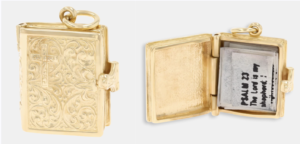
The Persephone medal is joined on the same loop as the psalm charm which (as I wrote in my previous post) probably contains Psalm 23. The underworld connects these two texts – Persephone as unwilling goddess of Hades and the Psalmist walking through the valley of the shadow of death in Psalm 23. If this connection is realised in a literal way in Strike 9, we may yet have a kidnap victim kept underground (maybe this will be the moment for J.E. Connor’s London’s Disused Underground Stations (2001) – a book hidden on Rowling’s homepage – to shine! ). The classical underworld likewise resonates throughout Harry Potter in the repeated formula of Harry’s yearly struggle with the forces of darkness in an underground space. In the first novel of the series, the connection of these spaces with the classical underworld is made explicit through its guardianship by a three-headed dog who is charmed by music (Fluffy is Hogwarts’s Cerberus) but there is also a more subtle parallel. In Philosopher’s Stone, the trio enter this underground chamber in a chapter which begins with Snape asking them to make a Forgetfulness Potion. Like figures from classical myth, they cannot enter the underworld until they have drunk from the waters Lethe: the river of Forgetfulness. The explicit connection with the Orpheus myth in Philosopher’s Stone, in the three-headed dog who is charmed with music, links the underground spaces of Hogwarts with the classical underworld. It opens up the possibility of reading the similar underground chamber of the following novel as containing a more subtle Orpheus allusion. In Chamber, in an optimistic rewriting of Ovid’s story, Harry goes down to the underworld and succeeds in rescuing the woman who will become his beloved from death. Hogwarts’s hidden chambers resonate with the stories of the classical underworld – of the loss of Eurydice and the abduction of Persephone – and respond to the exhilaration with which Rowling first responded to such stories. In a comic touch, when Hermione, Ron and Gabrielle are ‘taken hostage’ in the uncanny, underwater world of the lake in Goblet of Fire, Rowling reused a phrase she had earlier employed about the myth of Persephone being taken down to the underworld. Rowling wrote in the 1998 essay (quoted above) of this abduction of Persephone as ‘a thrilling tale of kidnap.’ When Ron tells tall tales about his underwater trials in the Triwizard tournament: ‘at first, he gave what seemed to be the truth… One week later, however, Ron was telling athrilling tale of kidnap in which he struggled single-handedly against fifty heavily armed merpeople’ (Chap 27). Ron’s kidnap into the dark waters of the Great Lake is a comic version of Persephone myth; I suspect we’ll be getting a somewhat darker echo in Strike 9 (but here’s hoping that, like Persphone, Ron, Hermione and Gabrielle, the kidnap victim will be returned alive).
‘The beauty that can emerge from dark confinement’
The charm bracelet is full of charms such as the ring case, the Trojan Horse and the psalm book box that hide things inside other things. I loved learning on the TSEF podcast that the original Jack-in-the-box was used to trap the devil (and can’t help noticing this is another trickster story linked with the name Jack – as is Jack the Giant Killer who traps the original Cormoran). The coffin emoticon links with this idea of containment as, in a sense, does the butterfly emoticon – a ‘symbol of transformation and liberation, of the beauty that can emerge from dark confinement’ as Rowling wrote. The Psyche story likewise has a box – rather like Pandora’s box – in which Psyche cannot help but look. But although she, like Pandora, is punished for looking into the forbidden box (which contains Persephone’s beauty) it is only sleep that comes out of it, rather than all the ills of the world. Cupid saves her by gathering up the sleep from her and enclosing it once more within the box. Psyche’s opening of the box forms a circle within the narrative, as it is a repetition of her curiosity and breaking of the fiat not to look at her lover at the start of the story – the transgression that brings on all her trials. But it is noticeable how much softer and more forgiving this myth is than so many similar myths. Unlike Pandora, who brings on all the evils of the world by opening a box, or Orpheus, who breaks the fiat not to look at his beloved and so condemns her forever to the underworld, Psyche is forgiven her transgressions. If Persephone’s charms links with the case, and Psyche’s image links with Robin,we can look forward to perhaps a happier resolution of both than the ‘wall-to-wall star-crossed lovers’ of The Hallmarked Man.
A thought to take away of the happy ending towards which we are all hastening – Psyche’s myth ends with her perfect union with Cupid and the birth of their daughter Pleasure. Or, as Keats – the most romantic of the Romantic Poets – puts it:
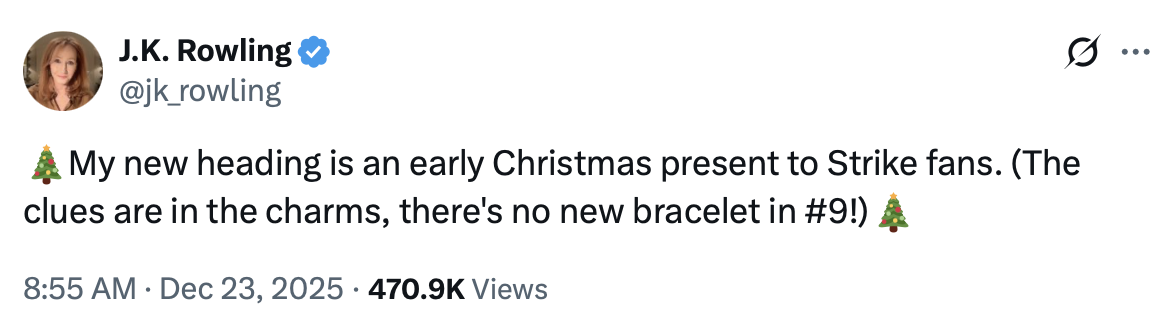
As most of us know, JK Rowling has long used her Twitter header as a way of giving readers clues about what she is currently writing. Strike fans, like myself, eagerly await the moment when a new header will arrive and head straight to Google to work out the clues. For Christmas this year, JK Rowling gave readers the perfect gift: a new header that contained not just one, but thirteen clues!
This gold charm bracelet features thirteen charms; thirteen clues for Strike 9. We’ll be going charm by charm (just like we did in Episode 10) to discuss what each charm could mean for Strike and Robin.
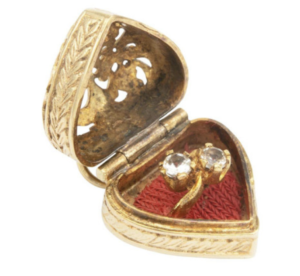
In addition to the Strike 9 emojis, this is the second diamond ring clue we’ve been given! The best thing about this ring is that, since there are two stones, we know this isn’t the sparkling shackle bought by Ryan Murphy. As Kenz said in Episode 10, this is called a “toi et moi” or “you and me” ring. Anyone else want to sing along to the Strike TV show theme song? “You and me. Me and you…:
My current theory is that the case for Strike 9 is going to involve an engaged couple, which would allow for a wonderfully tension filled connection to Robin who has two men who want to marry her. This ring could belong to this hypothetical case-couple. However, I do think that Strike is going to make every effort to show Robin just how serious he is about wanting permanence with her. I’m guessing that Strike’s efforts are going to include two major purchases: a new place to live (coincidentally suited for two) and a ring. Could this be the ring that Strike buys for Robin?
Kenz suggested another possibility, equally as swoon-worthy. The “toi et moi” ring was still quite popular in the 1960’s which would have been around the time Ted and Joan got engaged (after seven years of courtship!). Maybe Lucy has another memento of Joan’s that can be passed along to Strike!
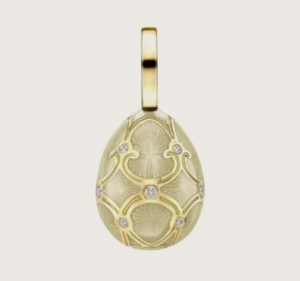
This one is a bit of a mystery as to how it could connect with Strike 9. Faberge Eggs are well known for elaborate designs that open up to reveal beautifully crafted surprises inside. In fact, there is a bit of a theme with a lot of these clues being things that open up to reveal something hidden. Maybe this will connect symbolically with Robin opening up her heart to find what’s really hidden inside (spoiler alert: she loves Strike!) or maybe we will see Easter celebrated as the most famous Faberge creations were made as Easter gifts.
We also know that Robin is still (sort of) contemplating what to do about her eggs. I suspect we will see her make a final decision in Strike 9.
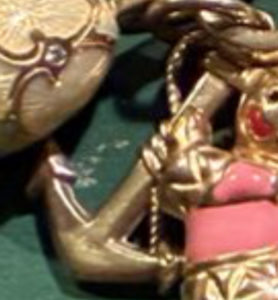
Anchor:
This charm was impossible to find. There are way too many options and not enough of the charm is visible to narrow it down; however, it IS on the same link as the Faberge egg. If this was a deliberate move by JK Rowling, maybe these clues must be put together.
According to this, “In 1909 Faberge produced an egg with a replica of the yacht “Standard.” This Easter masterpiece immortalized the beloved yacht of the last Russian monarch, who referred to it as his “dear Standard.”
Another here. I’ve also learned that an anchor is a key part of the official Russian hallmarks used on authentic Faberge items. Are we looking at a connection to Russia?
The first thing that came to mind when seeing this charm was a previous header of Tower Alley near Portsmouth and the connection to the Navy. Honestly, I want this to be true just to see Strike’s term of endearment for them!
Kenz reminds us that an anchor stands for stability, grounding, hope, and strength. We’re hoping for lots of settling down and anchoring in place for Strike and Robin!
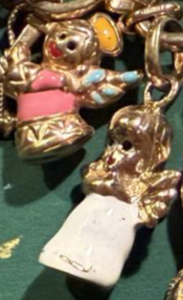
Two Angels:
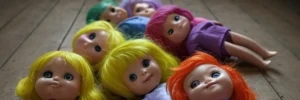
The angel in white was another charm that I wasn’t able to find and, unfortunately, the link for the angel in pink is no longer working. I honestly have no clue how this is going to connect to the book, but I can’t help but notice a slight resemblance to the creepy doll header!
It’s must be noted that this bracelet also includes a devil-in-a-box charm and the Book of Psalms. It seems possible that there will be some sort of spiritual element to Strike 9.
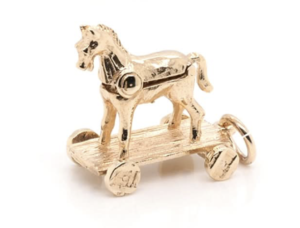
We all know what a Trojan Horse is, but how it will come to play in Strike 9 is still a mystery. We kind of had a Trojan Horse situation in The Hallmarked Man, so we can’t wait to see how it shows up – maybe we’ll get to see Strike ride a horse after all!
It was surprising to learn that the Jack-in-the-Box actually started out as devils instead of clowns. According to this, they were inspired by the story of a rector who trapped a demon inside his shoe. People later made intricate boxes with charming music with the intent of trapping demons. I’m really excited to see how this shows up in the book (especially since JKR said it was her favorite) and, again, I can’t help but wonder if there’s a connection with the angels and the Psalms. While we wait, I am reflecting on Robin’s need to face her own demons that she’s locked away for so long.
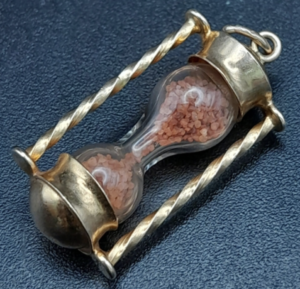
The hourglass is exciting because it could indicate a time sensitive case! A race against time to save someone?
White Rose of York:
We already knew from JKR’s York Minster header that we’d be traveling to Yorkshire, but this might suggest that we’ll be spending more time there than we had originally thought! This is a very exciting possibility for me because I would love to see Strike interact more with Robin’s family, especially Linda.
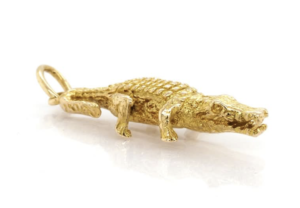
On its own, this one was a real mystery to me. However, because it’s on the same link as the white rose of York, I did some digging and think I’ve found an exciting possibility!
Crocodile Rock is a popular landmark in Northern Yorkshire and only about a thirty minute drive from Masham. Could there be a reason that Strike and Robin need to visit this rock during the course of their investigation?
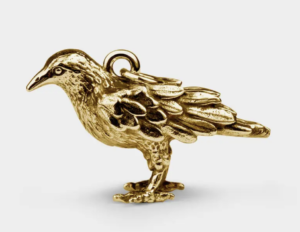
While I have no idea how this crow connects to the book, it’s not surprising to see a bird represented in charm form since we know JK Rowling has a thing about birds!
This is yet another clue we have for Strike 9 where something opens up to reveal something hidden inside. This charm features Psalm 23.
It’s hard to say right now whether the important part of this clue is Psalm 23 or if the whole book of Psalms will be relevant. My current theory, until we hear otherwise, is that the Psalms could be one of (if not the only) epigraph sources!
Recently, I made a post expressing how much I love when J.K. Rowling gives us insights into her characters through the epigraphs. Strike has been compared to a noble soldier (The Silkworm), the champion of true justice (Troubled Blood), and the superior man (The Running Grave). My friend and fellow Strike enthusiast, @happyrachy, shared that in the Psalms, the Hebrew word geber means man, strong one, or warrior. A geber is upright, with true integrity. Just a thought!
Beatrice Groves wrote a fantastic piece that suggests we might see the Psalms used to hide clues!
The Persephone charm is one of my favorites because of the idea it has sparked for me. Persephone is seen in the Story of Psyche and Eros when Psyche goes down into the underworld to collect Persephone’s beauty cream, but Persephone has her own story to tell.
Daughter to a loving, but slightly overprotective mother named Linda- sorry, I mean Demeter – Persephone is kidnapped by Hades and brought to the underworld to marry him and rule as Queen. Demeter is heartbroken and eventually finds out what happened to her daughter and they are eventually reunited (forgive me for the very brief overview).
My current theory is that the case of this book is going to revolve around an engaged couple (ring emoji and charm) and the mother of the soon-to-be-bride comes to Strike and Robin to ask them for help in finding her missing daughter. The hourglass charm makes me think that we might have reason to believe this woman is still alive, but she might not have much time left.
JK Rowling has already told us that Cupid and Psyche are important to the story and we are all extremely excited about what that means for Strike and Robin, but if Persephone connects with the victim of this case, I think we might see Robin (as Psyche) go into the underworld to rescue Persephone.
Given that Robin has two men who want to marry her and Linda as a mother, I have to imagine that Robin would feel a strong connection to an engaged woman with a loving, but slightly overprotective mother!
Psyche and the Palace of Persephone
Side note: Is it just me or does this version of Psyche look a lot like Holliday Grainger?
Let us know what you think about the charms and if you agree with any of our theories! I can’t wait to read Strike 9 and see how wrong I am about everything!