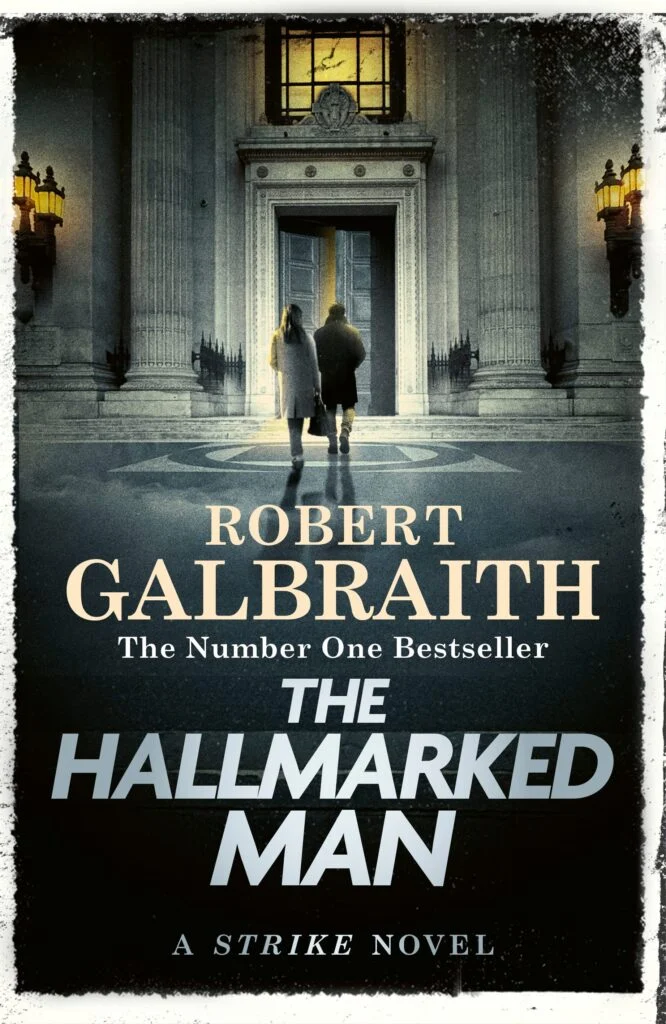
This week the cover for The Hallmarked Man, Robert Galbraith’s 8th book in the Cormoran Strike series, was revealed. And my word, is it gorgeous or what? It immediately made the top three of my favorites alongside Troubled Blood and The Ink Black Heart. We have no confirmation yet, but the book’s jacket is most likely created by Little, Brown’s Duncan Spilling, who also worked on the other Strike book covers.
I’m happy to share some thoughts on the wonders of this amazing cover. Because there is so much to say about the blurb that was also released this week, I’m intentionally leaving most of that out. It’s very much worthy of an entire blog of its own.
The Moment Before Entry
This is the first time we see Robin and Strike about to actually enter a building. So far, all covers show them outside in a deserted street, or in front of a building looking sideways. Now they are in motion, committed to going inside.
Grey Outside, Gold Inside
Everything outside is grey-toned and cold. There’s a warm glow coming from the lights that guide Robin and Strike to the open door. A similar golden light shines from behind the window. It could symbolise a coming truth, or emotional clarity that awaits them inside the building. Is this the start of ‘A Golden Journey’?
Cormoran Leads the Way
Another first is Cormoran being followed by Robin. He could be taking the lead due to the specifics of this investigation. The Freemasons are a brotherhood of men, and this could mean that Strike has easier access to a space where women are historically excluded. The way Strike is positioned also made me think it is a protective stance. He is slightly in front of her, but a bit to the side (yes, I’m over-analysing this 100%, and there’s a lot more of that to come). The subtle positioning still suggests that, professionally, they are entering as equals and partners, despite him leading the way.
You could also look at their positioning through an interpersonal lens. Cormoran is one step ahead of Robin when it comes to sharing his feelings for her, and is leading the way in that regard. An exciting thought from the ‘you’re clearly seeing what you want to see department’: strictly looking at the covers, Cormoran followed Robin for seven books. The roles are now reversed with her following him. Looking at where we were left at the end of The Running Grave, this is so meaningful. Perhaps she will follow his lead into truth and (emotional) intimacy.
Robin’s Burden
One of the first things that caught my eye when looking at this cover was Robin’s bag. I love me some handbags, and I instantly locked in on the large tote that Robin is carrying. While I can’t tell if it’s an actual handbag or a briefcase, if the bag is hers, both could symbolise her carrying weight, professional (I hope not too much after the draining work she did in TRG), or emotional. It could symbolise the weight of choices she made, unsaid feelings she carries around, a heavy loyalty she feels towards ‘Murphy-whats-not-to-like’, or difficult choices that still need to be made. She looks prepared, but weighed down. Chances are that the size of the bag isn’t just a coincidence.
Circles, Squares and Meaning
Both main characters are mid-step and about to cross a large symbol that’s visible on the floor. It’s a masonic war memorial, showing a large circle with a square inside. In Masonic symbolism, the square is actually the carpenter’s square, an L-shaped tool builders use to make sure everything’s perfectly straight. This is where the phrase ‘squaring your actions’ comes from. The circle stands for unity, eternity and spiritual truth. Together they show squaring the circle. It could symbolise a test of logic and emotion in Robin and Strike’s relationship, or a test of moral integrity in a case full of secrets.
The fact that this symbol is also a war memorial is an interesting link to Cormoran’s background in the army. I’m curious if that’s a coincidence. (Probably not).
Approaching the Light
Robin and Strike are walking towards an open door. The golden lights are on. It suggests they are invited, even though the door is only slightly ajar. While the welcoming lights inside could mean enlightenment, revelation and truth lie ahead, it could also be a potential danger. They could be heading for a fool’s gold (well, silver, but you know), or acting like moths heading towards a flame. Or are these golden lights in any way linked to the James Elroy Flecker header?
A Feminine Frame
And then there’s the silver font of the title. Jo has offered more than one hint about silver being important in this book: there was a bracelet, Sark, the island known for its silver, a silver neff, music (Silver Bells), and of course the title. But here’s where it gets interesting. The metal itself stands for the feminine, intuition and reflection. In contrast: think about the story we’re getting. There’s a man at the centre of the plot, we have a setting that centres around a brotherhood (the Freemasons), and a title focused on a man. A hallmarked man who I suspect is Strike himself, by the way.
From Troubled Blood, chapter 22:
Could the agency, for which they’d both sacrificed so much, which for Strike represented the culmination of all his ambitions, survive the partners falling into bed together? However he reframed this question, the answer always came back ‘no’, because he was certain, for reasons that had to do with past trauma, not from any particularly puritanical streak, that what Robin sought, ultimately, was the security and permanence of marriage. And he wasn’t the marrying kind. No matter the inconveniences, what he craved at the end of a working day was his private space, clean and ordered, organised exactly as he liked it, free of emotional storms, from guilt and recriminations, from demands to service Hallmark’s idea of romance, from a life where someone else’s happiness was his responsibility.
Yet, there’s a silver feminine that frames the heart of the story. Many of us eagerly wait to find out how Robin and Cormoran’s relationship proceeds in this book. Cormoran has made it clear how he feels (at least to us readers), and he was left in the dark with regards to how Robin felt. Everything hangs on her response. Will she reciprocate? Won’t she? When and how will she let him know? Whatever choice she makes will have major consequences for the final books. It seems as if The Hallmarked Man has an intentional, and amazing balance of male and female layers that are connected to silver!
Hear, See, Be Silent
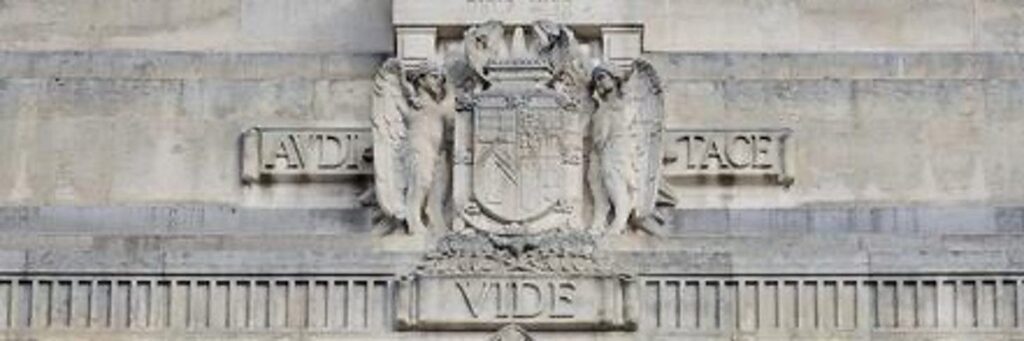
Lastly, the header J.K. Rowling shared at the beginning of 2024 shows a central coat of arms or a heraldic shield of sorts, surrounded by the words: Audi, Vide, Tace. It appears above the entrance of the Freemasons lodge. The Latin words translates to ‘Hear, see, be silent’ and is a motto often used in Freemasonry.
The complete phrase is ‘Audi, vide, tace, si vis vivere in pace’ and translates to ‘Hear, see, be silent, if you would live in peace’. The ‘si vis vivere in pace’ is missing from the building and the cover, but the full phrase feels like a fitting mirror for the relationship journey Robin and Strike are on.
Audi: hear. Robin heard Strike’s confession of love…right? Vide: see. They see each other for who they are…right? Tace: be silent. From what we learned from the blurb, Robin may choose not to speak about his confession, or her feelings, yet. But if you want to live in peace…speaking out might just be an absolute necessity. You’re welcome for the unsolicited life advice.
Reflections
Collectively, all the elements offer a final interesting idea: the positioning of the main characters, the smooth polished floor, the twinning beacons of light, the silver font, even the two pillars next to the entrance: they all evoke mirroring. I hope Robin and Strike are about to face reflections of themselves (and each other) between the covers of this book, and that we’ll gain more insight into who they are, what drives them, and why they make the choices they do. I can’t wait to dive into this book and find out more!
While rereading The Running Grave, I usually feel less tense after Robin leaves Chapman Farm. However, this time, my stress levels spiked again in Chapter 95, when Murphy finally appears at Robin’s flat—after a four-month separation and his return from San Sebastián in northern Spain, about a week after Robin escaped the UHC. This encounter awakened in me a fear that Murphy is truly a bad person and has prompted me to study his character throughout TRG, especially after Chapter 95.
I acknowledge that much of this is speculative and covers topics that have been extensively discussed. The brilliant team atThe Strike & Ellacott Files Podcast has conducted a thorough and unbiased review of most, if not all, of these points. Their analysis offers a much better balance than anything written here. The synopsis for The Hallmarked Man (THM) contains the worrying line: “Robin seems increasingly committed to her boyfriend, policeman Ryan Murphy” Therefore, my overly optimistic hope that Robin would immediately join Strike at the Flying Horse seems to have been shot down. It appears we will have to put up with Murphy further into THM than many would have liked.
My analysis is entirely biased and unapologetically critical of Murphy. I never afford him the benefit of the doubt; whenever I can interpret his actions negatively, I seize the opportunity. Therefore, if you are #TeamMurphy, you may prefer to skip this blog.
My intention is not to show any disrespect to Robin, who demonstrates incredible resilience and determination. Everything written here stems from the love and admiration I have for her. At the beginning of her relationship with Murphy, he is kind and supportive. She cannot perceive, as we can through the narrative, the broader aspects of Murphy’s character. Much of what I have written is based on this perspective. Robin also endures intense personal pressures for four months in the UHC without any support. Her emergence from this ordeal highlights what a remarkable woman she is, though the wounds must run very deep.
Nonetheless, I am determined to compile a comprehensive list of anti-Murphy points, in the hope that perhaps one of them is close to the fictional truth. This endeavour may help me find peace regarding Murphy’s role—hopefully short lived —in THM.
Apologies to the real Ryan Murphy in the Met—someone must have informed him about the books! Of course, everything written here is purely fictional.
In her question-and-answer session on 19th September 2023, J.K. Rowling, when discussing Murphy, posed the question, “What’s not to love?” Well, here I go…
Chapter 8: Wardle Reveals Some Background on Murphy
In this chapter, we see Murphy making an effort to up his game by taking Robin to a play. Naturally, this irritates Strike, who reflects that Murphy should have stopped pretending he’d rather watch a play than have a decent meal followed by sex.
Strike takes Wardle for a posh curry, and the two discuss at length the murder of Kevin Pirbright. At the end of the conversation, Wardle asks, “Robin still seeing Ryan Murphy?” “Yeah,” says Strike. Wardle then reveals, “You know he’s an alcoholic?” This is news to Strike.
Wardle goes on to describe Murphy as:
“A mean drunk. Real arsehole. Aggressive. Made a pass at anyone in a skirt. Tried it on with April one night. I nearly fucking punched him.”
In Chapter 72 of The Ink Black Heart, Murphy devises a plan to ask Robin out. He identifies himself to her as an alcoholic, stating, “Just need to put that out there. It’s what you’re supposed to do. AA rules.”
However, Alcoholics Anonymous (AA) doesn’t operate on strict rules; instead, it offers guidance, with anonymity being a fundamental choice for members to decide upon. There is a framework known as the Twelve Steps of Alcoholic Anonymous, many of which involve spiritual undertakings that may not align with Murphy’s character. There’s no indication that Murphy has actually joined AA. Recovery typically involves attending multiple meetings and engaging with other members. Those in recovery often use the discreet phrase “Are you a friend of Bill?” to identify fellow members. The title itself offers a clue about the overall approach adopted by this remarkable organisation, which has helped so many on their path to recovery.
Murphy, however, doesn’t exhibit the language or behaviour characteristic of someone actively engaged in recovery. The aggression that Wardle mentioned seems not solely linked to his drinking; it may persist even when he’s sober. Murphy’s behaviour doesn’t resemble a Dr Jekyll and Mr Hyde transformation; rather, he appears to be a calculating predator. His disclosure seems to be a tactic aimed at eliciting sympathy from Robin and persuading her to go out with him.
Chapter 92: Does Murphy Actually Want to Come Back?
In this chapter, Robin mentions to her mother that Murphy is due to return “next Sunday, unless he gets an earlier flight…” Honestly, if Murphy truly wanted to come back sooner, he could have found a way—connecting flight, ferry, whatever. It seems clear: he found someone else in Spain and stayed as long as he could. Classic Murphy.
Chapter 95: Murphy Finally Returns from Spain
At the start of this chapter, Murphy finally shows up. He has sex with Robin—who is tipsy and vulnerable—and then says, “I realised something while you were away. I love you.”
Really? This is from the guy who hadn’t even planned to stay the night because he had work the next day and needed to leave at 6 a.m. to change? It felt like pure emotional manipulation. He knew exactly what to say in a moment of weakness.
Also, this is the first time we see her using condoms instead of the pill while with Murphy. That raised a red flag. I pray Murphy was nowhere near them with a pin.
Robin feels dismayed by how relieved she felt not to have much time to talk to her boyfriend after he left, and she went to meet Strike. I feel relief that Robin and Murphy’s reunion lasts less than a page in the book
Chapter 99: Murphy’s Unpreparedness and Emotional Insensitivity
In Chapter 99 of The Running Grave, Robin visits Murphy’s flat to review footage of police interviews accusing her of child abuse. Murphy’s contact was unable to obtain all the recordings but did secure copies of three interviews with UHC members. Murphy’s decision to share these leaked materials is reckless; if discovered, it could jeopardize the case.
Notably, Murphy hasn’t thoroughly reviewed the footage himself. He struggles to recall Becca’s surname—”Who? Becca some—”—prompting Robin to interject, “Pirbright.” Considering the gravity of the accusations against Robin, one would expect Murphy to have studied the materials diligently and prepared notes. In contrast, Strike would likely have conducted a comprehensive analysis and guided Robin through the key points from memory.
The review process places Robin under significant strain. Murphy’s attempts to suppress her emotional reactions demonstrate a lack of understanding of the PTSD she is likely experiencing. He moves his chair closer to her at the end of the review to “put his arms around her,” but such support should have been offered from the outset. Shortly thereafter, Robin pulls away from his embrace. The review concludes with her stating, “I just need to call Strike.”
Following a discussion about the review, Robin ends the call. The narrative doesn’t specify how soon Strike contacts her to inform her of Carrie’s suicide, but Robin had brought her overnight bag, indicating she intended to stay the night. Given the circumstances, the likelihood of her receiving adequate support from Murphy upon hearing such devastating news seems remote.
Chapter 115: The Wrong Food and a Cross-Examination
In this chapter, Murphy thoughtlessly brings a meal containing noodles—surprising, given Robin’s strict noodle-and-slops diet at the UHC. This oversight exemplifies Murphy’s inattentiveness and lack of consideration.
The chapter marks a shift in Murphy’s attitude toward Robin, becoming more possessive since his impulsive “I love you” declaration in Chapter 95. Murphy questions Robin about spending the night at the office, obsessing over Strike’s whereabouts during that time. He cross-examines her so intensely that she feels compelled to lie, claiming Strike is dating a lawyer, whom she knows he has already broken up with. This fabrication, after a few more probing questions, finally ends the interrogation.
Notably, Murphy never expresses genuine concern for Robin’s well-being; instead, his behaviour suggests he believes his new role as her partner entitles him to certain expectations. Robin reflects on these developments at the start of Chapter 116, but, as often happens, she struggles to reach a definitive conclusion.
Chapter 119: The Police Interview Strike & Robin After the Shooting
In this brief chapter, both Strike and Robin are questioned separately about the car chase and shooting that occurred on their way back from the meeting at Prudence’s house. After her interview concludes, Robin returns to the waiting room. With a sense of dread, yet knowing she has no choice, she calls Murphy to inform him of the events.
Murphy shows some concern but quickly shifts to establishing a new set of rules for Robin. Typically, he doesn’t drop everything to come to her aid. When Robin mentions she’ll call an Uber to get home, Murphy replies, ‘Don’t call an Uber, for Christ’s sake. Let one of the cops take you home.’ He could have arranged this with a simple call. One would think he’d want to be with her after she was shot at.
At the end of the call, she murmurs, ‘I love you too,’ hoping Strike doesn’t hear as he emerges from his interview. Strike, surprised that Robin is still there—probably expecting Murphy to have come to take her home—takes the opportunity to support her. They decide to go for food, and, ignoring Murphy entirely, they take an Uber.
Chapter 122: Robin Tries to Prevent Murphy Getting Cross with Her or Strike
At the end of this chapter, Strike is pressing for police action and is considering getting his journalist to write something. “Would you mind not?” said Robin. “Or not unless it’s absolutely necessary?” Robin senses that Strike’s actions will cause problems between her and Murphy, and perhaps Murphy isn’t that fussed about helping his girlfriend get some closure on her recent ordeal. This mirrors how she behaved with Matthew.
Chapter 123: ‘That’s Not a Threat, Is It?’
In this chapter, all of the agency’s key police contacts and Murphy gather in the basement of the Flying Horse. Strike is running late, and Robin has ordered for him in advance—a gesture that Murphy cannot help but show irritation at.
‘Robin sensed undercurrents between Wardle and Murphy: the latter had become peremptory and curt in manner even before Strike arrived.’ It’s not difficult to understand the tension between the two, especially since Murphy had made a pass at Wardle’s wife.
Will reveals the fate of Jacob, and the shock hits Robin so hard that she is reduced to a single word: ‘Oh.’ Strike becomes aggravated with the lack of police action and tries to encourage the police with, ‘There is going to be a glory in this, for whoever takes the UHC down… and I’ve already got a journalist who’s gagging to run an exposé.’
This ignites Murphy into the conversation at last with, ‘That’s not a threat, is it?’ Robin immediately puts him down with, ‘No… it’s a fact,’ and has to explain the significance of every day of delay to Murphy and the other attendees. After this, Murphy says nothing more.
Murphy’s lack of support for Robin—his indifference in getting the case resolved so that his girlfriend can move towards closure—could not be clearer. Taking no notes, not promising any action, his only concern is his jealousy towards Strike. He manages a goodbye kiss with Robin, who no doubt is still in a state of shock about Jacob and the moving of Kevin to the vegetable patch. Murphy’s intention is clearly to stake his claim over Strike.
Chapter 125: Murphy Puts a Tracking Device in Robin’s Phone and the UHC is Raided
This chapter begins with Robin experiencing issues with her phone. Pulling her mobile out of her bag, she notices with frustration that it is almost out of power: either it hadn’t charged properly at Murphy’s the previous evening, or, which she thought more likely given its age, she needs a new phone.
Is it just coincidental that this happens after being with Murphy, who is now totally focused on managing his new “possession”?
We saw in Ink Black Heart that Murphy was well aware of how it’s possible to track someone through their phone without them knowing.
In Chapter 89 of Ink Black Heart, Murphy tells Strike and Robin, talking about Philip Ormond: “Confidentially, he eventually fessed up to having put a tracking app on Edie’s phone so he could put tabs on her.” It is known that tracking apps put a disproportionate amount of load on mobile phone batteries.
Next, we learn that Robin is “supposed to be meeting Murphy at a bar in the middle of town at seven.” Now, you would be very hard-pressed to find anybody in recovery within AA who would suggest going to a bar to meet someone on your own as a good idea. It’s unlikely that Murphy could expect they would arrive at the same time, thus exposing himself to being in the bar alone. There are lots of guidance notes about who you should go with, and the general advice is to avoid high-risk environments. Bars are designed for alcohol consumption, making them inherently risky for those in recovery. Even if you’re not drinking, the atmosphere can trigger cravings or lead to unintended consequences.
Murphy’s self-declaration about being an alcoholic seems more and more about pulling on Robin’s heartstrings rather than a determined effort at recovery.
When Robin arrives in the office, Strike, who had become very concerned about Robin’s safety, has a short, terse conversation with her, and Strike says angrily, “You need a new fucking phone.” Indeed, she does!
Strike breaks the fantastic news that “They raided Chapman Farm at six this morning,” and that Wardle is part of the raid squad. It should come as no surprise that Murphy is not with them; even with other work pressures, a concerned boyfriend would have made sure that he was part of the end process.
Strike and Robin go upstairs to Strike’s bedroom and start watching the breaking news on the television.
“Someone at the Met’s leaked,” said Strike. “Said there’d be glory in it, didn’t I?”
There are fewer than a handful of London police officers who would be aware of the impending raid, Murphy, of course, among them. My sense is that Murphy is consistently leaking information to the press; maybe they have something over him (see later in this blog), and therefore he leaked it and stayed well away from the raid.
Later in the chapter, Robin charges her phone and, having delayed her departure to meet Murphy by having a coffee with Strike, learns that Becca might be at the temple around the corner. She calls Murphy and cancels her dinner date. Murphy, it seems, doesn’t get much opportunity to speak, and Robin leaves with Strike with an undercharged phone battery.
Chapter 133: Murphy Cleans Up After Strike
At the end of his lengthy interview with Abigail, Strike says, “This is Detective Inspector Ryan Murphy of the Metropolitan Police. I wouldn’t make too much trouble when he arrests you. He was supposed to be having dinner with his girlfriend tonight, so he’ll be in a bad mood already.”
Can you imagine how cross Murphy must be at just doing the sweeping up? His complete lack of engagement with the police process shows that this is all he deserved.
Chapter 134: Murphy Out of Sync with Robin
In this chapter, we learn from Robin that Murphy was inclined to be triumphalist about the Church’s demise. However, this perspective is clearly at odds with Robin’s own feelings. Murphy told her she was being too pessimistic, but Robin holds a more realistic view, given how little recent events have changed Becca.
Chapter 136: The Final Moments
As we reach the conclusion of The Running Grave, Robin enters the office, breathless. “Oh, good,” she pants. “He’s not here yet—Ryan, I mean.” Her relief is palpable; despite being late, Ryan is even later. This is classic Murphy—failing to prioritize his time, leaving Robin waiting. It seems likely that their plans didn’t involve a strict train or plane schedule.
Murphy’s final contributions are a casual “hi” to Strike and a congratulatory remark. “Congratulations,” he says.
“What for?” Strike responds.
“The church case,” Murphy replies with a half-laugh.
“Oh, that,” says Strike. “Yeah. Well, it was mostly Robin.”
While Strike acknowledges Robin’s pivotal role in dismantling the Universal Humanitarian Church (UHC), Murphy fails to grasp the extent of her sacrifices. Robin’s undercover operation exposed her to severe physical and psychological trauma. She endured weeks of sleep deprivation, malnutrition, and constant threats of violence and sexual assault. Her experiences included being locked in a box for hours, nearly drowning during a forced baptism, and facing attempted sexual coercion by the cult leader’s son. These harrowing events exacerbated her existing post-traumatic stress disorder (PTSD), stemming from a previous violent attack that had already left deep scars.
Despite her critical role in exposing the UHC’s criminal activities—including sexual abuse, unreported deaths, and child trafficking—Robin’s contributions are downplayed by Murphy. Murphy’s lack of understanding underscores a recurring theme: Robin’s resilience and dedication often go unnoticed or are undervalued. Her experiences at the UHC serve as a stark reminder of the personal costs associated with her line of work and the need for greater support and recognition from those around her.
Looking Forward to The Hallmarked Man (THM)
The predictions based on J.K. Rowling’s headers are covered brilliantly by Dr Beatrice Groves. These are now all listed on the Hogwarts Professor site:
How she has managed to create all these insights based on just four images is remarkable!
My Attempt at a Prediction Focusing on Murphy:
J.K. Rowling’s Freemasons’ Hallmarked Man Header as the First Clue for The Hallmarked Man
Historically, there have been concerns about Freemasonry’s influence within the police. This is where Murphy could potentially fit in.
Although there is no requirement for officers to officially declare membership, Metropolitan Police Commissioner Sir Kenneth Newman advised officers to reconsider their membership due to potential conflicts with their duty of impartiality. In his 1985 publication The Principles of Policing and Guidance for Professional Behaviour, Newman stated:
“A Freemason’s oath inevitably holds the implication that loyalty to fellow Freemasons may supersede any other loyalty. One who is already a Freemason would also be wise to ponder from time to time whether he should continue as a Freemason.” — Sir Kenneth Newman
Operation Tiberius, an internal Metropolitan Police investigation conducted in 2002 and leaked in 2014, highlighted issues of corruption linked to Masonic associations. The report found that criminal organisations had used Freemasonry connections to “recruit corrupt officers” within the police force.
The Tiberius report focused on the early 2000s, but its leak in 2014 made it clear that these problems were still prevalent at that time. As a reminder, we are back in 2016 in The Running Grave (TRG) and likely to pick up in The Hallmarked Man (THM) directly from where we left off in September 2016.
I often pass the Freemasons’ Hall in London, where there are frequent meetings with large numbers of attendees.
From Magic Flute
There have always been concerns about the role of Freemasonry as a club for obtaining favours within the community. Indeed, as far back as 1791, Wolfgang Amadeus Mozart composed The Magic Flute (Die Zauberflöte) as a counter to the feelings of distrust and fear over the influence of Masons. In the opera, Sarastro, as head of the temple, embodies the ideals of the Enlightenment, emphasizing wisdom, moral integrity, and the pursuit of truth—very Strike-like qualities.
Here is a link to some of the music and story of The Magic Flute if you would like to find out more about the opera and hear some snippets of the glorious music:
In the United Kingdom, Freemasonry remains predominantly male, but there is a growing presence of women within the fraternity. The amount raised for charity by UK Masons is significant, with over £50 million donated in 2022/23.
So there you have my take on What’s Not to Love About Murphy!
I end with a quote from the Bible:
“Beware of false prophets, which come to you in sheep’s clothing, but inwardly they are ravening wolves.” — Matthew 7:15 (King James Version)
The significance of the source of this quote will not be lost on you!


 In Chapter 72 of
  Chapter 92: Does Murphy Actually Want to Come Back?
 Chapter 115: The Wrong Food and a Cross-Examination
 Chapter 119: The Police Interview Strike & Robin After the Shooting
 Chapter 125: Murphy Puts a Tracking Device in Robin’s Phone and the UHC is Raided