The Three Fates and The Hallmarked Man
On 28 May 2025, the blurb for The Hallmarked Man was released and (along with the cover, apparently released by mistake on Apple Books five days previously) confirmed two of the clues Rowling has long promised with her headers. Rowling has been particularly generous with headers for this book with more – and more varied – clues than any previous book. Rowling’s pleasure in toying with Strike fans clearly continues unabated and the variety of the locations in these headers – which include Scotland, Sark and Bristol as well as a number of London locations – suggests that this novel will range more geographically widely than any previous Strike novel: here’s to lots of road trips! The blurb does not hint at any locations beyond London, but it shows that Rowling has been playing fair with her header hints so far. It confirms – as suggested by hints dropped by Rowling in interviews as well as Twitter emojis – that the identifying the victim will be central to the plot and that, as the headers promised, silver will be a major theme (see my previous discussions, such as The Maid of the Silver Sea and the Hallmarked Man and Silver Threads) as will Freemasonry (which Rowling has touched on previously – see: “The Crimes of Grindelwald”, Kipling, and the Origins of the Deathly Hallows Symbol). But the blurb tells us something new with the evocative name of the client – something about which the headers for The Hallmarked Man have previously given no hint.
The client – who thinks she knows the identity of the victim – is called Decima. Decima is a name we’ve heard before, but in a different form. She is one of the Parcae – the Roman name for the women known in Greek as the Moirai and in English as the Three Fates. Decima is the Fate responsible for measuring out and allotting each person’s lifespan and – like her Greek equivalent Lachesis – she measures out the thread of life with her rod. Lachesis, as we know, formed a small but vital clue in Lethal White – as the name of a homeopathic medicine purchased by one of the murderers for her horses, and incriminatingly dropped during a liaison with her lover. Plato’s words about Lachesis – ‘Hear the word of Lachesis, the daughter of Necessity!’ – were then declaimed by the victim to this lover, as an oblique way of telling him that the game was up. The homeopathic remedy Lachesis, incidentally, is derived from the venom of a snake – Lachesis mutus – so deadly that it was named after the Fate (if you are bitten by this snake, your allotted time is up). Another hint that the purchaser of Lachesis might be more poisonous than she at first appears.
Lachesis was a clue I doubt anyone would have fully unravelled before a reread but when she appeared in Chapter 21 of Lethal White the moment felt freighted with meaning, even on a first read, because of Rowling’s header clues. Lachesis had been dropped in two header clues leading up to Lethal White. The Three Fates first appeared on 28 March 2017 in a tapestry from the Victoria & Albert Museum entitled the Triumph of Death, or the Three Fates.

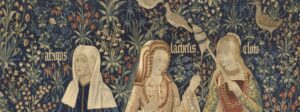
This was followed, on 1st June 2017, by a marble sculpture entitled ‘The Three Moirai’ or ‘The Three Fates’ fashioned by Johann Gottfried Schaddow for the tomb of Prince Alexander von Mark, in Berlin).
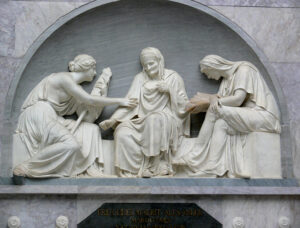
Both of these images are to be found on the Wikipedia entry entitled Moirai which suggests that Rowling – like those who follow in her footsteps! – read this page:
In ancient Greek religion and mythology, the Moirai (/ˈmɔɪraɪ, -riː/)—often known in English as the Fates—were the personifications of destiny. They were three sisters: Clotho (the spinner), Lachesis (the allotter), and Atropos (the inevitable, a metaphor for death). Their Roman equivalent is the Parcae.
The role of the Moirai was to ensure that every being, mortal and divine, lived out their destiny as it was assigned to them by the laws of the universe. For mortals, this destiny spanned their entire lives and was represented as a thread spun from a spindle. Generally, they were considered to be above even the gods in their role as enforcers of fate, although in some representations, Zeus, the chief of the gods, is able to command them.
-
- Clotho (/ˈkloʊθoʊ/, Greek Κλωθώ, [klɔːtʰɔ̌ː], “spinner”) spun the thread of life from her distaff onto her spindle. Her Roman equivalent was Nona (“the ninth”), who was originally a goddess called upon in the ninth month of pregnancy.
- Lachesis (/ˈlækɪsɪs/, Greek Λάχεσις, [lákʰesis], “allotter” or drawer of lots) measured the thread of life allotted to each person with her measuring rod. Her Roman equivalent was Decima (“the Tenth”).
- Atropos (/ˈætrəpɒs/, Greek Ἄτροπος, [átropos], “inexorable” or “inevitable”, literally “unturning”, was the cutter of the thread of life. She chose the manner of each person’s death; and when their time has come, she cut their life-thread with her “abhorred shears“. Her Roman equivalent was Morta (“the dead one”).
Betty Radice, in the entry for ‘Fate’ in the Penguin Who’s Who in the Ancient World, gives some useful literary context:
From the concept of an impersonal destiny, which in Homer seems both to implement the will of Zeus and yet be stronger than the gods, there develops a trio of goddesses (Moirai in Greek, Parcae in Latin) who are first named by Hesiod and said to be the daughters of Zeus and Themis (Righteousness), though Plato makes them the daughters of Ananke (Necessity). They are Lachesis who assigns man’s lot at birth, Clotho who spins the thread of life, and Atropos ‘who cannot be turned’ from cutting it at the moment of death. They sing the marriage song of Peleus and Thetis in Catullus’s poem (64) [foretelling the future of Achilles, the baby to be born from this union].
In Catullus 64, the Three Fates spin their thread as they sing – a telling point as, through this action, Catullus links their skills with his own. A rhapsode – a singer in ancient Greece – is (literally) a ‘song-stitcher’ (one who sews (rhaptein) the poem (oide). In English, likewise, great storytellers weave their stories (while bad ones fabricate theirs). ‘Texts’ and ‘textiles’ sound so similar because they do, indeed, come from the same root: the Latin verb textere, ‘to weave.’ A ‘textile’ is a woven fabric (from the Latin textilis) and a ‘text’ is from the Latin textus meaning – as the Oxford English Dictionary tells us – a ‘woven fabric, web, texture, structure, construction of a literary work (Quintilian).’ A ‘text’ is literally something that is woven and it is an etymology that connects writers with the traditional women’s work of weaving. The ‘song-stitcher’ Homer sings of Penelope, who continuously weaves a shroud for Odysseus’s father, and Helen, who weaves a great cloak which – like Homer’s own song – weaves into its fabric a depiction of the actions of the Trojan War. At the end of the Iliad, Helen, the skilled weaver of the Trojan War, will memorialise Hector – speaking of his exploits before all the people. Homer is the poet who will memorialise Hector for all time, and at the climax of the Iliad, he makes Helen his precursor.
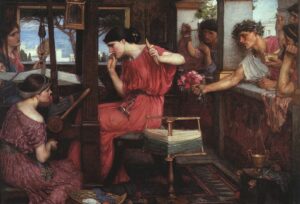
Story and spinning, weaving and song, likewise come together at the end of Catullus 64 as the Three Fates spin their threads as they sing the future of Achilles. I love that one of the images of Three Fates Rowling uses is woven into a tapestry – the medium is the message! I think she would have been drawn to this Catullan image of these three women as the ultimate storytellers who tell out the thread of life. It is particularly interesting that Lachesis and her sisters play such a major role in Catullus 64 (the poet’s most famous and important poem) because Catullus plays a crucial role not only in the Strike series as a whole, but also in the scene in which we first hear about Lachesis.
The epigraph to Chapter 21 of Lethal White hints that lots is going on in this chapter: ‘certain games are going on behind your back in this house.’ Explicitly, this is the game of deception Robin is playing by entering the ‘House’ of Commons as Venetia Hall. The reader also suspects something is going on in the game of humiliation-by-Catullus that Chiswell appears to be playing on Aamir Mallik. But the real game here is going on behind the reader’s back. Chiswell enters quoting Plato’s Republic (Bk 10) – ‘Hear the word of Lachesis, the daughter of Necessity!’ – and then asks Aamir, and afterwards Raphael, to identify the quotation. Neither of them play along:
‘Playing stupid, eh? Lachesis,’ said Chiswell, ‘was one of the Fates. She measured out each man’s allotted lifespan. Knew when everyone’s number would be up. Not a fan of Plato, Mr Mallik? Catullus more up your street, I expect. He produced some fine poetry about men of your habits. Pedicabo ego vos et irrumabo, Aurelia pathice et cinaede Furi, eh? Poem 16, look it up, you’ll enjoy it.’
This is the obscene opening (and closing) line of Catullus 16. The translation and notes by Peter Green (whose translation we know Rowling uses) provide two clues as to how Catullus is being used here. Firstly, Green argues that, despite the graphic nature of this line, and Chiswell’s heavy hints about Mallik, the phrase does not actually relate to gay sex: ‘commentators are fairly heavy-handed here, especially over the first and last lines, which are surely no more than a baroque extension of the kind of threat typified in English by the phrase, “Fuck you,” without any suggestion of actual sexual intercourse.’1 This might be a hint that Chiswell isn’t, in fact, talking about gay sex either. Green translates this line as ‘sucks to the pair of you’ – precisely what Chiswell actually means.
Rowling’s Twitter clues meant that I knew this scene in Lethal White was crucial when I first read this paragraph, even though I couldn’t decode it at the time! For alongside the two appearances of Lachesis in her headers, Rowling had given two Catullus clues in her tweets leading up to the publication of Lethal White. On 1 July 2018, she replied to a tweet (‘can you give us a tease on Lethal White?’) with the whole of Catullus 85: ‘Odi et amo. Quare id faciam fortasse requiris nescio, sed fieri sentio et excrucior’ [‘I hate and love. Why I do so, perhaps you ask, I know not, but I feel it, and I am in torment’]. This followed on from a post on 16 November 2017 of a picture in which I spotted Peter Green’s bilingual translation of Catullus hiding under the popcorn:
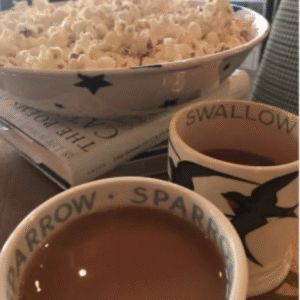
(This clue – incidentally – is Rowling’s most ‘meta’ clue to date. For in photos of the murder scene Strike strains to read the half-revealed book title on the coffee-table – ‘Strike could see nothing but a partial title on an old cloth edition – “CATUL”.’ In this tweet Rowling left the same five letters ‘CATUL’ visible on the book’s spine, placing internet sleuths in precisely the same position as Strike!)
Rowling, therefore, plays absolutely fair with her Twitter clues. If something appears in the headers, it will be important to the plot. Decima may, herself, be a name we’ve only just heard, but as she is one of the Three Fates who have appeared twice in Rowling’s headers, I think it is fair deduction that both she and the meaning of her name will be crucial to The Hallmarked Man.
One reason that Rowling is drawn to the Fates is because there are three of them. Primes, and odd numbers in general, have been traditionally associated with magic. (And the very name ‘prime’ itself – from the Latin for ‘first’ – marks out the way in which they feel mathematically and intuitively special). Although seven is the most powerfully magical number, three remains one of – if not the – most important prime in Harry Potter. Pythagorean number theory gave meaning to numbers, and three was considered the perfect number. It represents time (past, present, future; birth, life, death; beginning, middle, end) as well as being the number of the divine and in Harry Potter, of course, the number of our central trio.
Symbolic readings have been found in many mythic threes – such as the three heads of Cerberus (in Harry Potter, the three-headed Fluffy lurks on the third floor) which symbolise the universality of his destructive powers. As one eighteenth-century critic put it: ‘this Dog with three Heads denotes the past, the present, and the Time to come… Hercules got the better of him, which shews that heroic Actions are always victorious over Time, because they are present in the Memory of Posterity.’2 The most magical embedded story of Harry Potter – the story of the origin of the three Deathly Hallows – is the ‘Tale of the Three Brothers’ and the trio at the centre of Harry Potter reflect both a number of classic literary trios – such as the Three Musketeers, the three Magi, the Three Investigators – and, at a deeper level, form a surprisingly neat analogue to another classic triad: mind (Hermione), body (Ron) and spirit (Harry).
Three is the magic number – and, indeed, so it generally proves in fairy tales. You always have to knock or blow a trumpet or issue a challenge three times and travel three days and nights before you meet with three beautiful princesses. Harry Potter jokes with this expectation by having Harry’s first entrance into the Wizarding World happen when Hagrid taps the third brick on the left three times to get into Diagon Alley. In older myths, the three Graeae, the three Norns, the three Weird Sisters and the Three Fates (who were sometimes said to appear three days after a birth to foretell the baby’s fate) speak to the specifically witchy aspect of the number three. Ovid connects the eerie nature of the number three with the witch Medea, all of whose magic takes place in multiples of three: she waits three days, sprinkles water three times and turns three times during her incantations. It feels intuitively right that Hermione, the brightest witch of her generation, should turn the Time-Turner three times.
It is also noticeable that most mythic triads – the three Fates, the three Graces, the three Graeae, the three Weird Sisters, the three Norns – are female. The Three Fates are spinners who, like the Norns, ply a traditionally gendered craft – but in their case women’s work is work of absolute power (some traditions even consider them the most powerful of all the immortals). There seems to be a traditional link between witchy female power and the number three. In terms of The Hallmarked Man, this may mean that Decima will be a particularly autonomous, powerful and narratively important client.
Rowling once made a joke on this subject in a tweet that has an obvious interest for The Hallmarked Man: ‘odd numbers are very definitely female. You’ll be saying Saturday isn’t silver next.’ (So, watch out for some crucial Saturdays in the silver-themed Hallmarked Man!) It may be the case that Rowling sees odd numbers as female (and Saturdays as silver) due to some form of synaesthesia, but the identification may also be influenced by this powerful, traditional connection between mythic women and the number three.
This magical quality of the number three has another symbolic connection with The Hallmarked Man. As two headers have shown, and the blurb has confirmed, Freemasonry is going to play an important role in the novel. And the number three plays an important role in Freemasonry. Here, for example, is a Master’s newsletter from 2018 from the Ann Arbor fraternity:
Three is the magic number and comes up quite a bit in ritual. In the Fellowcraft degree alone there are many sightings of three. The three steps allude to the three degrees in Freemasonry and the three principal officers. Three are the original Greek columns: Doric, Ionic, and Corinthian. Three are the most revered of the five senses: hearing, seeing, and feeling. A solid is a figure of three dimensions, namely: length, breadth, and thickness. There are the three wages of the Fellowcraft: the corn of nourishment, the wine of refreshment, and the oil of joy–which denote plenty, happiness, and peace.
But the three most meaningful to me are the jewels of a Fellowcraft:
“…which are an attentive ear, an instructive tongue and a faithful breast, because the attentive ear receives the sound from the instructive tongue and the mysteries of Masonry are safely lodged in the repository of faithful breasts.”
The status of the number three in Freemasonry has a particular cultural importance because it plays an important role in greatest work of art to embody Masonic beliefs: Mozart’s The Magic Flute. The libretto for this opera was written by Emanuel Johann Schikaneder, who was ‘a friend of Mozart and a member of the same Masonic Lodge… As a practical man, Schikaneder saw his chance to exploit the forbidden rites for the stage. Out of the wicked sorcerer he made Sarastro, the sage priest of Isis. The ordeals of Tamino and Pamina became copies of the ceremonials of freemasonry. He also laid the scene of the opera in Egypt, where freemasonry believes its rites to have originated.’ The opera is built around the number three, with three ladies on attendance of the Queen of the Night, three Genii and three priests. The finale of Act 1 ‘takes place in a grove on three sides of which stand three Temples, dedicated to Wisdom, Reason, and Nature. Thither the three Genii lead Tamino, and leave him with the advice that he “be silent, patient, persevering”.’3 In 2019, I went to see a WNO production of The Magic Flute which built the number three into the set design with beautiful, and witty, effect. As noted in their show notes the importance of the Masonic ‘three’ is woven by Mozart into the fabric of the music, as well as the plot: ‘The opera’s opening overture is written in Eb Major, which has 3 flats, and it begins with 3 chordal gestures, imitating the secret knock that masons would have used in Vienna at the time to gain access to their Lodges.’

If The Magic Flute appears in The Hallmarked Man, it may be worth noting that is a love story that incorporates a detective-novel style twist: the Queen of the Night is the ‘client’ who hires Tamino to save her daughter from the evil clutches of Sarastro, only for the hero to discover that it is she who is evil and Sarastro who is good. This is the twist of Cuckoo’s Calling and I don’t expect it to play out fully in The Hallmarked Man (which would mean discovering that Decima is misleading them and is, perhaps, herself the murderer). But it is possible that parallels will appear with the opera – perhaps to the extent that the Freemasons in The Hallmarked Man (like Mozart’s Freemason stand-in Sarastro) appear at first to be the enemy but turn out to be innocent. It would indeed be an unexpected twist if this secret society is truly in pursuit of higher goals and has nothing to do with the murder (and Murphy is not, despite the hopes of many, embedded in the police to cover up his fellow Masons’ tampering with the DNA evidence). At the very least, I think the Masonic symbolism of the opera – in which Tamino and Pamina’s ordeals pattern out the symbolically purifying ceremonials of freemasonry – will connect with Strike and Robin’s story in this novel. Freemasonry, like alchemy, is one of the traditional story-structures which underlies the solve et coagula message of the series. The Hallmarked Man will be the novel in which this message will become a little more explicit through the plot-scaffolding of Freemasonry. Masons are on a clear journey of self-knowledge, passing through structured stages of initiation, and this echoes the personal growth of our protagonists as they pass through the trials of each novel, coming one step closer to enlightenment.
‘The silver shop is no ordinary one: it’s located beside Freemasons’ Hall’
It would be reasonable to assume that there is no connection between the naming of the Freemasons’ Hall and the ‘hallmark’ of the book’s title. But surprisingly, they are connected. Halls are places where guilds meet and a ‘hallmark’ – a mark of purity – was originally a ‘hall-mark:’ ‘reflecting the location of the London assay office at Goldsmith’s Hall.’ Strike’s name links with this idea of hallmarking or assaying. As the Surname Database puts it:
This unusual and very interesting name is an early medieval English occupational surname for someone who was employed to maintain the accuracy of a measure of corn by passing a flat stick or “strike” over the rim of the vessel holding the grain, thus levelling the grain and removing any excess. The derivation is from the Old English pre 7th Century “striccan” or “straccian” to stroke or smooth, Middle English “strike(n)”. This was an important and responsible position in medieval England, particularly since there was some dispute over the measure to be used.
A ‘strike’ is an accurate measurement of corn: to ‘strike’ grain (according to the Oxford English Dictionary) is to make it ‘level with the rim of the measure by passing a strickle over it,’ as in the medieval citation ‘see that your corne be mesured withe..a trewe bushell & that euery bushell be strekyn.’ Measurement of this kind is conceptually linked with the justice that is at once the divine tuning fork and pilot light of Strike’s moral character. According to the biblical concept of justice ‘with what measure ye mete, it shall be measured to you again’ (Matt 7.2) – a phrase that Shakespeare famously echoes in the title of his play Measure for Measure. This play stages a searching exploration of the complexities of good government, and how rulers can (and should) balance justice with mercy. The use of ‘measure’ in the title links with the way in which just measurement is a cornerstone of an ordered society: ‘dead pharaohs would be buried with measure-sticks in hand. Early on, the right to assess – and enforce – measurement became concomitant with political authority. We call them rulers for a reason. Defining and maintaining standard weight and volume – particularly in the all-consuming food and drink trade – continued as one of the state’s central obligations for millennia.’
And something that is particularly interesting about the name of the client in The Hallmarked Man – Decima – is that her name, just like Strike’s, relates to justice. In the Wikipedia entry on Moirai (which, as noted above, Rowling appears to have read) it mentions that Moirai – the Greek name for the Three Fates – connects (just like Strike’s name) with both fairness and a measuring stick:
The concept of moira referred to one’s fair allotment or portion, originally one’s portion of loot from battle, which was distributed according to strict traditions. The idea eventually began to be applied to one’s fair allotment in life. Obtaining more than one’s fair portion (ὑπὲρ μοῖραν “over the portion”) of loot, or of life in general was possible, but would result in severe consequences because this was considered a violation in the natural order of things…. [In Hesiod’s Theogony he calls the Fates] daughters of Zeus and the Titaness Themis (“the Institutor”), who was the embodiment of divine order and law, placing them as sisters of Eunomia (“lawfulness, order”), Dike (“justice”), and Eirene (“peace”).’
Decima, in this reading, is the sister of Justice (Dike). Decima, with her measuring stick, apportions out a fair and just allotment of life – she has, therefore, a powerful link with Strike, the champion of true justice named as he is after the measuring stick which portions out an accurate and just allotment of corn.
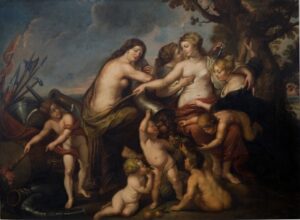
I predict, therefore, that Decima’s name means she will be a powerful and virtuous character and that her onomastic connection with Strike means that she, too, will be a champion of justice. I think that she and Strike are going to get on. This connection is also likely to mean that, as with Strike, Decima’s intuitions are right (firstly, presumably, in her belief about the identity of the victim but maybe in later important junctures in the case likewise). I think Decima is going to be the first (innocent) client who is deeply involved in the case. I shall also be looking out also for the number three more generally, given that it something that links Decima’s name with the location. And as music is so often important in Strike – and we’ve had an opera before – I’ll be keeping my fingers crossed for a mention of The Magic Flute (for other operatic possibilities in The Hallmarked Man see this blog post). Finally, it seems worth mentioning that one of the three wages of the Fellowcraft – ‘the corn of nourishment’ – links with measurement of corn after which Strike is named. Maybe the plenty, happiness and peace that these wages of Fellowcraft represent will be Strike and Robin’s in this book.
Here’s waiting for September the second….
1 The Poems of Catullus: A Bilingual Edition, trans. Peter Green (London: University of California Press, 2005), 218.
2 Borges, The Book of Imaginary Beings, 59-60.
3 Kobbés Complete Opera Book (London, 1969), 108, 110.