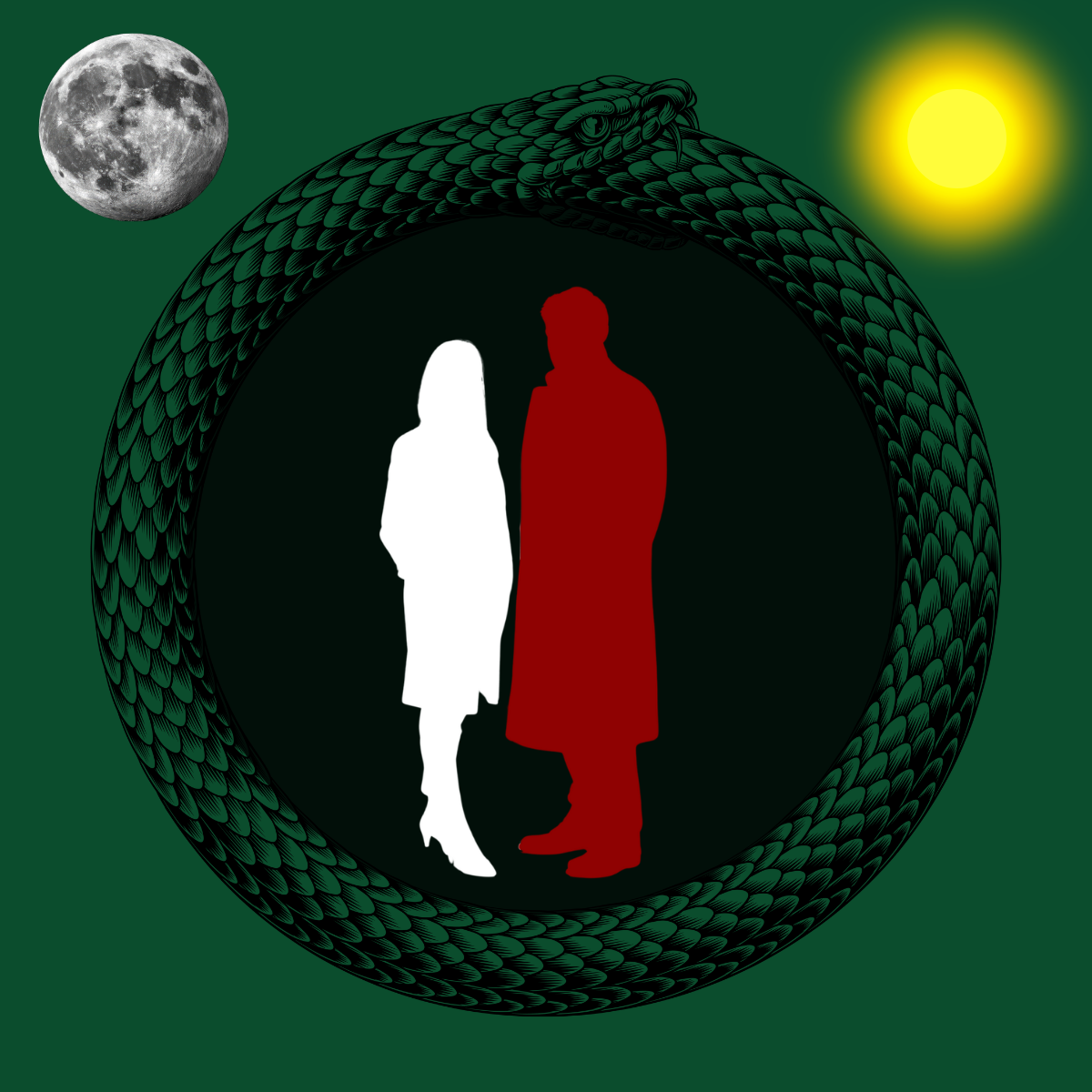
Spotting symbols that map Strike and Robin’s growth
In December 2025 J.K. Rowling answered some Strike reader questions on X. Because I love it when authors talk about how they build their stories, I took a chance. I asked if she plans alchemical symbols in her Strike books as far ahead as she does her plotline. She replied saying she couldn’t tell me without giving spoilers. Well. While that may not be a 100% confirmation that she does, the Jungian nerd in me was very happy with this answer.
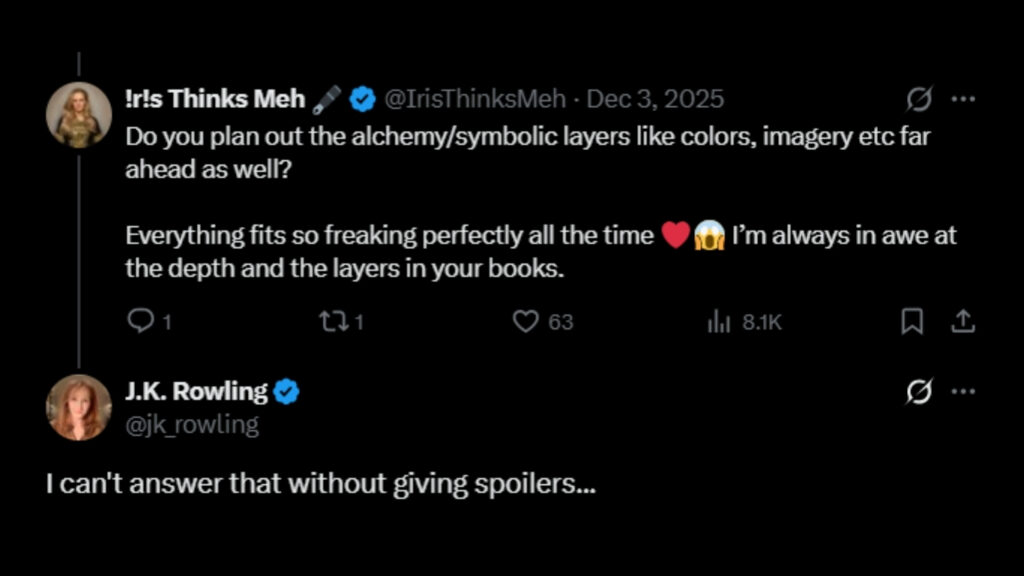
Since the publication of Harry Potter and The Philosopher’s Stone, hundreds of articles, podcasts and even books have explored JKR’s literary alchemy. For over twenty-five years readers have been spotting symbols in her books that could connect to Alchemy, and to Alchemy of the Mind. If you’re a JKR reader who keeps seeing this subject pop up and you’re curious what it’s all about, welcome to the Alchemy Rabbit Hole!
Looking for answers
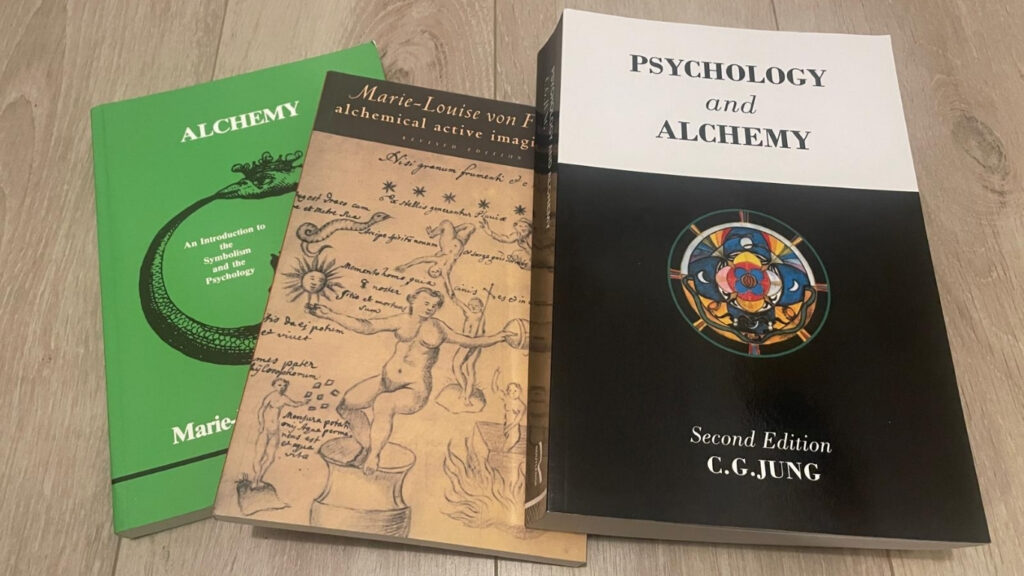
I’ve been interested in psychiatrist Carl Jung’s work on dreams for a few years now. That curiosity led me to classes with an analytical psychologist trained at the C.G. Jung Institute in Switzerland. Like pretty much every Jungian analyst, she’s happy to share her knowledge about Jung’s fascination with fairytales and alchemy. Before I knew it, I was thinking about possible Jungian links in my favorite books. The Strike series being one of them. So, here I am scribbling down some thoughts, more as a student and Strike reader looking for answers, than as an expert.
We’ll start at the beginning: at what historical alchemy is. Then we’ll look at how and why Carl Jung and psychology entered the picture, and why symbols of alchemy show up in the arts.
I’ll share links below to contributors who have written interesting articles on literary alchemy and Jungian alchemy. There’s some real gold in there, alchemical pun intended 😉
What’s in this blog:
- What is alchemy?
- The alchemists
- Four stages of alchemical transformation
- Where alchemy meets J.K. Rowling
- Carl Jung and the psychology of alchemy
- Why literary alchemy?
- Alchemy in the Cormoran Strike series
- Easter Egg toolkit
- Further reading and listening
What is Alchemy?
Alchemy is often called ‘the art of transmutation’. Most people know of it from the experiment to turn lead into gold, but for thinkers like Carl Jung it was also a psychological journey toward inner wholeness.
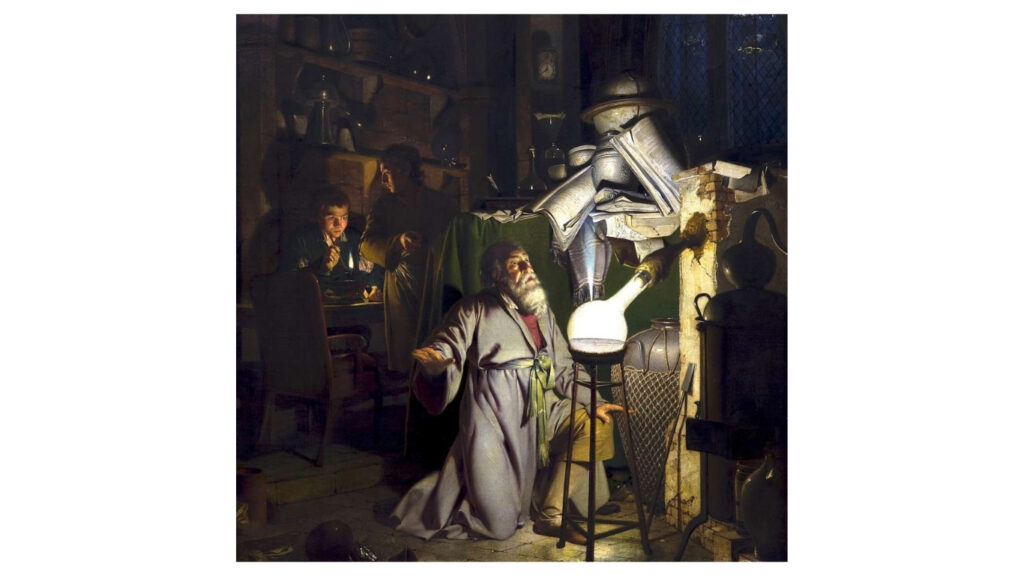
Image: ‘The Alchemist Discovering Phosphorus’ by Joseph Wright of Derby (1771)
Alchemy was practiced all across the world. Manuscripts from ancient Greece, Egypt, Persia, China, and later on in medieval Europe show that people had been experimenting with it for centuries. Alchemists would use heat and chemical baths to change substances like metals, pigments, minerals, and herbs to understand how these could be transformed. Their hope was that raw matter like the ones above would change into something entirely different. Often something more valuable, through that forced transmutation.
The alchemists
Maria Guidea is one of the earliest alchemists. Her water bath method (au bain marie) is still used today. Other famous alchemists include Zosimos of Panopolis who tried to turn lead into gold. Paracelsus used alchemy to make medicine, and physicist Isaac Newton wrote over a million words of secret alchemical manuscripts.
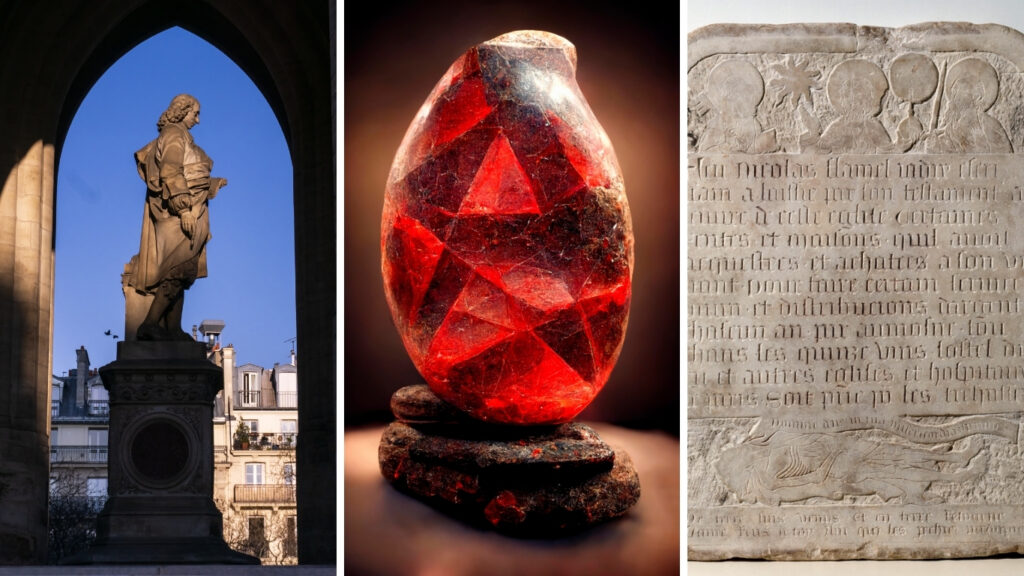
Image: statue of Nicolas Flamel in France, the philosopher’s stone (not real nor working), and Nicolas Flamel’s tombstone which was displayed at the exhibition A History of Magic (see below).
The name Nicolas Flamel will probably ring a bell, especially if you’ve read the Harry Potter series or seen the Fantastic Beasts movies. Legend has it that Flamel discovered how to create a stone and an elixir that gave you immortality. The Philosopher’s Stone and the Elixir of Life were names for the same hope: that the transformative processes that perfected metals would also reduce illness and aging in the human body. A fascinating idea, even though living forever sounds a bit too intense for my liking.
Before getting to Jung and Strike, there’s a short bit of theory that’s good to know about.
The four stages of alchemical transformation
How did these alchemists force substances to change? Different traditions describe anywhere from three to seven or more stages of transformation. Because we’ll be talking about Carl Jung, psychology and literary alchemy later I will use the four stages tradition in this blog.
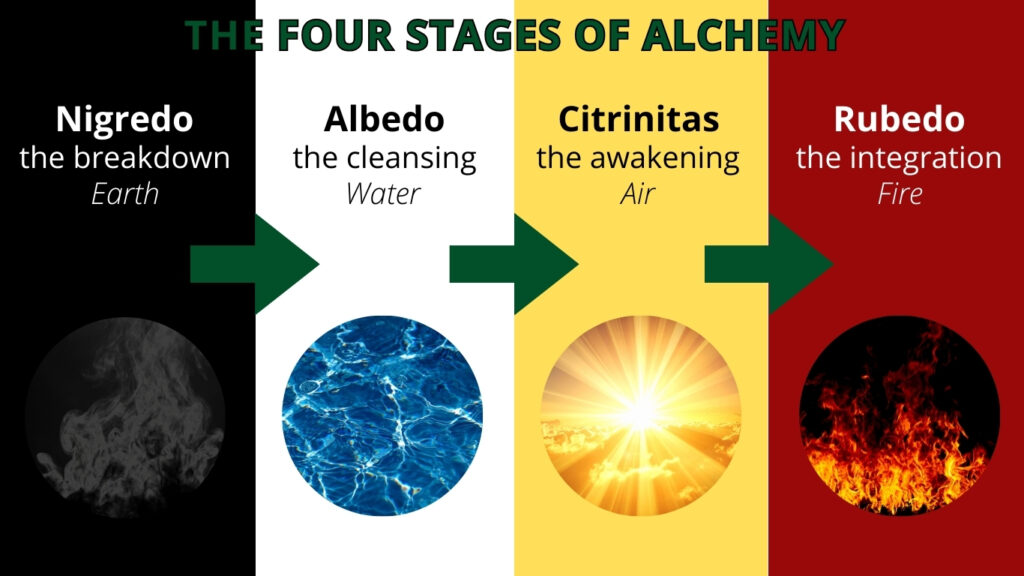
These stages always follow the same order:
Nigredo (blackening): Raw material is broken down by intense heat. It loses its form and breaks down, leaving behind charred, black matter.
Albedo (whitening): The blackened material is washed through chemical baths. This purifies the substance into a reflective white state.
Citrinitas (yellowing): The heat is increased to dry the material. It begins to turn yellow.
Rubedo (reddening): The fire reaches the Great Heat, fixing the material into a vibrant red. This is the final, indestructible form: the Philosopher’s Stone.
The alchemists checked for these specific colour changes to determine if the transformation process was progressing, or had failed.
The often mentioned gold colour comes in after the fourth stage. The red shows that the process is complete, with that red stone, gold was thought (hoped) to be made.
If you want to know more about the seven instead of the four stages Jungians often use, here’s a link to the complete seven stages of alchemy. For info on the three alchemical principles (The Tria Prima) that represent Mercury (spirit), Sulfur (soul), and Salt (body), you can visit Oxford University’s Cabinet.
Where alchemy meets J.K. Rowling
In celebration of the 20th anniversary of Harry Potter and The Philosopher’s Stone, The British Library and Bloomsbury ran a fabulous exhibition on The History of Magic, back in 2017. I was mainly there to see JKR’s handwritten notes on Potter, but the theme of alchemy was also part of this show.
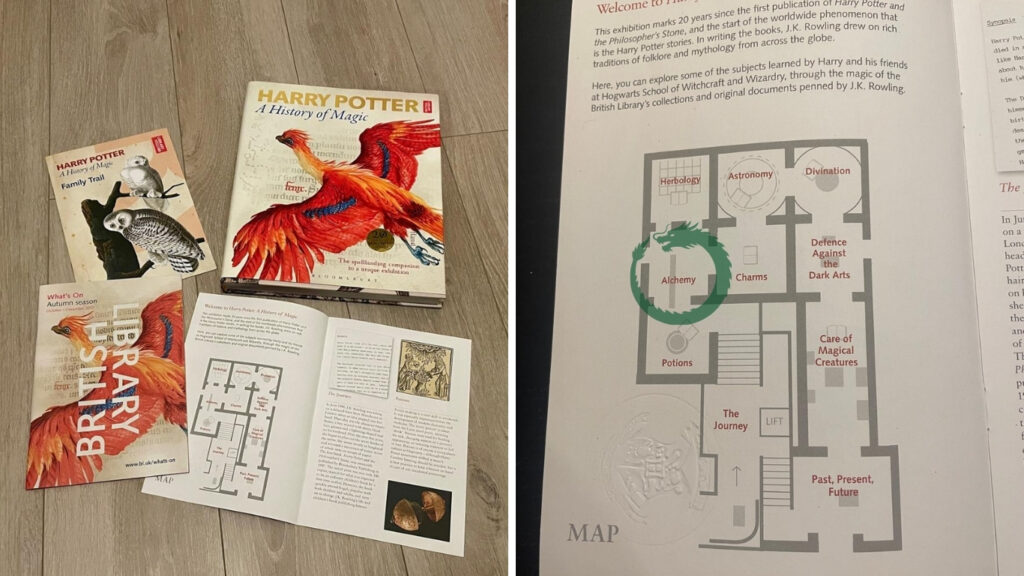
Alchemy manuscripts that describe the above transformation stages and practices are often beautiful, handmade, pieces of art. I remember walking into the alchemy section and leaning over a six metre long glass display case that contained ‘the gargantuan 16th-century Ripley Scroll that explains how to create a Philosopher’s Stone.’ You can explore the scroll digitally here. It’s an illustrated guide showing the stages of alchemy by using symbols like the toad, lion, dragon, but but also the sun, moon, a flask over a furnace (the vessel or crucible), the chemical bath, etc.

Image: Parts of the Ripley Scroll, British Library.
Another very famous piece at that exhibition was the Splendor Solis, a German alchemical manuscript from 1582. It’s beautifully illustrated with 22 full page paintings like in the image below. The border of the first of the three images contains a peacock, an owl, a crow, deer, and an iris (woohoo!). Each one of these symbols carries its own meaning. It’s quite easy to get sucked into an Easter Egg Hunt and research what the illustrations mean in relation to alchemy. It’s quite similar to what some of us do now with the Galbraiths.
You can see more on the History of Magic exhibition in this video, with the gorgeous Ripley scroll in frame at 00:40 seconds in.
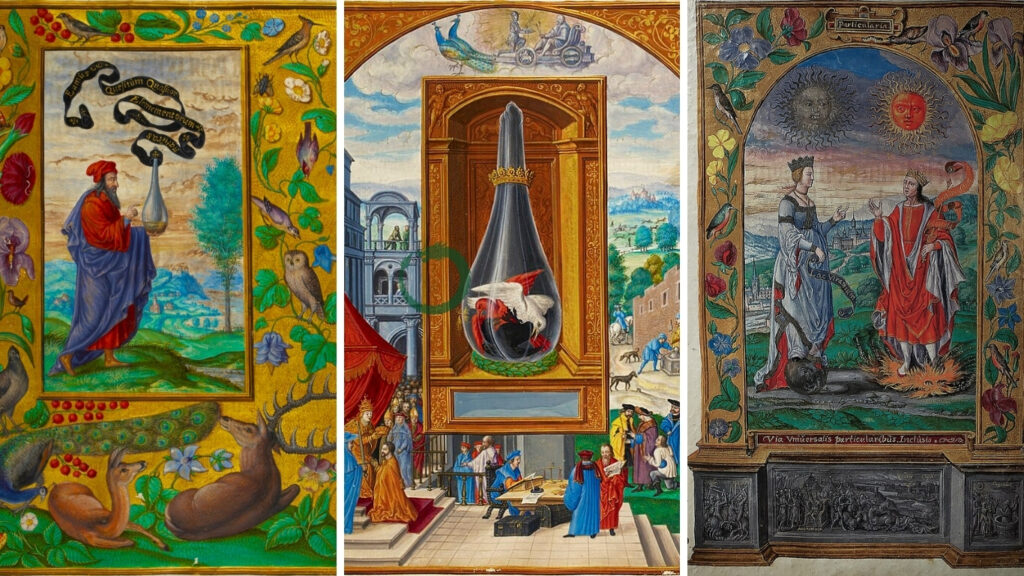
Image: Pages of The Splendor Solis, British Library.
I think we’re safe assume JKR collaborated on an exhibition where these alchemy pieces were so prominent because the subject is of importance to her and her work. Another hint to support that idea is of course the Latin phrase Solve et Coagula that she has tattooed on her wrist.
Did @jk_rowling get a wrist tattoo? Anyone have a better angle or an idea of what it says?
Also, that whole look is 🔥🔥🔥.
Pictures are from the premiere of Finding the Way Home, an HBO documentary inspired by the incredible work of @Lumos, airing December 18th in the US. pic.twitter.com/DO3S9KmbxN
— Aimée Carter (@aimee_carter) December 13, 2019
* alchemical tattoo and I’m keeping it.
— J.K. Rowling (@jk_rowling) March 30, 2025
Solve et Coagula is Latin for ‘dissolve and coagulate’ (to separate and join together). It is the master formula of alchemy and central to Jung’s alchemical psychology model. You dissolve what no longer works, and integrate what remains into something stronger.
And that brings us to the man who connected the protoscience of alchemy to psychology and made the approach popular: Carl Gustav Jung.
Carl Jung and the psychology of alchemy
Dr. Carl Jung was a Swiss psychiatrist who lived from 1875 until 1961. He was deeply interested in the mind, mental illness, dreams, symbols, myths, fairytales, religion, and patterns. He became interested in alchemy when he realised that the stages of breaking down, cleansing, awakening, and integrating mirrored the psychological process his patients were experiencing. He would speak of that process of growth as the Alchemy of the Mind. Individuation, Jung’s so named process of becoming whole, is sometimes used interchangeably. Put simply: Alchemy of the Mind gives us the map of the transformative journey, Individuation – the process of becoming whole – is the end goal.
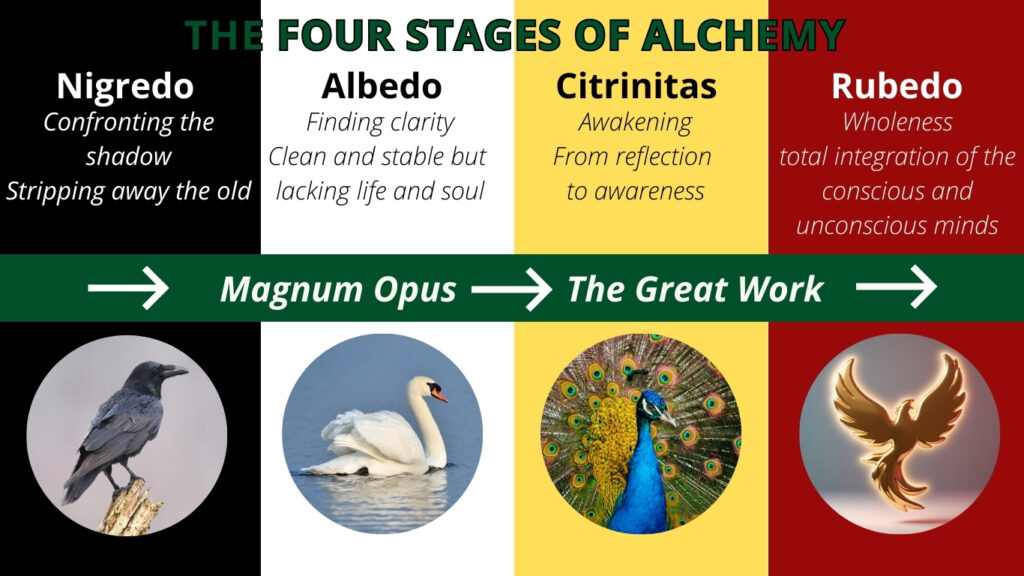
If you look at those four stages once again, but now through a psychological lens, they would offer this:
Nigredo: Breaking down. Confronting the shadow. What isn’t needed is burnt away in the darkness.
Albedo: Finding clarity. Cleansing by rinsing away the impurities to reach the stage of reflection and purity. It prepares us for a new awakening.
Citrinitas: Awakening. Going from reflection to a rising consciousness, letting new insights breathe.
Rubedo: Stabilising, refining, and integrating the conscious and unconscious mind. This is the Great Heat of completion.
It’s worth noting that Jung saw Alchemy of the Mind as a cyclical process, and not a ladder we climb in a race to the top. We may loop through the early stages for a bit, sometimes never reaching Rubedo. We’ll probably go through all of them more than once in our lives.
Why literary alchemy?
Why do so many artists, from writers to directors to painters, use alchemical symbols in their work? There are studies from researchers, and podcasts, videos and articles by readers who try to answer this question. Chances are there’s a lot of truth in their theories. But in-depth answers from the actual creators of the works are rare. And we don’t have any answers from Bob Galbraith yet either. I’ll therefore pivot to looking at why alchemy is such a powerful storytelling tool from our reader seat.
We recognise the archetypes
If alchemy stages are like the plot of a story (the breakdown, cleansing etc), the characters in the story are like the archetypes. Jung explains that there are several archetypes we all recognise, and who we will meet on our journey to become whole. He says these archetypes come from the Collective Unconscious.
He says that humans all have access to this Collective Unconscious. This was explained to me in three layers. The first layer is that we all have personal experiences that stay with us, conscious memories. For example, a pony bit you when you were a kid, and you therefore side-eye ponies for the rest of your life. You love the book your mother read to you as a child, and you can still recite the passages that made an impact on you.
We also have a Personal Unconscious: experiences that we forgot about, but a memory of feelings lingers somewhere deep down. Perhaps being humiliated by a teacher in front of the class. You forgot that specific moment, but you’re still nervous about speaking in public now. That is the second layer.
The third layer explains the Collective Unconscious. This is where the archetypes like The Mother, Wise Old Man, The Hero, The Shadow etc. live. The unconscious part is that we all know, regardless of in which culture we grew up, what being a mother is. We feel that a mother is linked to a nurturing, sacrificial type of love, (for Strike, Joan Nancarrow comes to mind) even if we never experienced this ourselves.
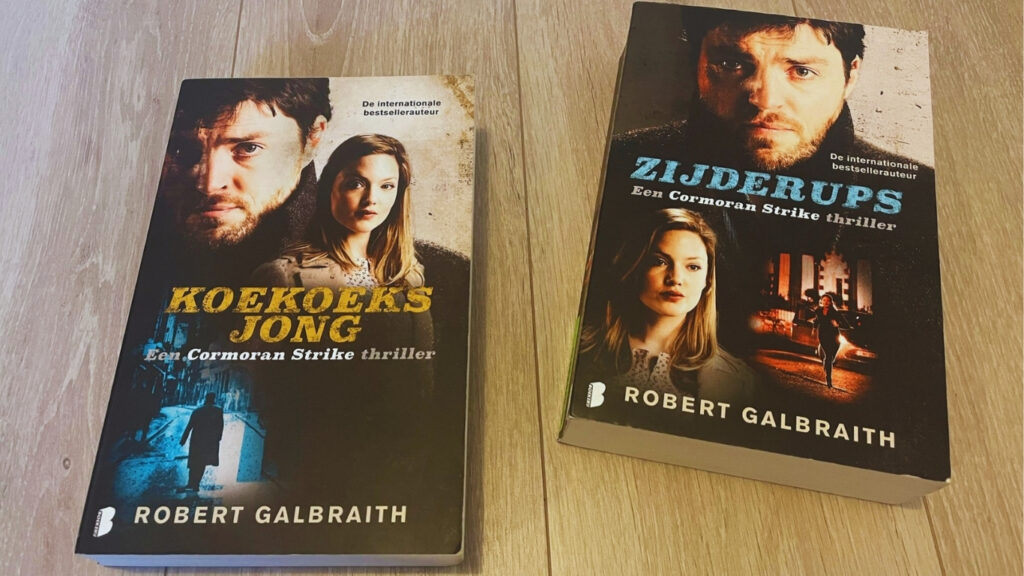
Image: book covers by Little Brown
When we read Strike and see how he moves in his world, we recognise The Hero. The man who decides to face the dark so he can give victims of crimes a form of justice. We can link the Wise Old Man to Ted Nancarrow. He’s the warm father figure offering sanctuary for Strike and Lucy when Leda took off again. He offers Strike advice throughout his life.
“When we read Strike and see how he moves in his world, we recognise The Hero. The man who decides to face the dark so he can give victims of crimes a form of justice.”
Another archetype is The Shadow. It represents the person who you’d rather not be and is a Nigredo stage archetype. The villains in the Strike books personify this aspect of the psyche. But after reading The Hallmarked Man, Robin also pops up in my mind related to this Shadow part. In book 8 she refuses to stray from her path towards a future with Murphy, even though her subconscious keeps nudging her that this is a big mistake. I read this Shadow as her being the people-pleasing daughter who doesn’t want to rock the boat. She’d rather suffer than ’cause damage’ by being true to her feelings. She’s wrestling with her shadow side that tells her the truth: Murphy ain’t it, sis. Do not do it. Stop. Make a u-turn.
On a positive archetype note: Robin was of course also actively looking for a Wise Old Man, well, woman (Crone) to help her. I’m very happy for her to meet the sweary therapist in Sleep Tight, Evangeline.
So, these archetypes live in the Collective Unconscious, Jung said. That unconscious holds what we personally never learned, but still instinctually know. Check out this website if you want to read more about the archetypes. I will get back to two important ones in the relationship paragraphs of this blog.
A common language that bonds author and reader
If we then go back to the alchemy symbols, I would argue that a similar thing happens as with the archetypes. Subconsciously we will feel that descriptions of scorched ground, ashes, or storms mean breakdown (Nigredo), and that the white snow of winter or a white dove signals clarity and purification. That a river or a pond can be connected to washing away things (Albedo). Yellow makes us think of bright sunshine, that we awake with sunlight. It isn’t a stretch to link it to illumination (Citrinitas).
We know that red means passion because we all bleed red, it’s our life force. We understand that a lion has immense strength and will come out on top in fights (Rubedo). We understand that a butterfly is to do with transformation and cocooning beauty (and could therefore cover all the stages of alchemy).
And lastly, gold. It’s one of the most valuable metals on earth. We know gold jewelry is expensive and that a gold Olympic medal is the one every athlete wants to win. It’s the highest ideal or goal we can achieve.
We probably won’t read the ending of a chapter where the sun rises near crocodile rock, and immediately gasp, ‘ah, there’s a Citrinitas for ya’. But we will read that yellow light as a symbol of hope and possible illumination.
So, why is literay alchemy used and loved? My best guess is that it offers author and reader a shared language through these archetypes and alchemical symbols.
Alchemy in the Cormoran Strike series
When I read a new Galbraith I let the first read just happen so I can fully enjoy the story. I don’t look for symbols. I don’t try to guess who the killer is. But as soon as I’m finished (and have recovered from whatever emotional wreckage the author has left us in) I dive back in.
Let me throw in a quick disclaimer: we won’t know what is and isn’t authorial intent until JKR hopefully answers questions after Strike Ten is released. So, even if some symbols seem to have been put in the books 100% intentionally, it may just be a projection of the reader. This projection isn’t a bad thing, in my opinion. Books are supposed to make you think, and not neccesarily make you agree with everyone else.
So, let’s look at some more of the possible alchemy hints in the Strike series and the slow burn we’re enjoying 🙂
Strike’s transformation loop
We meet Cormoran Strike at rock bottom in The Cuckoo’s Calling. He is deep in a Nigredo stage at this point, the darkness before a transformation starts. He’s struggling with a massive life and career change after losing half a leg in the army. He has no money, his relationship with Charlotte just blew up (again), and he’s sleeping in his office. These are classic Nigredo elements.
Through the seven books that have followed so far we see a pattern: one of a fighter. Strike breaks down, gets back up, adjusts, and changes. He’s never just a hero in ascent, there’s always a transformative loop. Through struggles he gets new insights repeatedly.

Image: book covers by Little Brown
True to Jung’s model, Strike’s journey isn’t a straight line to the finish, but it’s a loop back to the crucible (the place where a transformation happens) at times. This doesn’t happen because he fails but because he chooses to change, even when he is reluctant to, and even if it takes him years.
“Picking up his jacket and the folder Robin had left, he departed. Time would tell whether he’d just done something foolish or not, but Cormoran Strike had at last decided to practise what he’d preached to Charlotte, all those years ago. Happiness is a choice that requires an effort at times, and it was well past time for him to make the effort.”
– The Running Grave, chapter 136
But gaining insight doesn’t mean the entire cycle stops. In The Hallmarked Man he realises he messed up, and he needs to realign once again.
“The black fish called Cormoran was again flailing helplessly at the top of the tank. ‘Stupid arsehole,’ he snarled. ‘You’ve done it to your fucking self.”
– The Hallmarked Man, chapter 127
The office aquarium saga is fascinating to me. We have one fish wearing a crown (a hidden King), it’s black/grey (Nigredo). We have several fish with important names swimming in what Jung would call The Unconscious. The fact that the crowned fish is flailing at the surface could represent Strike’s new insights rising from the depths through struggles.
Robin’s hard-won growth: it’s coming!
In a blog I wrote last year on Robin’s Heroine Journey in issue 99 of Rowling Library Magazine. I made the mistake of thinking that The Running Grave was her Dark Night of the Soul, in alchemy her Nigredo. But what she experienced was brought upon her by external forces: The Chapman Gang, Mazu, Papa J and Tiao.
Robin’s struggle in The Hallmarked Man has much more to do with how earlier experiences have shaped her life and psyche. We’re seeing how she has (or hasn’t) dealt with the aftermath, now. Robin was always the child that didn’t rock the boat, so I can understand that she tries to repair, reason, endure, or even prove to herself that she can make this relationship with Murphy work. Perhaps especially so after her first ‘failed’ marriage. She’ll have to find out herself, even after divorcing a schmuck like Matthew, that a relationship with a guy who loves her and is ‘kinda nice’ won’t necessarily result in happiness.
“What is skipped is not integrated”
As readers we know that Ryan Murphy is not right for Robin. Perhaps we’d prefer it if she’d call it quits now because Cormoran is such a better fit. But apparently she isn’t convinced yet.
In a recent Jung class we talked about ‘Geschehen lassen’ meaning ‘letting it happen’. It’s a saying Jung often used (in a different context than the following, but it still matches perfectly): psychologists have to walk a very fine line between steering a client in the right direction, but also leaving room for that client to walk their own path toward transformation. Robin is hopefully pushed to face what she’s been avoiding by her swearapist. But she’ll have to do the work herself, otherwise the realisation won’t stick, and the growth might not hold. Jung explained it like this: What is skipped is not integrated.
The partnership as crucible
Earlier on I mentioned a crucible. It is a pressure cooker of sorts where the alchemical process of transformation takes place. In the lab that was a pot over a flame. But if you look at a crucible symbolically, a location or building can be a place of transformation too, like Chapman Farm, or Denmark Street.
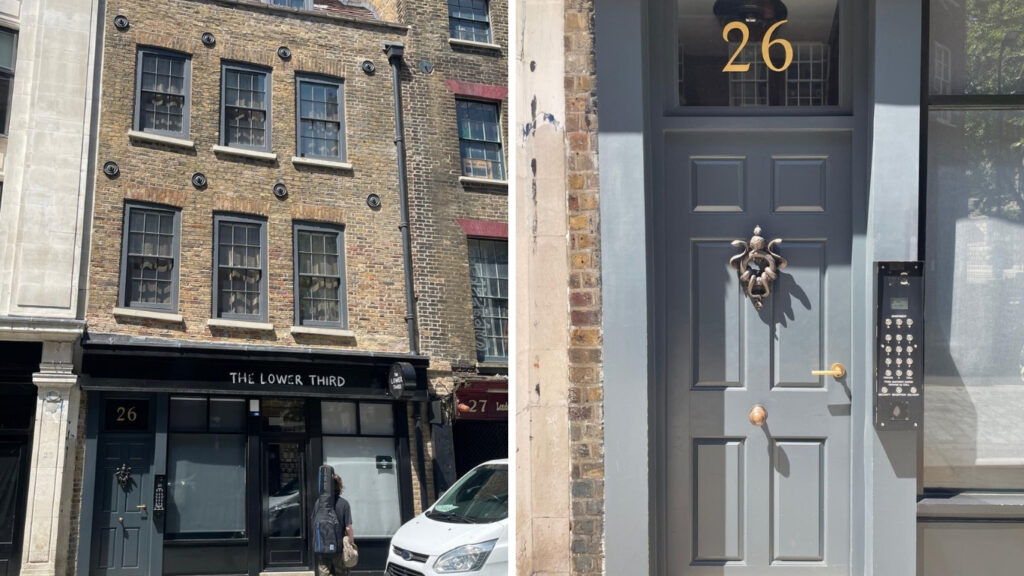
The Strike/Ellacott business partnership, where both the professional and the personal work happens, could also be seen as a crucible. In this symbolic pressure cooker their relationship brings heat, pressure, and friction that creates change in both of them. Their relationship is a catalyst in their personal growth. In the end, maybe the romance isn’t the final reward, but rather a natural consequence of everything they’ve been through.
This takes me back to two important archetypes Jung wrote about. The following is my interpretation, and not neccesarily something the author wants the reader to think (like the rest of this blog, of course).
Robin’s Animus and Strike Anima
Two of Jung’s most important archetypes are the anima, the unconscious feminine in men, and the animus, the unconscious masculine in women. Forgive me for oversimplifying it because this is already a long read: these archetypes represent qualities we have repressed in ourselves and often project them onto our romantic partners. You could see Strike’s choice for Charlotte, an emotionally intense woman, as a projection of his Anima, because he hadn’t integrated or allowed himself the feminine quality to access his own emotional depth yet. He outsourced emotions and feelings in a way. Robin calls on him to be vulnerable without the Charlotte type drama and doesn’t let him hide behind his emotional unavailability. She doesn’t need to be the emotional mirror. The ending of The Hallmarked Man and Strike saying ‘you’ve done it to your fucking self’ is a beautiful metaphor of his anima integration.
Again, oversimplifying, but I think there’s some truth here: Robin projects her Animus onto men like Matthew and Murphy. They provide a confidence and decisiveness that she hasn’t yet fully claimed herself. She’s letting them lead her by the hand because, on the surface, they seem to offer stability and direction. Let’s buy a house together. Let’s talk about babies. It can be comforting to let someone else take the lead, and on the opposite end, it’s scary to take control yourself and deal with the consequences of that. Strike sees Robin’s intelligence, her competence. He doesn’t let her talk down on herself and treats her like the equal she is.
So, in my opinion, they both call the other person out on what they haven’t integrated yet. That’s why I think their partnership is transformative for both of them.
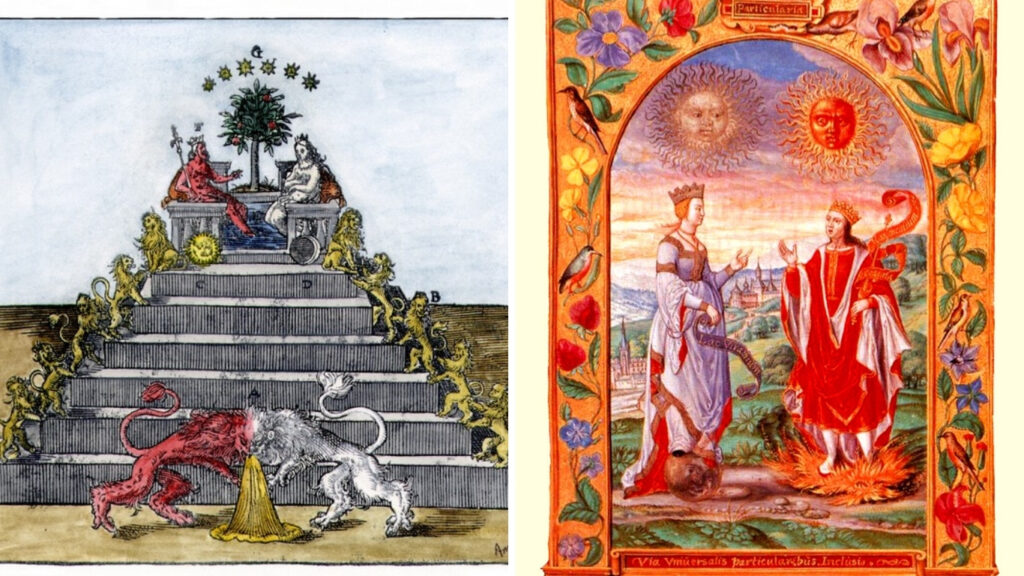
Image: Pyramid of Lions, Libavius, The Alchemy Website. The Splendor Solis, British Library. They show the marriage of the Red King and the White Queen.
Jung says that when you’ve integrated your anima/animus, you’ll be capable of true union. To me this feels a bit like the opposite of what we sometimes see in romance books. (I love romance and write it myself, so this isn’t a negative thing, just an observation.) Strike and Robin are not two wounded people seeking to find their other half so they can become whole together. Rather, it’s two people who’re becoming whole, and then can create something greater together. In alchemy this is called Coniunctio. It’s the sacred marriage of the Red King (the sun) and the White Queen (the moon) shown in the Rubedo, the final stage of the alchemical transformation.
I’m really hoping this isn’t one of my reader projections.
Easter Egg toolkit
While waiting for Sleep Tight, Evangeline, why not hunt for alchemical symbols in the earlier books? Here’s what you can look for. A disclaimer: this list is far from complete and only contains some examples. There’s often discussion about these symbols as some can fit more than one stage, depending on the context. Here’s what I’ve gathered so far from my deep dives:
Nigredo – the breakdown stage
Colours: Black.
Metals: Lead and iron. Heavy, dark, base metal that is associated with depression and weight.
Elements: Earth. Sometimes water, but only in its dissolving aspect with floods or storms suggesting chaos and breaking down.
Images of decay, burning, decomposing, caves, the black sun, prisons, skeletons, coffins (yikes, book 9 emojis), rotting, winter, cold, descent, being underground, Saturn.
Animals: Crow and raven, dragon (fighting the shadow), the green lion, snake/ouroboros (though it spans all stages), toads representing base matter and corruption.
Prima Materia: fits this stage as that is the raw chaotic material with which transformation begins.
Time: Night, autumn.
Qualities: Darkness, heaviness, confrontation with shadow.
The peacock represents the chaotic, glittering in-between stage, Cauda Pavonis. I’ve seen it placed between Nigredo and Albedo, but also between Albedo and Citrinitas.
Albedo – cleansing and reflection
Colours: White.
Metals: Silver. Reflective, purified, feminine principle.
Elements: Water in its purifying aspect of washing or cleansing. Rivers, rain, mist, dew, water basins. Sometimes air is also mentioned connected to clarification, separation of subtle from gross.
Images of the moon or moonlight. Washing, milk, purification, clarity, mirrors, confession, baptism, separation. White flowers, the white queen.
Animals: Pelican (self-sacrifice, letting go. It is also in Rubedo). A swan or dove, unicorn.
Time: Dawn or early morning light, winter.
Qualities: Clarity, reflection, purification.
Citrinitas – awakening and getting insight
This is a much debated stage in European Alchemy. Some traditions don’t even use it, they fold Citrinitas into Rubedo.
Colours: Yellow.
Elements: Air rising. Fire connected to solar awakening.
Images of sunrise, daylight clarity, dawning awareness, illumination, yellow flowers, morning star, the wise old man, Venus.
Animals: Rooster, the yellow lion.
Time: Spring.
Qualities: Awakening consciousness, glittering chaos, solar potential not yet realised.
Rubedo – integration and wholeness
Colours: Red, and gold as culmination colour.
Metals: Gold. Perfected metal, completion, masculine principle.
Elements: Fire, transformative heat. (In Strike: Bunsen burner symbolism suggesting the final ‘cooking’ as this burner gives extreme heat).
Animals: Phoenix for death and rebirth, completion of cycle. The red Lion for strength under control and successful transformation. The pelican also makes an appearance here (see Albedo), because she feeds her young with her own blood representing ‘death into new life’.
Time: Sunrise, summer.
Images of completion and union, crowns, red or golden sunlight. King and Queen, sovereignty, wedding or marriage, unifying of masculine and feminine. Red roses, blood, red wine, summer heat, sun at height. Coniunctio, the sacred union of opposites, and the sun and moon together.
Qualities: Integration, completion, union.
Some symbols appear throughout the process such as the Ouroboros, the snake biting its own tail. It represents the cycle of transformation. Of course, there’s the red philosopher’s stone that represents completion of the entire process, the perfected substance.
Further reading and listening
As I mentioned in the introduction, there are literally thousands of articles, podcasts, and books to read on the subjects of Alchemy, Alchemy of the mind, and Literary Alchemy. Here are a few I enjoyed:
If you prefer to read about alchemy in literature:
A short piece by J.K. Rowling on alchemy in Harry Potter: https://www.harrypotter.com/writing-by-jk-rowling/Alchemy
A three parter from Beatrice Groves on alchemy, this is part 3 on literary alchemy: https://mugglenet.com/2020/05/solve-et-coagula-part-3-literary-Alchemy/
A comprehensive list of dozens of alchemy related articles in J.K. Rowling’s work, and literary alchemy by John Granger: https://www.hogwartsprofessor.com/literary-Alchemy-the-pillar-post-project/
If you enjoy a good listen, here’s some podcasts:
I listen to pretty much every episode of This Jungian Life, hosted by three Jungian analysts. These specific episodes are interesting if you want to know more about Jung’s ideas on alchemy: https://thisjungianlife.com/jungian-Alchemy-the-secret-of-inner-transformation/
or if you want to hear this crew deep-dive into the detective archetype (with a fun mention of Cormoran Strike by one of the hosts): https://thisjungianlife.com/detective-archetype-decoded/
The Creative Codex: MJ Dorian created three podcasts focused on Carl Jung and alchemy, here is part one (episode 39, 40, 41 are about Jung): https://plinkhq.com/i/1430850607/e/1000616265246
Podcast Rhetoric in retrospect, episode 2, literary alchemy (JKR is mentioned multiple times): https://open.spotify.com/episode/2XKbcEv8PeX0wGve9iO487?si=0nQjVVrVTESMVt2FXVtJXA